This is an interesting question and one that I was discussing with Steven recently. More on that in a bit.
I have never gotten to what I would consider any level of mirror edge with the WEPS diamond stones. The scratches are simply too deep and the edge scatters light rather than reflecting it back in a single direction. I have never used the WEPS ceramic stones (mostly because I could never get them). Lots have people have said that they could get a mirror edge with them. I would think that you could with the new microfine ceramics too, but it would require a bunch of strokes.
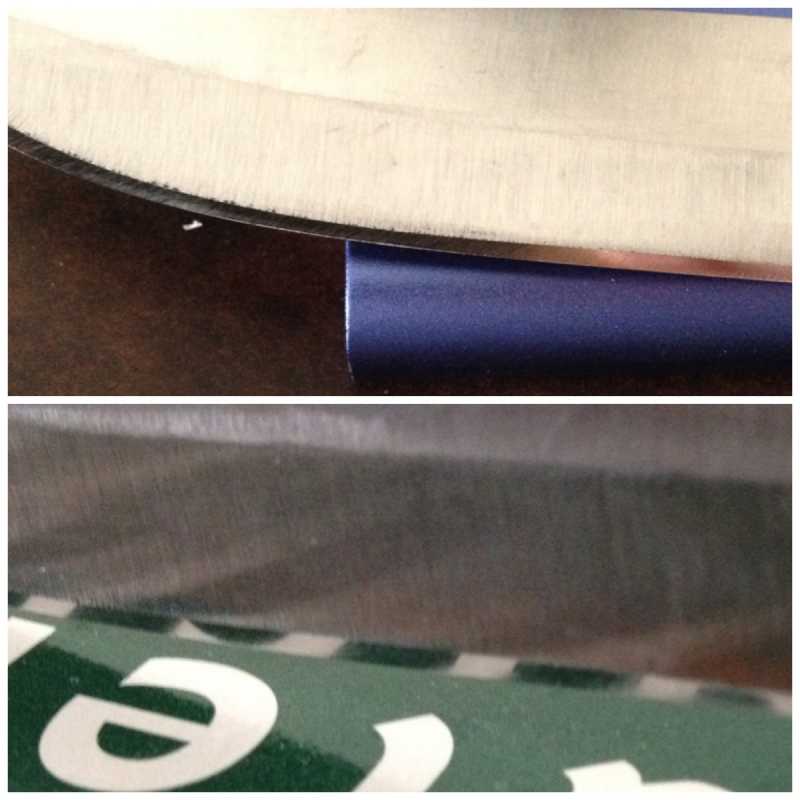
The thing that I started off with here was the conversation that I was having on trying to measure the amount of mirror in what people call a mirror edge. Some people say that a 1000 grit Chosera stone give a mirror edge. There was a video posted here where a member created what he called a mirror edge with the stock stones and various grades of sandpaper and lapping film.
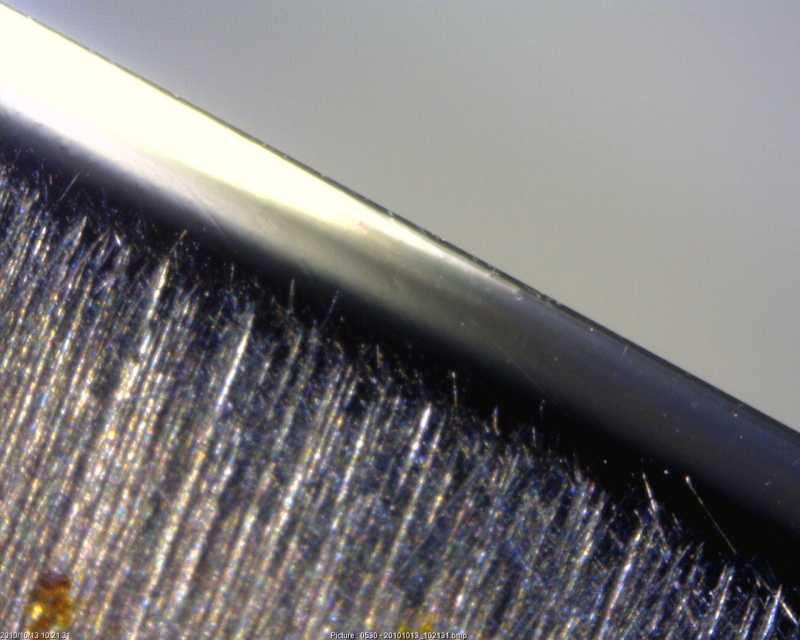
I find that I get a nice looking edge that reflects well after the 2K Choseras, but it gets visibly better with higher grits. After the 10K it is really starting to reflect. After each grit of stroping compound it gets better. I end with 0.025 micron on nanocloth and it is real shiny. So, what is the difference between my 0.025 polish mirror and the folks that get a mirror at 1000 grit?
More in a bit.
Ok Tom in his excellent series on using the Choseras and Shaptons talks about something called a “Critical Leap” in a progression. He defines this as the point (and I am paraphrasing) in a progression where the polish goes from being shiny to the eye to the point where it is shiny in the microscope. For the Choseras he says that is at the 10K level, from memory now, he says that it is at either the 15K or 30K level with the Shapton stones.
Now I wanted to see if I could quantify the difference that I see going from the 10K stone to the 0.025 micron spray on nanocloth. What I found out is that there are devices sold as optical reflectometers that would give the answer. Unfortuanately they are real expensive. But the key thing to remember about them is that their primary function is to measure surface roughness. The smoother the surface for any given material, the more it reflects… and the more mirror like it becomes.
Keeping this in mind it is easy to see that the higher grit you use, the smoother the surface, and the more mirror like your edge becomes.
Someone asked about getting a real reflective edge but still having some haze. Another thing I found out in researching this is that any given material has a maximum amount of reflectivity, even with a “perfectly” polished surface. Clay mentioned using more magnification will slways show some abrasive pattern, wekk what if we could use and abrasive that left no scratches… that would be a perfect polish. At that point most stainless steel would reflect 65% of the light falling on them. Manipulating the angle of the light that you use to view will likely always result in you seeing a less than perfect reflection, no matter what you polish with.
This 65% is nothing close to what a good telescope mirror will do… in the high 90s.. 96 to 98%. No matter what you do to steel, you will not get there.
So what am I saying? First, a mirror edge is a relative term. I found that some places doing inspection for levels of polish ahd to get humans out of the loop because they were too subjective. Bottom line is, if you think that you have a mirror edge at 1200 or 1600, take it to 0.025 microns, you will see a difference, but you will not have a true mirror edge!
Second, if you want an edge that comes close to the maximum reflectivity for the steel that you are using, it takes very fine abrasives. Unfortunately the 1000 grit diamonds will not get you there.
I guess this brings up a question. What do you really want to do? If it is to get a great working edge that is very sharp and will work great for most cutting tasks, the 1000 grit diamonds will get you that.
If your goal is “pretty” resign yourself to pursuing ever finer grits.
Hope this helps, and I can quote sources for anyone interested.
Phil
[quote quote=“RonRobichaux” post=4250]I just purchased the WES a few weeks ago and have the same problem with getting a mirror look.
The smallest grit stones I have are the 800/1000 then the 5 and 3.5 strops.
How do you know when to go to the next highest grit. because my edge is not even close to mirror.
now it is sharp but dull and scratchy looking. I spent 30mins working on this.
Should the 1000 grit leave a smooth not polished finished…???
Is there a step by step instruction
on going from one grit to another?
[attachment:3]spdy blade.jpg[/attachment][/quote]