OK guys… I recently thinned my first kitchen knife down to a zero grind and then put a microbevel (20* per side I think) on it… This thing is a slicing machine now. This was sparked after my question on the sushi knives and seeing how well they cut, so I decided to thin down my kitchenaide (or whatever the name brand is). So even though it slices well, it seems like the edge is denting /rolling after it contacts the cutting board a few times. When I try to put lateral force on the edge with my fingernail, I can visibly see it flex… So this got me thinking: how do the microbevels/grinds relate to edge strength?
For example… If I put a 2*/side full flat zero grind on the blade, and then put a .001" shoulder behind the edge with the edge finished at 20*/side, how does this differ and how will the durability differ from one that I have a FFG with a .040" thick edge at 15*/side with a 20*/side final micro bevel?
I hope you guys are getting my drift… How does the metal behind the edge affect durability even though the edge of the edge is finished the same (at 20*/side). I can’t find any scientific or geometric research that reversals any knowledge on this point, but surely there is a mathematical way to determine the percentage of strength?
If I’m understanding you correctly Josh, my first take is that the blade to metal ratio is just too thin and it won’t hold no matter what.
The steel is not up to snuff.
Did you try it first without a micro bevel?
If you think of a straight razor and how thin it is, how much chopping can you do before it gives?
The quality of the steel is what it is all about if the blade is too thin then it will roll I rolled the blade on my shun santoku using it that’ve off strips of Serrano ham from the bone using the knife for something it was not designed for .
This is why a chef has different knives a boning knife is much thicker than a filleting knife .
Maybe you were a little over zealous with the thinning in this knife not to say it is unusable it will slice raw fillets or soft vegetables beautifully . I think you are on the right track further experimentation will help some times the thinning is only necessary to take the shoulders off the v grind if you can feel them when you pinch the blade edge I would thin them off the same can be done for a convex once again if the curve of the convex is really easy to feel it may again need thinning unless this curve is been used to remove meat from bone then the curve helps to stop the edge shaving the bone.
Interesting question! I’m afraid we’d need a metallurgist and a physicist to andwer this question in properly. Unfortunately I’m neither…
But on an inuitive level I’d say both Zig and Leo are right. The quality and hardness of the steel do matter.
And so does the thickness of the blade. Not only at the edge of the edge, but also (sometimes far) behind that. Imagine that you’ve thinned a blade such that it is only one micron thick at the edge and maybe a few microns behind the edge. If you now put a microbevel on this blade, it will still be a few microns thick at or just behind the edge. That could cause it to chip or roll.
[quote quote=“LeoBarr” post=14852]The quality of the steel is what it is all about if the blade is too thin then it will roll I rolled the blade on my shun santoku using it that’ve off strips of Serrano ham from the bone using the knife for something it was not designed for .
This is why a chef has different knives a boning knife is much thicker than a filleting knife .
Maybe you were a little over zealous with the thinning in this knife not to say it is unusable it will slice raw fillets or soft vegetables beautifully . I think you are on the right track further experimentation will help some times the thinning is only necessary to take the shoulders off the v grind if you can feel them when you pinch the blade edge I would thin them off the same can be done for a convex once again if the curve of the convex is really easy to feel it may again need thinning unless this curve is been used to remove meat from bone then the curve helps to stop the edge shaving the bone.[/quote]
So apparently the thickness of the bevel behind the edge of the edge does matter… What is ideal? Obviously not too thin, but nothing too thick either (I have heard .010 is ideal for most kitchen knives). So Japanese high rc knives can be thinner and still hold up I guess, whereas western knives won’t?
[quote quote=“razoredgeknives” post=14858]
So apparently the thickness of the bevel behind the edge of the edge does matter… What is ideal? Obviously not too thin, but nothing too thick either (I have heard .010 is ideal for most kitchen knives). So Japanese high rc knives can be thinner and still hold up I guess, whereas western knives won’t?[/quote]
These lead to more questions from me. Hope not to confuse the issue.
Like what applies, if thickness behind an edge is the issue, to a hollow grind?
For example, isn’t the edge angle thinner behind the relief and cutting edge?
I’m referencing Jay Fisher’s page and image for info and food for thought, I hope Jay doesn’t mind:
Ex1:
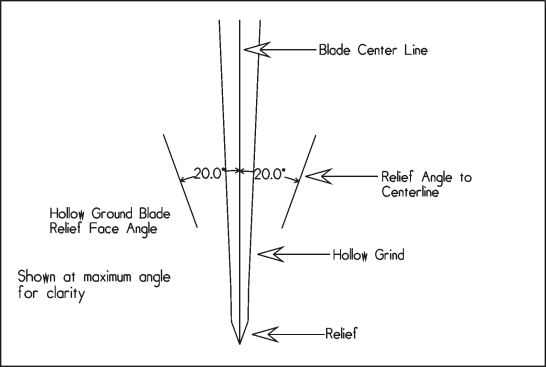
“Initial knife edge geometry
This graphic illustrates the initial geometry of a functional edge. Before an edge can be applied, the thickness of the blade must be relieved. The relief face is ground at a maximum of 20 degrees to the blade center line, and properly thins the metal behind the cutting edge. The relief face can be easily seen on the knife blade without magnification, and on knives with blade relief, this appears as a bright line of ground steel that may be 1/16” wide on a typical blade. Remember, the 20° is a maximum angle, and lower angles create a sharper edge and perform better, but are somewhat thinner in cross sectional area, thus affecting blade strength at the edge. "
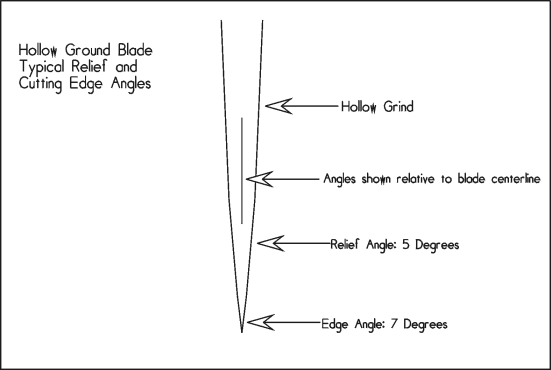
"Hollow ground knife blade cutting edge geometry
More typical of the cutting edge on my knives is represented by the graphic shown here. Relief face angles are often 5-10 degrees, sometimes less, cutting edge face angles are 7 to 15 degrees. In order for low relief and edge angles to work, the blade grind must be significantly thin. This is where good grinding form, practice, and skill are demonstrated in handmade and custom knives. Factories and CNC machines can not grind blades that are thin at the edge. It takes a great deal of time, practice, and control, and can be dangerous for the inexperienced. Usually, factory knives are left thick, and are edged with one wide relief/edge face combination, which only allows a few sharpenings before the blade is too thick. Some makers and factories sharpen with a convex edge, which they sometimes call a rolled edge, because they roll the knife blade around while sharpening it. This is not a good edge because it is not clearly defined with accurate face angles, is thick and has high edge angles. and is not sharper no matter what you may read. The reason for a convex cutting edge is one of skill. It takes accuracy to create a cleanly beveled edge, and factories just round over the edges with power tools to quickly get the knife out the door."
Another thought I had was watching Sushi Chef’s slice.
Is it me or do they slow down and seem to lessen the pressure on the board just before the cut is finished?, maybe saving the edge from rolling, unlike American/Euro style cutting and chopping.
I think the real answer is not absolute I would like to say it depends perhaps there is an ideal thinness relative to RC but the real answer is to thin it gradually over sharpenings rather than all in one go what will ultimately create a blade roll is hitting bones , cutting hard root vegetables and to a certain extent the way it is wielded so start thinning at the shoulders where it is possible overly thick and take less away as you approach the edge.
You can always thin it more another time if it is overly thin then some of the blade will have to be sacrificed to thicken it up.
I think feed back from the steel as it sharpens is probable an important factor if it sharpens very quickly then the steel is probable soft where as if it is slow to sharpen it is probable very much harder steel. This can only be gained over experience I think the further we go into sharpening the greater that feeling becomes this is not quantifiable in measurement be it thickness or hardness .
Even take two average chefs the likely hood is that the pressure and blade technique will differ from the other.
I am not sure that it is possible to be that scientific about it .
Perhaps someone else may be able to quote figures I would like you be interested to know .
Jon of JapaneseKnifeImports actually puts a micro micro bevel on top of the micro bevel so say his micro bevel is 15Ëš then he will do about 3 light passes with the finishing stone on one side at 25Ëš which strengthens the edge up (the side would be the right on a right hookers knife this can be done on a conventional “V” bevel).
That final bevel angle is still relative to the thickness and could be quite visible on a thick blade where as on a very thin blade two things happen the bevel is almost invisible and it is that easy to do that often it can be done with one or two of the finishing grits .
If the blade if overly thin for the steel then even a conservative bevel angle say of 20Ëš will still be delicate .
So I think I get back to my point in my last post .
If you have over thinned and the blade damages easily then it is a worthy lesson and perhaps for the benefit of all post a picture .
A comparison for me would be like riding a motorbike if you never come off you are probable not such a good rider and you do not know the limit of the bike.
[quote quote=“LeoBarr” post=14864]That final bevel angle is still relative to the thickness and could be quite visible on a thick blade where as on a very thin blade two things happen the bevel is almost invisible and it is that easy to do that often it can be done with one or two of the finishing grits .
If the blade if overly thin for the steel then even a conservative bevel angle say of 20Ëš will still be delicate .
So I think I get back to my point in my last post .
If you have over thinned and the blade damages easily then it is a worthy lesson and perhaps for the benefit of all post a picture .
A comparison for me would be like riding a motorbike if you never come off you are probable not such a good rider and you do not know the limit of the bike.[/quote]
Good point Leo, a lot of this will be trial and error and see what works… I will try to get pics up soon
The stiffness is cubic with perpendicular cross section in load and quadratic in strength. This means a 0.020" thick edge is 8 times as stiff as a 0.010" thick edge and is 4 times as strong. This is in regards to a lateral load applied right at the point it is 0.020" thick. This is basic physics so you won’t find published papers on it, but you will find it in basic textbooks.
To answer the general question as to how in general a blade is stronger than another you would need to know the force distribution as a function of height from the edge and integrate that over the height. In general most forces tend to be concentrated right at the edge of a knife and thus a decent first approximation is to assume they are constant and only exist at the edge and thus the above cubic/quadratic approximations hold.
As an example of why this is a very good approximation in general, just take a really nice optimized cutting kitchen knife and use it roughly. At most you will damage it just very close to the edge meaning that all the steel above it isn’t really doing anything and neither are the forces above it of practical consideration and you can to a strong approximation just think of the edge only.
Very interesting although much of the time surly a blade is not going to be absolutely perpendicular to what it is cutting.The time perhaps when the blade is perpendicular to the cut is when slicing or chopping but this will not necessarily hold true when cutting through materials of varying resistance often in these circumstances the blade my well change angle through the cut this is how the blade rolls or chips either as a result of hitting bone. cartilage or stones .
i often slice meat with a Yanagi and when using such a knife in draw cutting the blade will be perpendicular to the flesh so in this instance the physics holds up .
Consider that home cooks or even some chefs have maybe one or two knives they favour then it is likely that the cutting will often not be perpendicular so I think this is where using figures becomes overly complicated to cover all the use and misuse a blade may encounter.
But I do enjoy physics for it precise explanations for the fundamentals such as defining light , sound , force energy etc
Just from a grunt perspective, I’d say ultimately the style and shape of the relief face and angle as well as the face and angle of the edge will be determined by not only the use but by the steel.
For some great info and reading, here’s Jay Fishers page:
If anyone knows him, it would be great to get him to chime in
The info I’m finding on his site is intense and is peeking my interest in the roll of the relief face and angle.
His steel types explanations are great.
A note on my experience with steels that have been overly thinned by the common restaurant sharpener running them through a dual grinding wheel system, forcing a hollow grind on all knives with a thinned hollow body behind the relief . I run across these OFTEN here, there’s one notorious large sharpening company doing it. It seems they use the adjustment of the wheels to allow thinning sometimes half way up the blade body??!!
This may be relevant to your thinning experience Josh.
One thing is consistent no matter what brand or steel when I get these.
My first reaction is to smooth out the body attempting to visually fix the blade body first, ignoring the edge.
What I found is consistent, and I don’t attribute it to heat, is that if I then try and put a convex edge or flat or micro with relief, the thinned steel fails and breaks away while sharpening and continues up the hollow thinned body.
My gut says it can’t hold any strength at that thinness and something with the metal has changed.
What I now do is grind the edge flat, and grind until I hit hard metal, sometimes taking off quite a bit of the knife, but the point where hardness starts is definitive.
I then work on the body, thinning it as much as I dare in order to get a smooth finish, then test the now flat edge and double check the steel is still hard, and it usually is.
At that point I judge the relation to the knife’s use and what edge it will get.
If more thinning is required to properly transition to the edge, I will, testing that it doesn’t loose hardness and they usually don’t at that point, and then go on applying an edge that will hold.
Why these quality knives all fail after they’ve taken the abuse of the mass market sharpener I still can’t say for certain, but feel they were overly thinned and somehow the metal changed … it even looks different as it comes off … sort of crystally and chromed.
My gut says its not heat, there is no discoloration really, and the color shift only happens as the grind knocks it off, but I may be off.
I attribute the breakup to metal fatigue.
The physics I quoted always holds, it doesn’t matter as to what or how is being cut.
The reason why lateral (perpendicular) forces are the critical ones is because the parallel ones will act to compress the edge directly and the compressive strength of steel is extremely high compared to materials typically cut.
In general when a knife is exposed to any cutting there will be a general resultant force on the knife (or more specifically a pair of forces between the knife and the object being cut).
This resultant force can be broken down into two component forces, one which is parallel to the edge and one which is perpendicular to it. This is often referred to finding the x and y component of the force.
The parallel component will try to compress the edge and fail. When it fails to compress the steel, the material being cut will itself be compressed. This will continue until the localized stress on the material surpasses the rupture pressure of the material and the material is now cut.
The other component of the force will try to push the blade to the side. Even though steels are strong, in very thin cross sections they are not. Take a regular hacksaw blade, any normal man can easily bend that. The edge of a knife is much thinner still and thus it can and will bend under very small side (lateral/perpendicular) forces.
This is also why people who are skilled with using knives can use knives with much thinner edges because they cut with far less twisting/turning of the knife. This is often why lateral forces are also referred to commonly as the unbalanced forces but this isn’t technically correct as the parallel component is always unbalanced (otherwise the knife would not be moving at all).
[quote quote=“CliffStamp” post=14869][color color=#ff0000]The stiffness is cubic with perpendicular cross section in load and quadratic in strength. This means a 0.020" thick edge is 8 times as stiff as a 0.010" thick edge and is 4 times as strong. This is in regards to a lateral load applied right at the point it is 0.020" thick. This is basic physics so you won’t find published papers on it, but you will find it in basic textbooks.
To answer the general question as to how in general a blade is stronger than another you would need to know the force distribution as a function of height from the edge and integrate that over the height. In general most forces tend to be concentrated right at the edge of a knife and thus a decent first approximation is to assume they are constant and only exist at the edge and thus the above cubic/quadratic approximations hold.
As an example of why this is a very good approximation in general, just take a really nice optimized cutting kitchen knife and use it roughly. At most you will damage it just very close to the edge meaning that all the steel above it isn’t really doing anything and neither are the forces above it of practical consideration and you can to a strong approximation just think of the edge only.[/color][/quote]
Thanks for chiming in Cliff!
So the first paragraph above doesn’t really matter very much when it comes to strength of the actual edge, except that the steel behind the edge does support the very edge? I guess I am wondering if a knife should be zero ground with a super thin edge placed on after or it if would be more profitable to put a 10*/side edge with a micro bevel on it. Obviously ex. A would cut much better because it wouldn’t have shoulders on the edge, but it also wouldn’t last as long.
Now why is this though? If they are both finished at 20*/side? I suspect that it has something to do with the carbides being there to support the steel behind the very edge and prevent it from denting/rolling?
[color color=#ff0000]The physics I quoted always holds, it doesn’t matter as to what or how is being cut.
The reason why lateral (perpendicular) forces are the critical ones is because the parallel ones will act to compress the edge directly and the compressive strength of steel is extremely high compared to materials typically cut.
In general when a knife is exposed to any cutting there will be a general resultant force on the knife (or more specifically a pair of forces between the knife and the object being cut).
This resultant force can be broken down into two component forces, one which is parallel to the edge and one which is perpendicular to it. This is often referred to finding the x and y component of the force.
The parallel component will try to compress the edge and fail. When it fails to compress the steel, the material being cut will itself be compressed. This will continue until the localized stress on the material surpasses the rupture pressure of the material and the material is now cut.
The other component of the force will try to push the blade to the side. Even though steels are strong, in very thin cross sections they are not. Take a regular hacksaw blade, any normal man can easily bend that. The edge of a knife is much thinner still and thus it can and will bend under very small side (lateral/perpendicular) forces.
This is also why people who are skilled with using knives can use knives with much thinner edges because they cut with far less twisting/turning of the knife. This is often why lateral forces are also referred to commonly as the unbalanced forces but this isn’t technically correct as the parallel component is always unbalanced (otherwise the knife would not be moving at all).[/color][/quote]
So, if I understand right, you are saying that lateral forces will cause more damage than compressive forces, because the physics of the edge reveal that it is much stronger with a perpendicular cut than a lateral force on the very edge, right?
So I guess the real question is, how do you figure out what is the optimal grind and microbevel of a given edge that will perform the best without giving diminishing returns (i.e. the strength to cutting ability ratio balance)?
[quote quote=“zig” post=14872]Just from a grunt perspective, I’d say ultimately the style and shape of the relief face and angle as well as the face and angle of the edge will be determined by not only the use but by the steel.
For some great info and reading, here’s Jay Fishers page:
If anyone knows him, it would be great to get him to chime in
The info I’m finding on his site is intense and is peeking my interest in the roll of the relief face and angle.
His steel types explanations are great.
A note on my experience with steels that have been overly thinned by the common restaurant sharpener running them through a dual grinding wheel system, forcing a hollow grind on all knives with a thinned hollow body behind the relief . I run across these OFTEN here, there’s one notorious large sharpening company doing it. It seems they use the adjustment of the wheels to allow thinning sometimes half way up the blade body??!!
This may be relevant to your thinning experience Josh.
One thing is consistent no matter what brand or steel when I get these.
My first reaction is to smooth out the body attempting to visually fix the blade body first, ignoring the edge.
What I found is consistent, and I don’t attribute it to heat, is that if I then try and put a convex edge or flat or micro with relief, the thinned steel fails and breaks away while sharpening and continues up the hollow thinned body.
My gut says it can’t hold any strength at that thinness and something with the metal has changed.
What I now do is grind the edge flat, and grind until I hit hard metal, sometimes taking off quite a bit of the knife, but the point where hardness starts is definitive.
I then work on the body, thinning it as much as I dare in order to get a smooth finish, then test the now flat edge and double check the steel is still hard, and it usually is.
At that point I judge the relation to the knife’s use and what edge it will get.
If more thinning is required to properly transition to the edge, I will, testing that it doesn’t loose hardness and they usually don’t at that point, and then go on applying an edge that will hold.
Why these quality knives all fail after they’ve taken the abuse of the mass market sharpener I still can’t say for certain, but feel they were overly thinned and somehow the metal changed … it even looks different as it comes off … sort of crystally and chromed.
My gut says its not heat, there is no discoloration really, and the color shift only happens as the grind knocks it off, but I may be off.
I attribute the breakup to metal fatigue.
Does that help or make sense?
my 2 cents[/quote]
Interesting observations Ziggy! I can’t say for sure I understand what you are talking about when it comes to “overly thinned restaurant knives” could you post a nice pic up for us? It would help me to better visualize… then again, I don’t sharpen hardly any restaurant knives =)
I like the look of it you have given it an apple seed (you have thinned it at the top as well which means it only has one point of contact okay not quite on this one but its good).You could now strengthen it up slightly by putting it on the WE and putting an 18Ëš bevel on it and I would do it lightly first and gradually go deeper until the blade is stiff enough or put more of a convex on it on the Kally or whatever you thinned it with.
It certainly looks like it was really really thick.
[quote quote=“razoredgeknives” post=14877]
So the first paragraph above doesn’t really matter very much when it comes to strength of the actual edge, except that the steel behind the edge does support the very edge? I guess I am wondering if a knife should be zero ground with a super thin edge placed on after or it if would be more profitable to put a 10*/side edge with a micro bevel on it. Obviously ex. A would cut much better because it wouldn’t have shoulders on the edge, but it also wouldn’t last as long.
Now why is this though? If they are both finished at 20*/side? I suspect that it has something to do with the carbides being there to support the steel behind the very edge and prevent it from denting/rolling?[/quote]
There are quite a few things going on here.
If you grind a knife to zero with a very low primary grind, say 1.5 dps and then micro-bevel with a large angle, say 20 dps and try to cut even moderately hard material (cardboard) you will see the edge ripple very easily behind the micro-bevel.
If you look at it under magnification then you will see the 20 dps micro-bevel (and likely apex) is still almost unharmed however the steel behind it warped as it was too thin in cross section to take the lateral loads during the cutting.
You have to increase the angle behind the microbevel to ensure it has enough strength to not ripple (or fracture depending on the steel).
A quality steel with a decent hardening will start to be stable on cardboard, ropes and such at about 5 dps (on foods and papers less about 2 dps, cross cutting woods is more about 8 dps). At this point the apex will become the failure point and it will start to wear, deform and twist, i.e. the knife just blunts.
Now a curious thing happens if you keep increasing the angle behind the microbevel, you will find that the edge durability/retention of the micro-bevel goes down at a given micro-bevel angle. This is because it takes more force to push this knife (with the heavier cross section) through the material and the higher angle behind the micro-bevel causes more distortion in the material being cut and thus more concentration of the force around the micro-bevel.
Thus if you do some experimenting you will find that the optimal geometry is the one which has just enough thickness to keep the knife from warping. If you go below this the knife will fail by warping that you will see. If you go above it then it will increase the rate of wear, deformation and fracture at the very apex.
You will also notice the same thing with micro-bevels directly.
If you apply a 45 dps micro bevel you will likely not get improved edge retention over a 20 dps microbevel (for most materials). The reason being is that the 20 dps micro bevel isn’t warping anyway so the extra strength of the 45 dps bevel isn’t helping and that heavier bevel will cause more force to be placed right at that very apex and the apex will also thicken faster under a given amount of wear.
Again it is a case of finding the “sweet spot” that maximizes the performance, too high or too low will cause problems. In general (very general) :
-the better quality the steel (less voids, segregations, impurities)
-the better the thermal processing
-the cleaner the grinds (even, symmetric)
-the more skilled the user
the more this “sweet spot” point will be thinner/finer.
Now as carbide volumes get high this means you have to take them into account because some steels have carbide loads which are so dramatic that if you under cut the steel and make it very thin there will not be enough steel to hold the carbides in place. It would be like trying to pour a slab of concrete 3" thick if you had 4" rocks in it. If you grind too thin for the carbides it is easy to see because the steel will just break apart. If you do it dramatically then it will form dramatic burrs in sharpening due to the heavy fracture.
This is a low carbide steel (5Cr15, 55 HRC):
vs a high carbide steel (S35VN/60 HRC, Peters):
Finished on the same stone to the same angle (<5 dps). Note how one forms very clean and the other clearly is fracturing readily. The stone was a 700 X Bester.
Yes, exactly.
[quote]
So I guess the real question is, how do you figure out what is the optimal grind and microbevel of a given edge that will perform the best without giving diminishing returns (i.e. the strength to cutting ability ratio balance)?[/quote]
Take a knife that you don't really care for and isn't that expensive and grind it to the point it obviously fails. This sets the lower bound for performance. Using the above cubic/quadratic rules you can then estimate what the points are that can be ground on other knives and as well how to modify knives which do fail.
[quote quote=“LeoBarr” post=14881]I like the look of it you have given it an apple seed (you have thinned it at the top as well which means it only has one point of contact okay not quite on this one but its good).You could now strengthen it up slightly by putting it on the WE and putting an 18Ëš bevel on it and I would do it lightly first and gradually go deeper until the blade is stiff enough or put more of a convex on it on the Kally or whatever you thinned it with.
It certainly looks like it was really really thick.
[/quote]
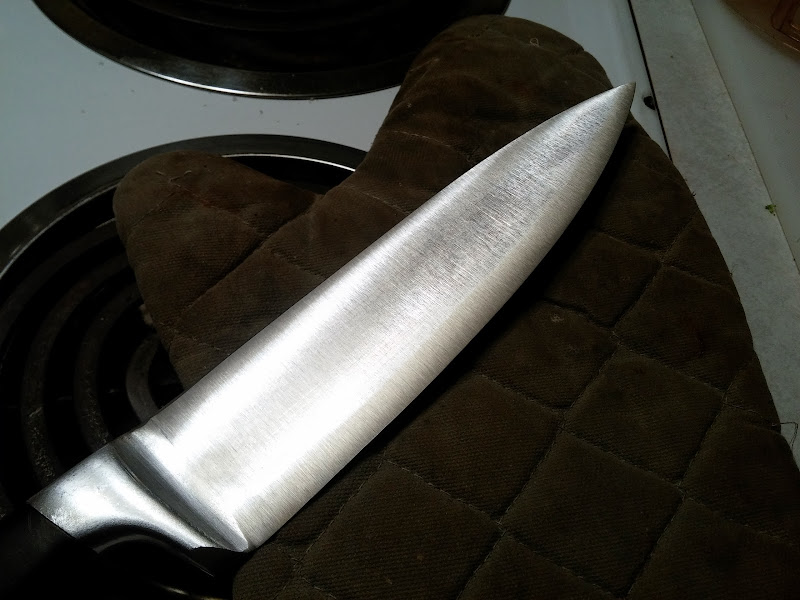
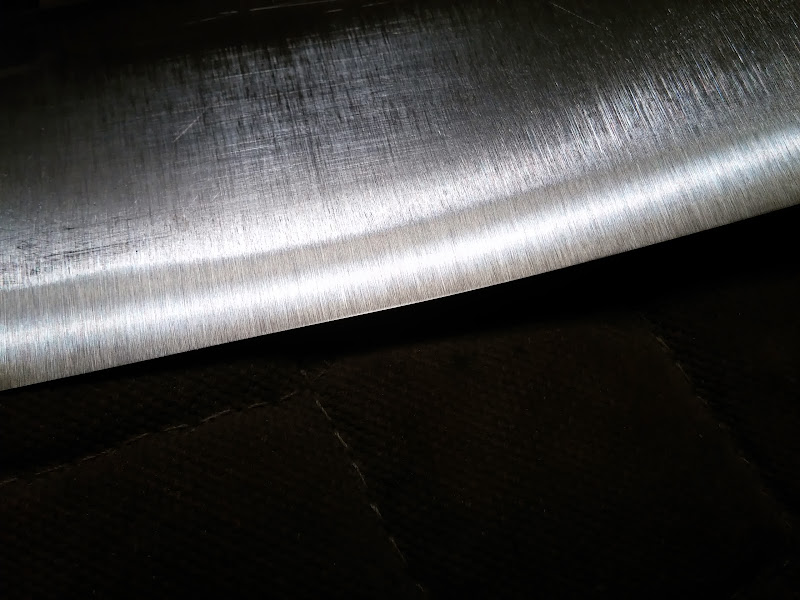
well, that was unintentional but i figured it would happen since i was doing it on a slack belt with no platen =) I just don’t know how much metal I should remove to strengthen the edge enough… i guess trial and error. I will try to get a pic of the current edge flex I am experiencing.


 [/center]