Edge retention as a function of edge angle / steel

As I’ve mentioned here many times before, the “shaving sharp” edge that so many folks rave about simply won’t really cut things like foam rubber, meat, and rope very well. It’s one of the modern myths that persistantly bug the knife world that an edge capable of shaving a small section of soft arm hair, is really capable of doing significantly better on items cut more frequently than will an edge that won’t feel as polished. The type of edge that I’m trying to talk about will be a lousy shaver. It’ll probably cut you if you try to make it shave, but for exactly that reason it will be significantly better for cutting meat, rubber and twisted fibers. – Mike Swaim7

The above was on Cliff’s website about Measures of Cutlery Sharpness. This is easy to prove…just sharpen your knife with edge leading strokes from heel to tip using each grit paddle up to as high as you want, then you will find that your knife will be a very lousy shaver, but will cut mason line or something else with ease. I test slicing sharp on my finger…yeah, my finger. I hold the knife against my finger tip, where I have the most callous, then begin drawing the knife ever so lightly and softly and if it bites immediately, then it is slicing sharp ready!

cliff you wrote an article/paper recently using this picture in it… would you mind posting it here? can’t find it but it was very helpful and well written.

Yes, and most people say the opposite. Here is why it is wrong :
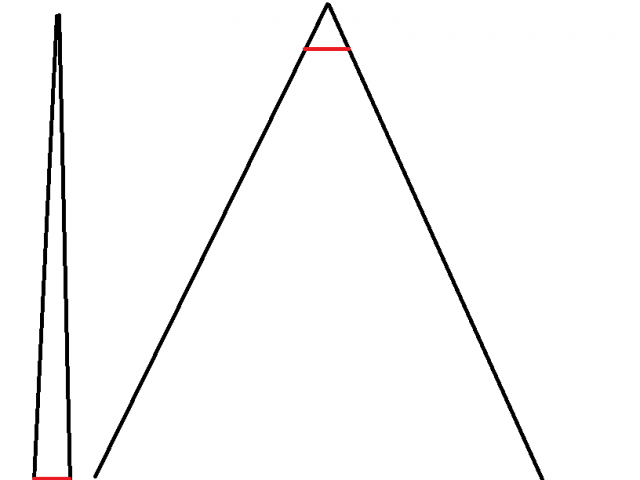
These two crudely drawn triangles reflect a very low edge angle and a very high edge angle. Note the red lines represent the same thickness of a worn apex. The thickness of the apex is a very strong influence on the sharpness (it isn’t the only thing, but it is a heavy factor).

Which one do you think will happen sooner, which knife will reach the red line faster, the one on the left with the very low angle or the one on the right with the very high angle?

Now there is where you might jump to “Hey, doesn’t this just say we should sharpen at zero degrees for ultimate performance - that is obviously wrong.”

Yes, this is true, the relationship in the above graph will not just continue beyond 13 dps in a straight line, at some point a very dramatic change will be made and the performance will decrease rapidly and at some further point the edge retention will fall to zero. This happens because at some point the micro-bevel will be so low that the apex is no longer strong and/or durable enough and it will just grossly deform/fracture. The trick then is to find the lowest angle this doesn’t happen as that give the optimal performance. This will depend on the steel, the material being cut and operator skill/experience.

As a bit of math, the reason this happens is because the edge retention behavior in total has not only the affect I have noted in the above which is just a linear relationship it also includes step functions on strength and toughness. Step functions are particular functions because the basically do nothing until a certain limit is reached but at that point they can cause dramatic effects. The math is a bit wonky as step functions are written similar to this for the effect of angle on the stiffness of the edge which is related to it deforming to failure :

s(x) = (1 if x > Ao; 1/x^3 for X < Ao; 0 for x < Ac)

Thus the edge retention would be written as :

E(x) = l(x) * s(x)

Where l(x) is that linear equation and s(x) is the step function. This jibberish translates to :

-if the angle is above some angle (Ao) then the edge won't really deform/fracture significantly and just slowly wears, deforms and chips at a very small micro-level

-however if you go below that angle then the strength/toughness is no longer there to keep the micro-bevel stable and it will just deform/fracture beyond the apex, the entire micro-bevel will start to take damage and the blunting will be very rapid

-if you go beyond that point further and reach a critical angle, Ac, then the strength/toughness is so low that the micro-bevel will just crack of the first time you try to cut with it

Now the math is a bit complicated and the language possibly foreign, but it is easy to understand as we see things like that every day. For example the life of tires on your car has a number of step functions. If you drive on the highway you get tire life which is a very slow process of small wear and little rips/tears. If you go off road at some point the rocks can be jagged enough that they will start to damage the tires beyond the normal tread wear. But if the rocks are not jagged enough this doesn't happen and you just see slow wear. If you hit a nail there is sudden and catastrophic failure.[/quote]

http://www.cliffstamp.com/knives/articles/microbevel.html

Awesome thanks Cliff!

The article that changed my thinking and opened the door to much better edge performance for me. Cant thank you enough! It was this research that inspired me to try and take the angles on the WEPS lower(and lower(and lower)). :whistle:

The real world testing on your youtube channel where you talk about practical use and results based on different steels and angles is some of my absolute favorite stuff to watch.

Aloha

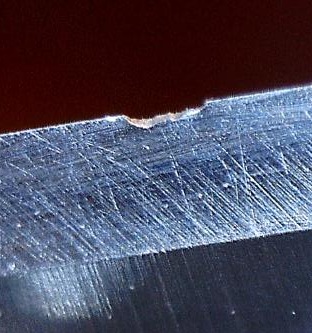
I had some of the same kind of dammage to my ZDP Cali today. I cut up a lot of boxes at work. I hit one staple I know of and I wondered if it did anything. I did not hit it hard. more glancing blow I would say. This is not ordinary cardboard but really thick stuff. It sliced it real well the whole time but I did notice it not as smooth in some spots at the end. I did not cut all that much in my opinion. The ZDP does keep a working edge long but it does seem to take damage more easily than I had hoped. Maybe I just had really high hopes for it. This is a 17DPS bevel.
If a fella was cutting a lot of clean cardboard I think they would like it. Maybe this was a second from spyderco because it got tempered poorly? I am not giving up on it yet but want to give some other steels a run as well.

I am experimenting with different light. Not as good as Tom yet but getting there. Thanks for the tips Tom!

I will see how hard it is to get them out tomorrow. Then I will take the Domino to task next.

Attachments:

Eric:

So far, I have a little over a year of use on my ZDP Delica. It’s been touched up a half-dozen times, but only once did I get a chip in the edge. I think it was something like your cardboard staple that did it. I recall hearing it make contact with something hard and thinking that there’s be a chip for sure - and it was. I have been staying with 20 dps, thinking the edge would be a little more resistant to chips. Repairing the chip was the only time I had to go below 800 grit.

I’m would bet that your ZDP blade is not a second. I believe that Spyderco buys their ZDP blades finished from Seki, Japan. The ZDP steel is made by Hitachi, but the blades are finished in Seki, which is an equivalent to Solingen, Germany in terms of knifemaking reputation. I’ve read elsewhere in the knife forums that Spydie has a plant in Seki, but it’s probably a particular knifemaker that is contracted with them.