Edge retention as a function of edge angle / steel

I am not where where this should go, this seemed like the best fit.

This is a piece of work which intends to look at the edge retention as a function of micro-bevel angle, steel type and possibly grit finish in an exhaustive manner using the Wicked Edge to set the micro-bevels.

It will be part of the Mule-Library program I have started a test run which I will do on two Spyderco knives. The procedure is basically this :

-sharpen a knife on a Wicked Edge/1000 grit diamond with a specific angle micro-bevel
-cut 1/2" hemp and periodically measure the sharpness
-determine the edge retention statistics
-repeat a few runs until stable
-then repeat this whole thing across a range of micro-bevel angles
-then repeat this whole thing again across a range of steels
-possibly repeat this whole thing across multiple grit finishes

Note the work is blinded to prevent bias.

The results of this comparison when finished allow you to answer some very interesting questions such as :

-At what angle/grit do I need to sharpen 420J2 to have the same edge retention as as 21 dps - 1000 grit WE edge on S110V cutting half inch manilla hemp?

This question in fact many people don’t even realize has an answer at all. In fact the more dramatic question :

-At what angle/grit do I need to sharpen 420J2 to have twice the edge retention as as 21 dps - 1000 grit WE edge on S110V cutting half inch manilla hemp?

also likely has an answer as well because the influence of edge angle / grit on edge retention is very large.

Here is one run only on a VG-10 blade from Spyderco (Lum Chinese) :

-primary grind full zero
-edge bevel is approx. 6.5 dps in the final sweep (slop from stone wear, not intentional)
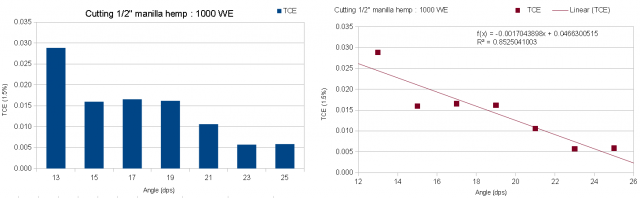
I would like to get 11 dps, but it is not possible easily with the WE, I am going to play with this a little. In fact very low angles would be interesting because at some point the strength would be compromised and the apex would fail by lack of strength. However hemp is so soft that this takes very low angles, less than 5 dps.

Now before anyone reaches any dramatic conclusions from the particular shapes or relationship between one angle and another, again this is one run only I can not even bound the performance with error bars at this point. However there are still some obvious observations :

-the edge retention appears to depend critically on the edge angle
-further it decreases significantly as the micro-bevel angle is increased
-this change is so large that angle could be as critical (or more) than the steels

A lot of this I have discussed before, however the point to this is to move from these general statements to doing the work in enough volume to allow answering some very specific questions about steels and angles and at what point one can compensate for another.

It will take 3-5 runs before the measurements will stabilize and I think it should be a smooth trend. That large difference between 13 and 15 dps is likely just amplified by random scatter. This is a lot of work, just to compare two steels will take about 100 runs of cutting hemp with just one grit and multiply that by any grit changes (so almost 500 runs if you wanted five grit finishes) so do not expect it completed any time soon.

As a final caveat, you can not generalize from this to edge retention in general. Hemp is so weak (compressible) that it can easily be cut with ultra-low angles in contrast hard wood cutting (plywood etc.) can easily turn edges at 10 dps on weaker steels. Thus if you ask the same question :

-At what angle do I need to sharpen 420J2 to have twice the edge retention as as 21 dps - 1000 grit WE edge on S110V cutting half inch plywood?

The answer might be that it is not possible as you can not reduce the angle on the 420J2 enough to compensate as it would be so low it would not have the strength to cut the plywood and would just deform.

Great! I was just asking about this.

So I am curious why you choose hemp rope? If it is soft and easier on a blade it will take longer. And not many people are into cutting hemp rope all day. If you made cuts in cardboard or something it seems like that could speed up the process and also give some added benefit of edge durability since the cardboard is harder. It may cause the edge to fail sooner and would be a way more real world helpful data point than hemp. Everyone I know cuts cardboard these days. Or at least cuts boxes open.

Thanks for doing this! Just a question to maybe help speed things up!

Those are valid points, the simple reason why I used 1/2" hemp is because I just don’t have enough cardboard to do it. It would take about 250-500 m of cardboard to do one run. That means I would need to cut about 50 km for this comparison on just two knives with one grit. I do cardboard edge retention runs, and carpet and wood and other materials as I get them.

I have tons of cardboard all the time.. Wish you were close to me! I would get you a truck load!

Makes sense though Cliff. Thanks!

What information are you starting from? I have 0 idea of what angle to start with and what micro bevel angle to use on the various types of steel. Is there a chart somewhere? The Knife data base is a little thin. I hope to help add to that in the near future.

I have been doing this for awhile so I know what the curves will look like in general, but here I am aiming to get exact numbers for how the edge retention depends on angle, grit, steel and so on.

I picked VG-10 as it is very common steel, almost a benchmark for Spyderco. I am still considering what to use for the other one; 8Cr13MoV, S30V or something like S110V/10V . I have one of the new Spyderco’s / Farid’s and I might use that.

awesome! Thanks for posting here Cliff… i’ve been away from the forums over vacation, but I did see your thread on your forum. I will be following there as well.

Here is an update with two runs done on multiple angles to show the expected scatter :

I think I will stop at three runs for each and use another steel.

Cliff, will you explain your process and what we’re seeing on the graph? I think covering the basics would be really helpful e.g. started with angle x, made n number of cuts, required how much force etc…

Clay :

-Paramilitary in S30V from Spyderco, zero ground
-final edge angle of 6.5 dps
-micro-bevels set at angles from 13 to 25 dps with the WE/1000 diamond

The procedure :

-set a micro-bevel angle
-cut 1/2" hemp (unsupported) on a 2" draw
-measure the sharpness periodically
-calculate edge retention statistics

This is then repeated multiple times with each micro-bevel angle (the blade is zero ground between each round)to produce an average result.

The sharpness is measured by the amount of length to cut Bergia spinning thread on a 35 gram load, and confirmed on jute with a 500 gram load.

The edge retention statistic is the TCE which is just the sum of :

-amount of material cut (in inches) * sharpness (as a percent)

added in every interval. This basically is a piecewise integral.

Now you might ask, why not just cut until Y amount of sharpness and stop? The reason is that statistic will have a lot more scatter. The TCE is more stable as it uses the performance of the blade throughout the entire cutting.

For further details :

-sharpness is inspected under 50X linear magnification
-also confirmed with basic checks (shaving, paper)
-the work is always partially blinded
-the cutting is always done though random sampling

This means for example I bought a full spool of 1/2" hemp, I then take from that ten runs of 10 feet and I cut from those by generating random numbers from 1-10 and then making cuts based on that. The reason for this is that it essentially averages the properties of the hemp through the entire roll and prevents a bias from the hemp being different from one run to the next.

By partial blinding I mean that the person doing the sharpening or doing the cutting and doing the measuring are not always the same person. This prevents what you expect to happen from controlling the results. This is really critical as it stops even a subconscious bias from being an issue because you don’t “know” what should happen until everything is revealed and that is only done after all measurements are completed.

In even more detail, I also (always) use some measure of robust statistical analysis. In this case I use weighed averaging, in some other cases (where I collect more data) I use median based statistics. I am a severe numbers gear and an actual experimentalist (physics) by trade so I can drown anyone in details if they want.

Thank you. How are you performing the sharpness testing? Do you have a jig set to draw cut with specific weights placed on it or are you using the sharpness testing jig that you posted plans for?

I’d I also like to know that, Cliff. I think I sort-of understand what you are doing. But I’d really appreciate it if you could elaborate a little more on your method. What is shown on the Y-axis? And what exactly is a run in relation to what the graphics show?

TCE which is an edge retention statistic, it is calculated by taking a sum of :

(sharpness) * (amount of material cut)

For example, if you cut 10 pieces of 1/2" thick rope at 50% optimal sharpness (0.5 as a decimal) then that gives you :

(0.5) * (10 cuts * 1/2 in) = 0.25 in

if you cut another 10 pieces but the sharpness has decreased to 40% then you have :

(0.4) * (10 * 1/2") = 0.20 in

and you continue until some stopping point, measuring the sharpness and calculating the product and then at the end you add up all the bits to get the TCE.

I use 1.5% as the stopping point in the above which is very dull, the knife has little fine cutting ability and the edge is even starting to reflect light and be visible.

It shows the edge retention as a function of micro-bevel angle with a fixed edge angle (6.5 dps) and a fixed grit (1000 diamond/WE). The edge retention decreases as the angle increases.

I think you are referring to Dan’s jig which is a push cutting device.

The simplest way to do it is hang a weight from piece of cord, have a clamp which can catch the other end and then you can put the knife under it, lift the knife and then draw it.

It can be all machine recorded as well. At one point I actually did it with a stand/clamp to hold the knife at a specific height, 1mm above the cord attachment, and had it move on a fixed track and measured the tension in the cord electronically. The problem was that the extra precision wasn’t of benefit as I found there is too much scatter in the results due to random and systematic error.

Consider for example when you are cutting the material you are using to dull the knife, even if you do it very controlled, then all the things that can change :

-the material itself isn’t going to be overly consistent (unless you get ISO rated material)
-speed, force, angle of the cut
-temperature, humidity of the environment
-dirt, dust, debris
-initial sharpness, angle, grit

The you have things like the actual steel itself which is a big mish mash of micro-structures :

-tempered and untempered martensite
-pearlite
-cementite
-alloy carbides
-retained austenite

and the edge is just a random selection of all of that, hence it blunts in a very random manner. Parts of it will wear smooth (well tempered martensite + cementite), parts of it are very weak and roll/deform (austenite, pearlite) and parts of it just chip/fracture (around or through the alloy carbides).

In general, as controlled as I can be, from one run to the next, the most confident I am is about 50% in any run hence I always do at least 3-5 to make sure I have reasonable scatter estimates. Now once you stop doing the controlled comparisons and just do real work, the variability goes through the roof and the performance can change by a factor of ten easily. Hence outside of the “lab” you really want to average over a long time before judging a knife as good, bad or ugly as a knife can easily “fail” simply because it hit a rough patch of material or you were not the best technique wise so you need to find a consistent patter.

Here is a full three runs, the scatter is starting to calm down now and the trend is fairly clear :

This is all the jazz behind it which generates that little graph :

Thanks a lot for your extensive explanation, Cliff. And for the interesting experiment of course. I am really curious about the results of the next ones.

It shows the edge retention as a function of micro-bevel angle with a fixed edge angle (6.5 dps) and a fixed grit (1000 diamond/WE). The edge retention decreases as the angle increases.[/quote]

What I meant is simply: does this graphic show the results of one run? Because you emphasized “one run” in your first post. (And, if so, did you plan to do multiple runs of every knife in order to minimize statistical errors, or did you mean something else?)

[quote quote=“mark76” post=19136]
What I meant is simply: does this graphic show the results of one run? [/quote]

The latest one shows three runs, the average is plotted as the points and the standard error is used to generate the error bars. Ideally at least three should be done at a minimum, I like to do 5-7 most times. The problem is just time, ask yourself this - what is more interesting/useful :

-one VG-10 graph with seven runs
-a VG-10 and S30V graph both with three runs

It takes the same time to do both and each run of one data point is about an hour so it takes ~20 hours to do three full runs at all micro-bevels so it is ~40 hours just to look at two steels with three runs. To be frank I am not confident enough in three runs to let that stand and will likely take each to five runs which means it will be ~80 hours for those steels and this is at just ONE grit.

If I wanted to look at five grits as well that would mean it would be ~400 hours. Lets say I wanted to see if there was any difference in the WE diamonds vs the DMT or EZLAP that would mean it would expand to ~1200 hours. If I wanted to add more steels then it would start to climb up to ~10, 000 hours. It should be easy to see that you have to keep perspective in work/time. Often times I get asked “Hey, why don’t you …” . These can be great questions, interesting questions but I simply don’t have the time.

If it isn’t clear, one of the things I have been very vocal about is that I have never intended and never do intend that what I do be used as some kind of ultimate reference. The only thing I am trying to do is at most make people think about things. If you look at this graph and you take from it “I should put a little effort into making sure my micro-bevel angle is optomized” then I consider it a success. What I don’t want to happen is someone look at it and say “Oh, this means XXX is the best angle”. This graph will change if you switch from hemp to plywood to cutting up cod . The general relationship is always there (micro-bevel influences edge retention) but the shape/form will be different. The point is just to realize that micro-bevel can influence edge retention so don’t just default to some standard angle of you care about edge retention.

Just got caught up on this thread! Good stuff!

The only thing I am having trouble with is the TCE, even though you explained it thoroughly Cliff. I am definitely NOT a numbers guy like you and have difficulty understanding how to interpret the TCE in relation to the angle. In otherwords, is it good or bad that the TCE goes down as the micro bevel goes up… what is that saying? Is it saying that you get better edge retention on hemp rope the higher the micro bevel?

sorry for not understanding :frowning:

It is a measure of edge retention, the higher the TCE the higher the edge retention.

Now you might ask the following question :

“Why don’t you simply cut material until the sharpness is say 5% (or whatever) and use that amount of material to measure the edge retention?”

This is a very good question and on the surface it seems reasonable to do it that way. But if you try it then you will find that measurement is prone to large variations. What I do is similar to :

-cut material until the knife is say 90% of optimal sharpness
-cut material until the knife is say 80% of optimal sharpness
-cut material until the knife is say 70% of optimal sharpness
-cut material until the knife is say 60% of optimal sharpness
-cut material until the knife is say 50% of optimal sharpness

and so on and from all of those intervals I calculate the edge retention. Because I am using much more data is it a much more stable measurement.

Think of it this way, imagine you have a guy digging a hole and you want to get a feeling for how much dirt he can move in a given time and his fatigue rate. If you just looked at how much dirt he moved at the start and how much dirt he used at the end you are only using two points. What about if he injured his hand half way, or he hit a large rock and had to waste time moving it?

Instead what about if you checked on him at say every 10 minutes and looked at how much dirt he was moving and then used all of those points to make an “average” performance over the entire time. This will be a much more stable or reliable indicator of performance because those points of injury or where he hit a large rock won’t just dominate the entire performance then.

By doing this you can also spot those events and if necessary repeat the experiment to find out what happens if he doesn’t get injured or hit the rock. But if you don’t check in intervals you would never know it happened anyway.

It is a measure of edge retention, the higher the TCE the higher the edge retention.
[/quote]

everything you explained makes perfect sense… thanks for breaking it down for me like that!

If what you say is true (above) then your graph would be showing that the lower the microbevel the higher the edge retention, which wouldn’t make sense… I have always heard that the higher the edge angle the higher the edge retention, is this incorrect? in other words, are you saying that the more you raise the angle of the micro-bevel the lower the edge retention?

My theory is this: Force is the enemy of sharpness and a more obtuse angle requires more force to cut, dulling the knife more quickly. There are limits on both ends based on the steel, heat treatment and the material being cut.