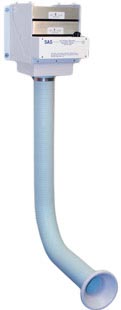
While in my shop I use a 3m Breathe Easy Turbo PAPR system to protect my lungs and am very serious about protection as long term exposure can be very serious. I am curious as to some sort of dust management system for inside at my permanent sharpening table. Of course, the easiest way for full protection is to sharpen while keeping your stones wet, but unfortunately I do not always have this liberty as the liquid can stain expensive blades I work on.
Right now, I am thinking about a desktop air purifier at this point, to protect against the shed abrasive diamond particles as well as metal dust. I know some have tried magnets but this would only ‘solve’ half the problem.
Have you tried the Swiffer Duster to wipe up the dust with each grit change? Seems to work really well for me. I use it to clear any and all dust from the knife before USB 'scope inspection and I don’t get much build-up around the base. It’s amazing how well that fuzzy rag picks up all the dirt and dust.
If you’re concerned about airborne particulates generated at the belt sander, that’s another problem entirely. I wouldn’t have thought that metal dust would become airborne that easily, but I guess there are other materials involved as well.
Josh; I have been looking into this recently myself. I have purchased these new masks (Elipse- P100) which are simply pleasant to use. One can wear these for long periods of time with little fatigue. (View Link Here). I wish they made the NBC masks in the military to this standard. I also have been studying these two systems. One system is from Jooltool by Anie found (Here- Click to view) I like it simply because it has a foot pedal and turns off an on quickly upon demand (Hands Free). The other system is made by Magna-Magtic (Click Here to View Website) Both of these system are industrial and should last a long time. Both are designed for the types of particles we find ourselves in contact with daily while abrading metal. I use the Swiffer Dusters to clean my work-space and the blades like TCmeyer. They work pretty well. Also, have you tried using distilled water for sharpening? The lack of minerals in the water helps to protect the stones and customer tools. It is used for cleaning because it is seeking to bind to tiny particles. Distilled water isn’t laden with other minerals like tap water and even bottled water. I hope that gives you some ideas!
No I haven’t tried the Swiffer Duster yet Tom, I’ll have to give that a shot and see if it works better than my windex/paper towel method hehe. But what I’m worried about here is the dust shed both from the stones and from the steel when sharpening. You can try this: sharpen a little bit and then hold up a bright led flashlight above the Wicked Edge and you will see stuff floating through the air. That’s what I want to clean as it’s right in my face
Love those masks dude, they look very comfortable and light weight! Unfortunately I have a beard (although if it comes down to my lungs or beard the beard’s got to go!) I am trying to find another option if possible though.
Those dust vacuum’s look great, thanks for the links!! I did find this (check out their video), which looks perfect I’m just not sure on the cost… looking into it.
Distilled water huh? I’ll have to look into it? Would this prevent any staining or oxididation on the blade if it was 1095 or d2 or something? That’s what I’m worried about.
Josh, that unit looks pretty cool. I remember a long while back a customer brought up the issue and made a little video about it. He was keeping his computer monitor near his sharpening station and noticed that his screen was getting covered in dust. There was a decent discussion about it back then and some of our more scientifically literate members shared that the metal dust could be bad for the lungs but not to worry about the diamond dust because it’s inert. I don’t know the truth of that statement but found it interesting.
You could try coating the flats of the blade in oil to prevent oxidation while using water on your stones. My favorite dust capture is to keep a sponge in a shallow tray with water and dish soap behind the sharpener and occasionally dipping the stones onto the sponge. They foam a little but don’t get so wet that water runs down onto the blade.
Thanks Clay, I have seen you do that and now that you mention it it does make sense to use the sponge method as it only gets the stones damp not soaking (like spraying would). I am not sure on the truth of that statement either, I have always heard that breathing in abrasives is bad though. Thanks for chiming in!
IF you or a loved one has used a wicked edge sharpener and developed cancer in the last 20 years, please call 1-800-bend-over. The law firm of Love,You and Jesus would like to help you get the settlement you want. CALL RIGHT NOW!!! TODAY
Josh: I use distilled water with my Shapton 120 And 220 then Mineral Oil on the Soft Arkansas, Hard Arkansas and Black Arkansas stones then finish the knife off with Balsa wood. I get a little dust from the Balsa wood after i clean it up with sand paper but that is it. Great topic
Josh; This guy is using the P-100 with a beard just fine. (Click Here). I see no risks to using a diamond abrading tool from time to time without a mask, however, long term exposure like we see commercially sharpening tools must be taken into consideration. I would rather be wrong on this issue and have spent some money protecting my airway than to be right and not have done anything to protect myself.
Distilled Water; These statements are from my personal observation, I am not a chemist. I have read the words of an actual chemist on this forum from time to time, maybe he will “chime in” with his observations.
It is my understanding… (Distilled water- (Click here for more) is a extremely active cleaner and will pull ions from any surrounding metal, including stainless steel. As de-ionized water contains no ions of its own, it will always look to draw from its immediate surroundings and even the atmosphere. So, it will leave your blades with a cleaner surface at the microscopic level that is less likely to rust or corrode.
Ordinary “Tap water” and most bottled water contains ions that are the result of dissociating various salt compounds. (Click Here to see a Total Dissolved Solid meter Example). If you were to wash a board with this water, some of those salts would be left behind as residue as the water evaporates (Just like in a clothing Iron just on a smaller “scale” (Pun intended) . Over time, these salts will react with atmospheric humidity and cause corrosion (Rust-Oxidation) on metal surfaces.
De-ionized water A.K.A Distilled water has been used for the cleaning of metal of all types for a long time. I would give it a try.
I like the variable speed control of the wall mounted fume extractor. If only we could get all the features in one product (C’est la vie- Such is life) Thanks for sharing.
[quote quote=38131]Josh; This guy is using the P-100 with a beard just fine. (Click Here). I see no risks to using a diamond abrading tool from time to time without a mask, however, long term exposure like we see commercially sharpening tools must be taken into consideration. I would rather be wrong on this issue and have spent some money protecting my airway than to be right and not have done anything to protect myself. Distilled Water; These statements are from my personal observation, I am not a chemist. I have read the words of an actual chemist on this forum from time to time, maybe he will “chime in” with his observations. It is my understanding…. (Distilled water- (Click here for more) is a extremely active cleaner and will pull ions from any surrounding metal, including stainless steel. As de-ionized water contains no ions of its own, it will always look to draw from its immediate surroundings and even the atmosphere. So, it will leave your blades with a cleaner surface at the microscopic level that is less likely to rust or corrode. Ordinary “Tap water” and most bottled water contains ions that are the result of dissociating various salt compounds. (Click Here to see a Total Dissolved Solid meter Example). If you were to wash a board with this water, some of those salts would be left behind as residue as the water evaporates (Just like in a clothing Iron just on a smaller “scale” (Pun intended) . Over time, these salts will react with atmospheric humidity and cause corrosion (Rust-Oxidation) in metal surfaces. De-ionized water A.K.A Distilled water has been used for the cleaning of metal of all types for a long time. I would give it a try. I like the variable speed control of the wall mounted fume extractor. If only we could get all the features in one product (C’est la vie- Such is life) Thanks for sharing. [/quote]
Thanks for the info! I’ll have to pick up some distilled water for sure!
Sorry to say, they are not the same. Distilled is made by collecting steam. Deionized is made with electronic charged resins to remove all charged ions. Deionized is what you want to use, not distilled. Deionized is what is used in laboratories.
Josh: Have you tried the Swiffer Duster to wipe up the dust with each grit change? Seems to work really well for me. I use it to clear any and all dust from the knife before USB ‘scope inspection and I don’t get much build-up around the base. It’s amazing how well that fuzzy rag picks up all the dirt and dust. If you’re concerned about airborne particulates generated at the belt sander, that’s another problem entirely. I wouldn’t have thought that metal dust would become airborne that easily, but I guess there are other materials involved as well.
No I haven’t tried the Swiffer Duster yet Tom, I’ll have to give that a shot and see if it works better than my windex/paper towel method hehe. But what I’m worried about here is the dust shed both from the stones and from the steel when sharpening. You can try this: sharpen a little bit and then hold up a bright led flashlight above the Wicked Edge and you will see stuff floating through the air. That’s what I want to clean as it’s right in my face M1rrorEdge wrote:
Josh; I have been looking into this recently myself. I have purchased these new masks (Elipse- P100) which are simply pleasant to use. One can wear these for long periods of time with little fatigue. (View Link Here). I wish they made the NBC masks in the military to this standard. I also have been studying these two systems. One system is from Jooltool by Anie found (Here- Click to view) I like it simply because it has a foot pedal and turns off an on quickly upon demand (Hands Free). The other system is made by Magna-Magtic (Click Here to View Website) Both of these system are industrial and should last a long time. Both are designed for the types of particles we find ourselves in contact with daily while abrading metal. I use the Swiffer Dusters to clean my work-space and the blades like TCmeyer. They work pretty well. Also, have you tried using distilled water for sharpening? The lack of minerals in the water helps to protect the stones and customer tools. It is used for cleaning because it is seeking to bind to tiny particles. Distilled water isn’t laden with other minerals like tap water and even bottled water. I hope that gives you some ideas!
Love those masks dude, they look very comfortable and light weight! Unfortunately I have a beard (although if it comes down to my lungs or beard the beard’s got to go!) I am trying to find another option if possible though. Those dust vacuum’s look great, thanks for the links!! I did find this (check out their video), which looks perfect I’m just not sure on the cost… looking into it. Distilled water huh? I’ll have to look into it? Would this prevent any staining or oxididation on the blade if it was 1095 or d2 or something? That’s what I’m worried about. [/quote]
Unfortunately, I don’t believe that using distilled water in the place of tap water would entirely prevent oxidation on high-carbon steel blades. As I understand it, water itself (not just the ions dissolved in tap water) facilitates the oxidation of iron in the steel. Using distilled water in the place of tap water will slow the process, but it won’t totally prevent it.
De-ionized water A.K.A Distilled water has been used for the cleaning of metal of all types for a long time.
Sorry to say, they are not the same. Distilled is made by collecting steam. Deionized is made with electronic charged resins to remove all charged ions. Deionized is what you want to use, not distilled. Deionized is what is used in laboratories. Marc [/quote]
Deionized water and distilled water are purified differently but can be used interchangeably for many applications. The process of distillation yields higher water purity than deionization but it is more energy intensive and therefore more expensive. In the case we are discussing (cleaning metal dust off of a stone or blade) I would expect them to preform essentially the same. Deionized or distilled water will leave the steel cleaner than using tap water because it will not leave salt residues (often visible in the form of water spots) when it dries.
I was going to reply to this right after you posted it, then got involved in other things and forgot! I have that exact air purifier and probably would not recommend it for this purpose (without some modifications to the exhaust). First (though not functionally significant), it is noisy on high speed. From a functional standpoint, the exhaust is very strong and shoots straight up in the air directly behind the intake. If placed close to your sharpener (which you would probably need to do … see last two sentences), I would think that more particles would be lifted into the air, before settling and sucked up into the intake (greater chance of them coming closer to you and within breathing range). I guess if you were to create some type of deflector (which directed the exhaust back … away from the intake … and down) that would minimize this. In addition, I would think you would need to keep the unit fairly close to your sharpener to be effective. Metal/sharpening media dust is probably heaver than the regular type of dust and such the unit was designed to filter.
After Josh said that with a strong LED light, he can see dust particles floating in the air around his WEPS, I tried the same. A possible difference is that I have a bright LED desk lamp that directs light downwards from directly over the WEPS. At any rate, I couldn’t see any dust floating around. I do see a fine dusting of metal particles around the base - mostly at the opposite end. My Swiffer easily picks these up, along with the dusting at the blade itself.
FWIW, I don’t use any liquid and my workspace is relatively cool at 64 F . The humidity is at about 40%.
It seems to me that if airborne dust poses a potential hazard, it would make sense to not use a loupe to inspect the edge of the blade in the vise. Why stick your face right down into the worst concentration of the hazard? Another argument for USB microscopes.
Maybe I just can’t see the dust in the air because my eyes are degenerating to some degree at 72 yrs old, but at my last exam, my vision was at 20/20 with glasses. I had cataract surgery in one eye two years ago and what’s interesting is the color difference. My new eye sees white light, but the other (old) eye sees everything with a warm yellow tinge. According to the opthamologist, this is normal for aging eyes. Looks like nicotine staining to me and I quit smoking in '83.
Assuming the source water was tap or spring water, distilled water is pure enough for nearly all lab applications. It is used for:
solvent to prepare solution
analytical blank
calibration standard
cleaning glassware
equipment sterilization
making high purity water
The purity of deionized water depends on the source water. Deionized water is used when a soft solvent is needed. It is used for:
cooling applications where it's important to avoid depositing minerals
microbiology autoclaves
many chemistry experiments involving ionic compounds
washing glassware, especially the final rinse
solvent preparation
analytical blanks
calibration standards
in batteries
As you can see, in some situations either distilled or deionized water is fine to use. Because it is corrosive, deionized water is not used in situations involving long term contact with metals.
<h3>SUBSTITUTING DISTILLED AND DEIONIZED WATER</h3>
You don't generally want to substitute one type of water for the other, but if you have deionized water made from distilled water that has been sitting out exposed to air, it becomes ordinary distilled water. It's fine to use this type of leftover deionized water in place of distilled water. Unless you're certain it won't affect the outcome, do not substitute one type of water for another for any application that specifies which type to use.
My 2 cents, because distilled water has nothing in it, it does some cleaning effect. You would be surprised at just how much garbage is in your water. I drink and cook with distilled water, and it dramatically changes the taste of some foods. If you would see the amount of dirt in about 4 gallons of water, you would be surprised
Prevention is the key! I generally follow Clay’s instructions in this video (Click here-Metal Dust Capture) , however, I use distilled water instead of tap water. I make my own with a product from Waterwise (Click here for link). They also happen to manufacture and distribute a desk top Air purifier which some may be interested in (Click here for more). I have gone to distilled water for everything I clean these days. I even use distilled water in a ultrasonic cleaner (Click here to see My device) . To learn more about a ultrasonic cavitation (Click here). In the US we can purchase distilled water in the automotive section. They sell it in grocery stores as well, normally, adjacent to the bottled water.