The work I do is meat cutting in a grocery store where my knives get heavily used every day on various meats. If I was to get a super low angle on my edge with a mirror finish will it last only a few minutes? My guess is that it will depend on the quality of the steel but I’m not sure if victorinox knives have the best steel in the world (I’ve been wrong before).
I’m probably going to be getting the pro pack II soon and I think I’ll be putting low angles on my pocket knives and higher angles on my butcher knives.
thoughts?
First time actually posting on here and I don’t know nearly as much as a lot of the other guys on this forum but just my two cents, if you really wanted to go super low angle, like 12-15 degrees, you would absolutely have to put a micro bevel on it at 20-22 degrees otherwise it would not last too long butchering meat through bone and what not. Victorinox steel is on the softer side of things but you don’t really want a super hard steel butchering meat, it’ll chip too easily. Anyway… Hope this helps
Sent from my iPhone using Tapatalk
with the work that i do day to day, i dont cut through bones with my knives. i only cut pre-packaged cryovac boneless pieces. if theres any work i need to do that involves cutting around a bone i use a backup beater knife for that.
As vono says around 15˚with a microbevel 20-25˚will suit admirable Victorinox is a pretty reasonable steel probable similar to A2. How the blade fairs is largely down to the way you use it if you find next time they need sharpening there are micro chips increase the main bevel angle say to 17˚.
should i even consider getting the low angle adaptor?
I do have the PP2 and as far as I can tell, it is able to do everything I need it do because of the riser block. I have sharpened my chef’s knife at 12.6 degrees with this setup. Just something to consider. This was on a Mac TH-80 which has a very hard steel on it so I was able to do this while still having it hold an edge for quite some time with everyday use.
Macs do have very hard steel which is fine until they need correcting either a wavy profile due to aggressive use of a steel or need for thinning.
I had one to do last week that was completely messed up the edge was so misshapen it looked like a butchers knife and the spine had been ground.this was one I had to reshape using my belt sander it probable took 20 minutes before it resembled a gyutu (that was after re grinding both the spine & the edge) I do not sharpen with a belt sander this I do on whetstones it still took a while since it needed thinning probable 8-10˚ before micro beveling.
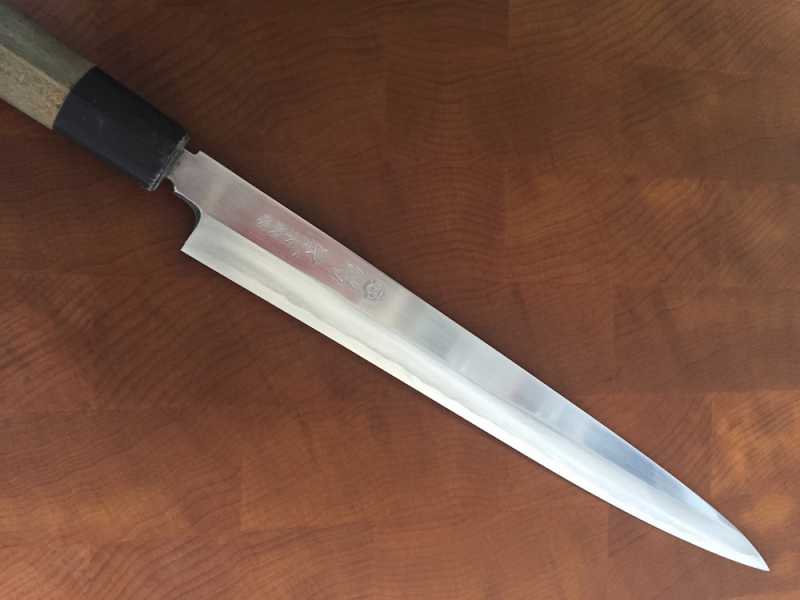
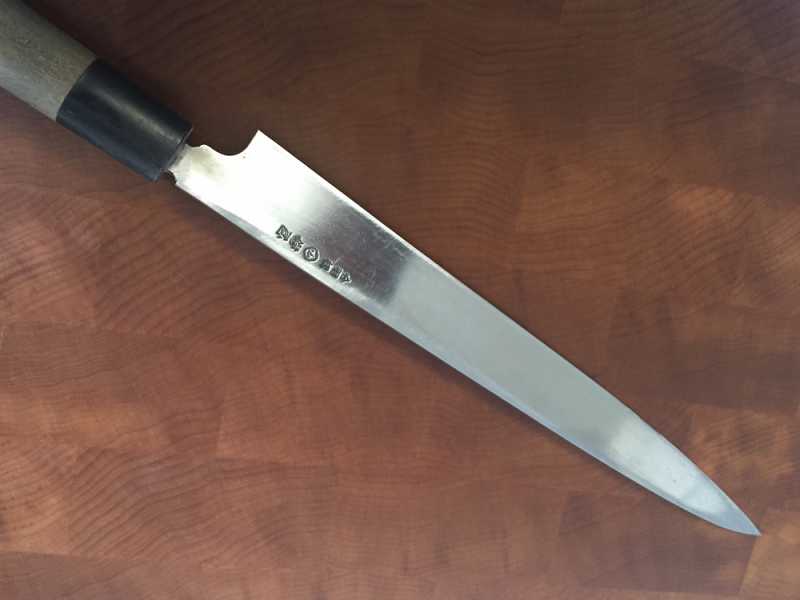
It is a shame Macs are not laminated it would make corrective work much easier. Still the steel is good. I should have taken photos but it was part of a batch of knives I had to do and every minute counted . There was a yanagi which needed a lot of thinning and although laminated it was extremely tough steel & took 4 hours or more to do. That one I did photograph.
Wow… I am happy that I am the only one who uses my knife and I have not needed to thin it yet. My chef’s knife doesn’t look anything like the yanagi pictured but the blade is still pretty thin (2mm at the spine) and the actual bevel is crazy thin. Mine didn’t come with a 50/50 but instead with a 80/20 grind which was weird, but I’m not in a hurry to grind it down and correct it, although to do it properly on the wicked edge, I would need the low angle adapter for the factory 10 degrees and then the factory 15 degree micro… Oh well. It’s sharper than any other knife I’ve had unless we get into my super steel pocket knives haha
You may well find that if you look from the tip to the handle that the whole blade is from spine to edge off the centre line often asymmetric knives are.
My big thinning jobs were the result of someone just sharpening the edge and even increasing the angle . Provided on a thicker knife that the thinning bevel & the edge bevel are sharpened each time it should never be necessary to thin. I find on Macs for instance that once about 15-20% of the blade has been sharpened away it is necessary to thin. Often bad use of steels will require that once the waves are removed it is necessary to thin.
All single bevel knives should be sharpened from the shinogi and the the edge each time especially on debas that may be as wide as 5mm on the spine.
You’re correct Leo, the only thing about this one is that is supposed to be a double bevel knife and sharpened on both sides, they just didn’t do that. It’s a Japanese made knife with a western style blade. I hope I’m saying that right… Hahaha
Austin
If it did have an 80/20 grind you can use the same angles each side just on the right side I would work that bevel almost through to the authorised then repeat the angle on the other side just enough to get a slight burr with luck you should have something like an 80/20 the other way to do it is count so 8 passes on the right to 2 passes on the left the idea is that the edge should be below your centre of effort so if the blade is offset then the bevel should be at the lowest point since the left hand side of the blade should be a lot flatter so the edge will be much closer to the fatter side.
I think I am probable succeeding in making it sound more complicated than it really is it is not an exact science the blade smith will not have sophisticated tools to set perfect angles so accept a sort of mas or menus approach to it the most important part is to have the same angle each side if you find it steers when cutting through a big melon note the direction it is going so if it is left there is not enough bevel on that side or vice versa I have not had to do this but I think that is the way it works certainly if you think about it say if it was a single bevel the knife would steer to the left on a deep cut since I think the bevel would eventually would try to run parallel with the cut I admit not been much of a melon fan I have not tried it either way you could prove this on a junk knife put a single bevel on it and see how it steers I would hazard a pretty good guess and say that if the knife tracks left then it needs a bit more bevel on the left to compensate . I am pretty certain I have it right please do correct me if you set up an experiment with a junk knife on a melon and find I have it the wrong way round I do like to see the mechanics of something over pure theory much easier too grasp.
So I may or may not have had to read that Oh say a few times… But I think I do understand what you’re talking about. This specific knife is supposed to be 50/50 it just wasn’t ground correctly so I did take it to the weps and I corrected the bevel on it.
But thank you for the information on sharpening single beveled and knives with weird bevels on them! I appreciate it
Austin
i think what im going to do when i get my weps is try to sharpen one of my work knives at as low of an angle as possible and see how long that lasts with my daily work load. then i might look into putting either a lower angle on the blade or a micro bevel set up.
I would start thick and go thin, once you thin the edge there’s no going back:)
Austin
One thing to note micro bevels really do not take much to add to an edge you can create an almost invisible micro bevel just by doing 2 passes each side with your finishing stone when you have this the knife will cut as if it is a low angle say less than 15˚ or lower but it just makes the edge a little more robust I also then do one honing stroke on the micro bevel with either a 1K or a 600 grit just to add a little more bight to the blade.
Often thinning takes time and either using the weps or freehand it pays to thin in increments nothing ever goes well if you get bored an honyaki nakiri of mine took around 4 hours to thin but it needed it I think some of the clad paring or petty knives are often too thick Tojiro is one make in particular even though it means thinning away some of the damascus cladding then knife is better for it.
You are right you cannot put it back if you take too much away but bear in mind a steel spatular for spreading filler often cuts carrots exceedingly well unlike a razor sharp axe.
Thinning a low angles should be done slowly when the knife next needs attention search for micro chips that is often a sign of either misses or the blade reaching its limits.
I think the biggest decider on the matter is the user some people really mistreat their knives whilst a careful user can use a knife that sticks in the cutting board with made of very average steel with no blade damage.
In reality in both blade & edge geometry has no finite numbers the higher quality Japanese knives have no recommended angle since it is down to the user how they like their blade.
when i get my system i plan on getting some knives at a thrift store to practice on. in my knife bag for work i also have a couple knives i can experiment with edge angles on. im just seriously curious how long a super low angle can last where i work. is it sensitive enough that a light tap with the edge on the cutting board will roll the edge over? i mean surely its not going to be tin foil.
That all depends on the steel and the hardness for sure.
Austin
I’m not sure what steel victorinox uses, but.from experience it tends to be soft
I can’t use any of those expensive sushi knives either because I have to have an antibacterial handle for health code reasons
You can still tune the blade so to speak by thinning behind the edge , then steepening at the edge.
I took a Chinese 2$ knife and did a zero grind on it I left a little thickness at the edge it cuts extremely well all things considered (razor sharp but not too delicate).