A theory of how the WE diamond pastes work

When I first saw Tom’s microscope photographs of the edge of a knife after stropping with the 14 micron and 10 micron diamond pastes I was baffled. I was it again when I was able to repeat this myself. Even though the edge got very smooth and sharp, there were only tiny scratches caused by the pastes. How could pastes that were so little abrasive create such smooth edges, both on balsa and on leather?

I did some additional experiments and a bit of thinking. I think I now know why it was so difficult for me to comprehend how the diamond pastes work: I was trying to explain what I saw through the microscope in terms of assumptions I held about why stropping with the diamond compounds worked:

[ul]
[li]Leather has a stiction that causes it to burnish the edge, i.e. smear out metal over a larger area that causes scratches to become less wide and less deep or sometimes even to disappear.[/li]
[li]The diamond pastes are abrasive because they remove metal by making lots of scratches with a width and a depth of their specified micron size (or a little lower, since only a part of every diamond particle would touch the edge).[/li]
[li]The diamond pastes work on leather due to the dual effects of burnishing and abrasion.[/li]
[li]The diamond pastes work on balsa due to abrasion.[/li]
[/ul]
Tom had already shown that the second assumption was likely not true. It dawned on me when I saw with my own eyes that the first assumption was not true either. The additional experiments and thinking showed that all four assumptions are wrong!

my blogYet these pastes do work. So I tried to come up with an alternative explanation. You can read it in full on . But in short I think the following is happening:

[ul]
[li]Both the balsa and the leather strops are hardly abrasive by themselves. They do not cause much burnishing by themselves either.[/li]
[li]The strops become effective when loaded with the diamond pastes.[/li]
[li]The diamond pastes cause a lot of burnishing, but hardly any abrasion.[/li]
[/ul]
It is the pastes that do the work, not the strops. And these pastes are hardly abrasive, but have a strong burnishing power.

[quote quote=“mark76” post=2399]When I first saw Tom’s microscope photographs of the edge of a knife after stropping with the 14 micron and 10 micron diamond pastes I was baffled. I was it again when I was able to repeat this myself. Even though the edge got very smooth and sharp, there were only tiny scratches caused by the pastes. How could pastes that were so little abrasive create such smooth edges, both on balsa and on leather?

I did some additional experiments and a bit of thinking. I think I now know why it was so difficult for me to comprehend how the diamond pastes work: I was trying to explain what I saw through the microscope in terms of assumptions I held about why stropping with the diamond compounds worked:

[ul]
[li]Leather has a stiction that causes it to burnish the edge, i.e. smear out metal over a larger area that causes scratches to become less wide and less deep or sometimes even to disappear.[/li]
[li]The diamond pastes are abrasive because they remove metal by making lots of scratches with a width and a depth of their specified micron size (or a little lower, since only a part of every diamond particle would touch the edge).[/li]
[li]The diamond pastes work on leather due to the dual effects of burnishing and abrasion.[/li]
[li]The diamond pastes work on balsa due to abrasion.[/li]
[/ul]
Tom had already shown that the second assumption was likely not true. It dawned on me when I saw with my own eyes that the first assumption was not true either. The additional experiments and thinking showed that all four assumptions are wrong!

my blogYet these pastes do work. So I tried to come up with an alternative explanation. You can read it in full on . But in short I think the following is happening:

[ul]
[li]Both the balsa and the leather strops are hardly abrasive by themselves. They do not cause much burnishing by themselves either.[/li]
[li]The strops become effective when loaded with the diamond pastes.[/li]
[li]The diamond pastes cause a lot of burnishing, but hardly any abrasion.[/li]
[/ul]
It is the pastes that do the work, not the strops. And these pastes are hardly abrasive, but have a strong burnishing power.[/quote]

Mark,
grit progressionsThis is really well, done, thanks for the contribution. I really enjoyed reading the whole write-up on your blog. I agree that the compound itself is a considerable factor in the burnishing effect we see. I went back through a progression from a couple of weeks ago () to examine the various pastes and the scratches of various grits are clearly visible in the ascending/descending progressions.
Your theory seems very sound - the substrate plus paste provides enough ‘stiction’ to burnish which is further aided by the abrasive in the paste. The abrasive itself has an effect but is much less, grit for grit than if it were synthesized into a stone.

Thanks for you kind words, Clay!

I took a look at your photographs again and they are better than mine :-). You can see the scratches left by the 14-10-5-3.5 micron pastes more clearly. In my photographs (still to be posted) I was not able to see any scratches caused by the 3.5 micron paste (probably because I could not get the lighting right).

I was thinking whether it would be possible to measure the scratch size (which abrasion is ultimately about; it is not the size of the diamonds that determines the abrasiveness of a stropping compound, but the size of the results they produce). I already saw you have software with which you can draw lines with a particular length in microns. Suppose you drew a line of, say, 20 or 30 microns long perpendicular to the scratches. If you then magnify this portion of the photograph, we can perhaps count the number of scratches per 10 (or 20 or …) microns and work out the scratch size in that way.

That would not only give an indication of the relative abrasiveness of the stropping compounds, but could perhaps also allow us to compare the abrasiveness of the stones to the abrasiveness of the stropping compounds (since the grits comparison chart appears not to be very useful for that purpose).

Interesting theory Mark. Pictures of edges after stropping seemed confusing to me also, they were just too smooth regarding the size of diamond particles. So it looks to me like one size of diamond particles on strops are sufficient, and this size is quite irrelevant.

This gives me a nice idea for an easy experiment:

1000# > 10 micron strops
1000# > 3.5 micron strops
1000# > 1 micron strops

I’ll embark on that next!

Okay, long fun day of experimenting with the sharpener and various grits. Today I mostly worked on the following: 1000# diamond stones, 14, 10, 5, 3.5, 1 and .5 micron diamonds on leather and some on balsa. Since there were so many different progressions, I’ll break it up into a variety of posts, starting with a 1000 grit diamond stone finish:

510x

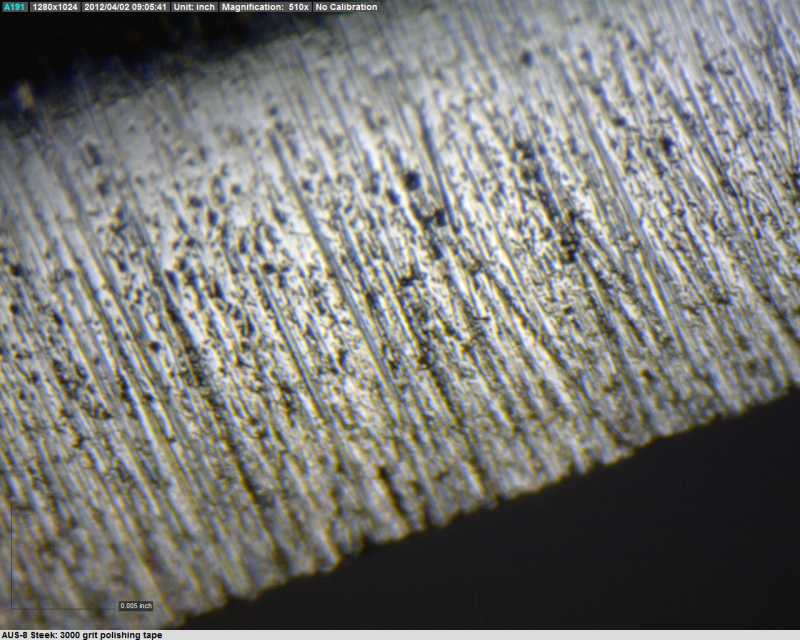
Next I went to 3000 grit polishing tape:

510x

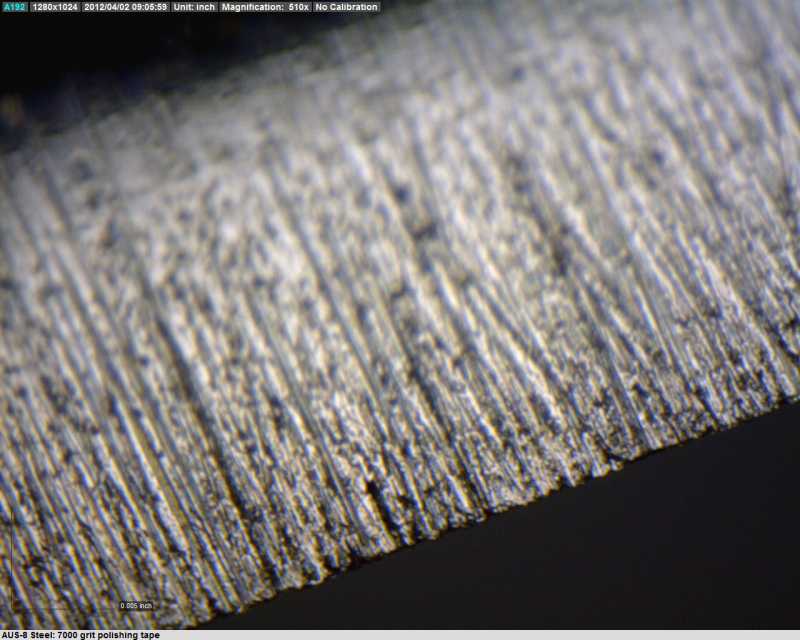
And then 7000 grit polishing tape:

510x

I was really surprised at the results of the polishing tapes, I expected a much finer finish. This is an experiment that I’ll have to do again, starting from an already polished edge. One thing that jumps out at me right off is that when I repeat this, I’ll need to spend a lot more time than I’d anticipated with the tapes - they don’t remove scratches nearly as quickly as I had assumed.

Attachments:

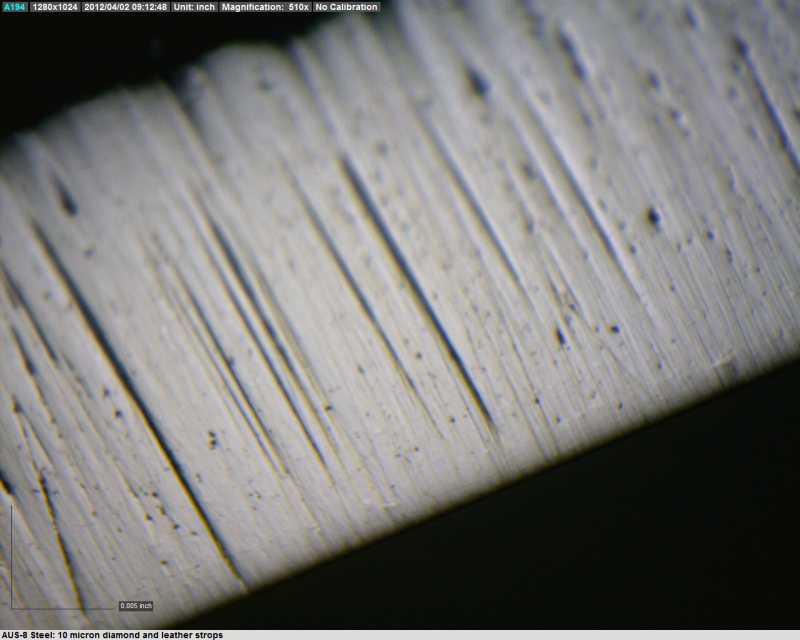
Next I stropped the blade with 10 micron diamonds on leather and then 3.5 micron diamonds on leather:

510x - 10 micron diamonds on leather after 7000 grit polishing tape

510x - 3.5 micron diamonds on leather sequence= 7000 tape> 10 micron strops> 3.5 micron strops

The diamond paste and leather strops made a big difference quickly.

Attachments:

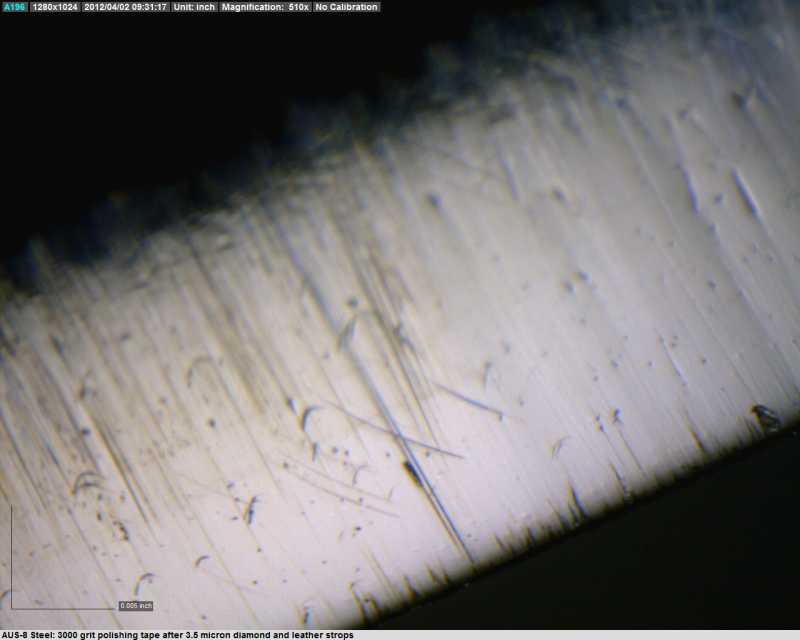
After getting the edge to 3.5 microns, I then went back to the polishing tapes:

510x - 3000 grit polishing tapes after 3.5 micron strops

510x - 7000 grit polishing tapes after 3000 grit tapes after 3.5 micron strops

I need to do a lot more work playing with the polishing tapes!

Attachments:

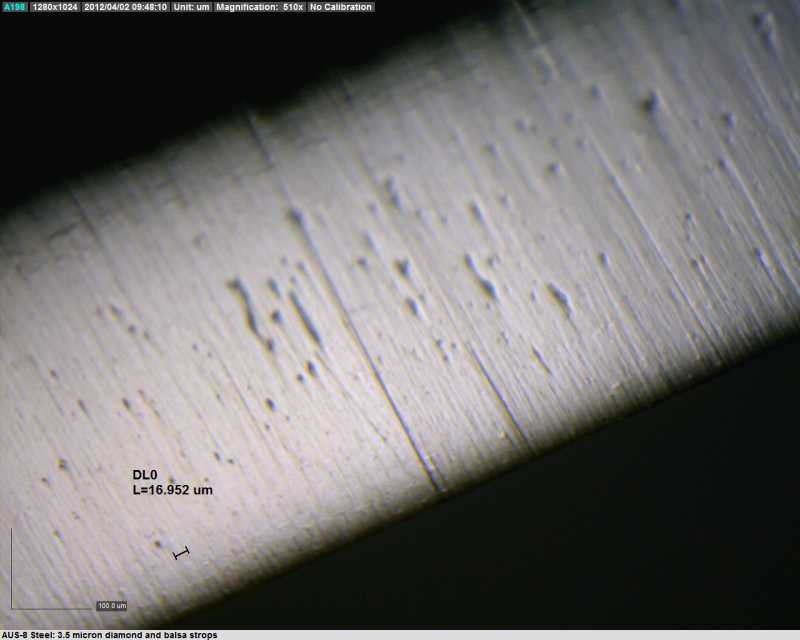
Next I decided to try 3.5 micron balsa strops to compare with the 3.5 micron leather strops:

I first went to the 3.5 micron balsa strops right after the 7000 grit tapes

510x - 3.5 micron diamond and balsa strops after 7000 grit polishing tapes

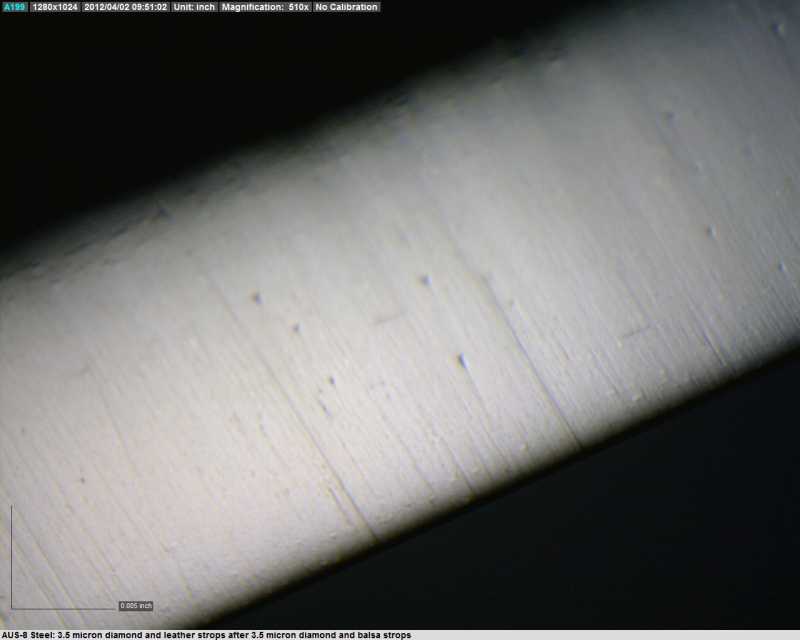
Then I went to the 3.5 micron leather strops right after the 3.5 micron balsa strops

510x - 3.5 micron leather strops after 3.5 micron balsa strops

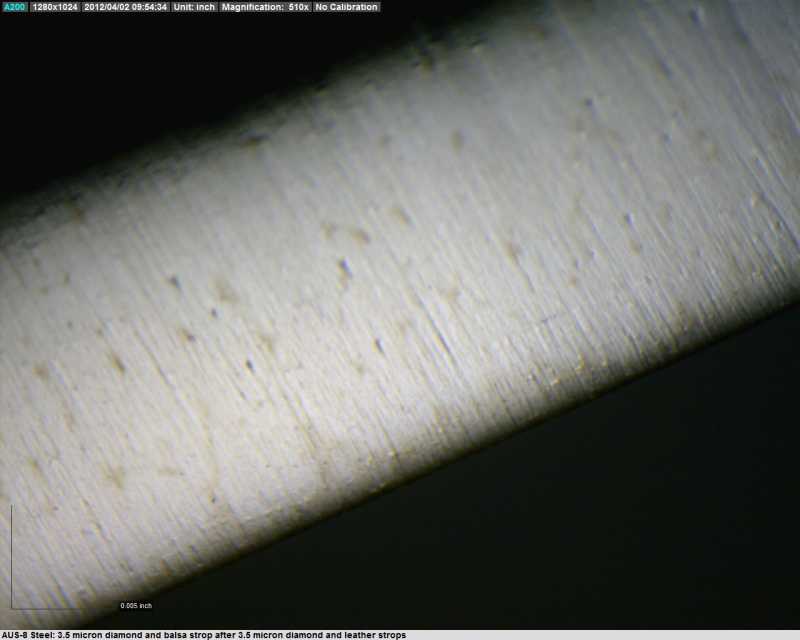
Then I went back to the 3.5 balsa strops

510x - 3.5 micron balsa strops after 3.5 micron leather strops - 2nd pass

Then back to the 3.5 leather strops

510x - 3.5 micron leather strops after 3.5 micron balsa strops - 2nd pass

It looks like there is a clear difference in finish between balsa and leather.

Attachments:

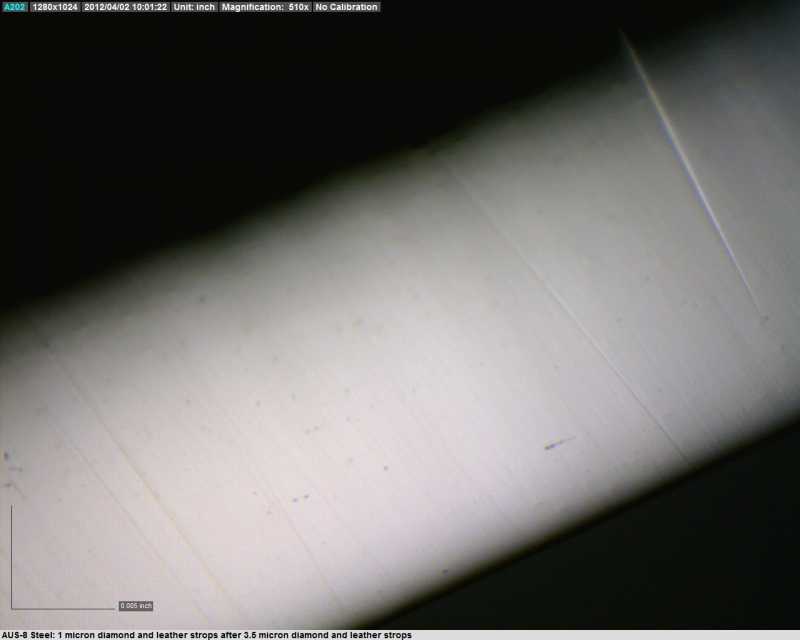
Now on to 1 micron diamond and leather after the 3.5 micron diamond and leather:

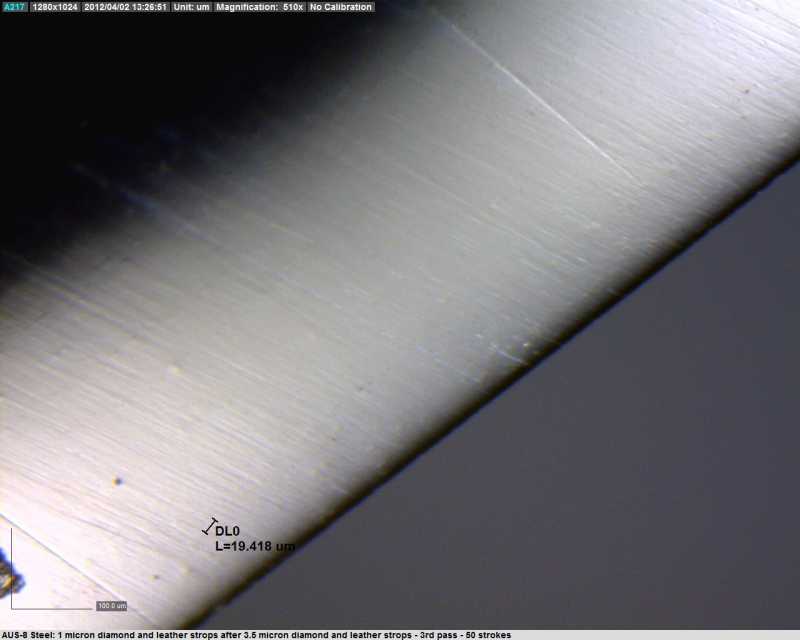
510x - 1 micron diamond and leather strops after 3.5 micron diamond and leather

Looking good!

Attachments:

next a whole new direction…

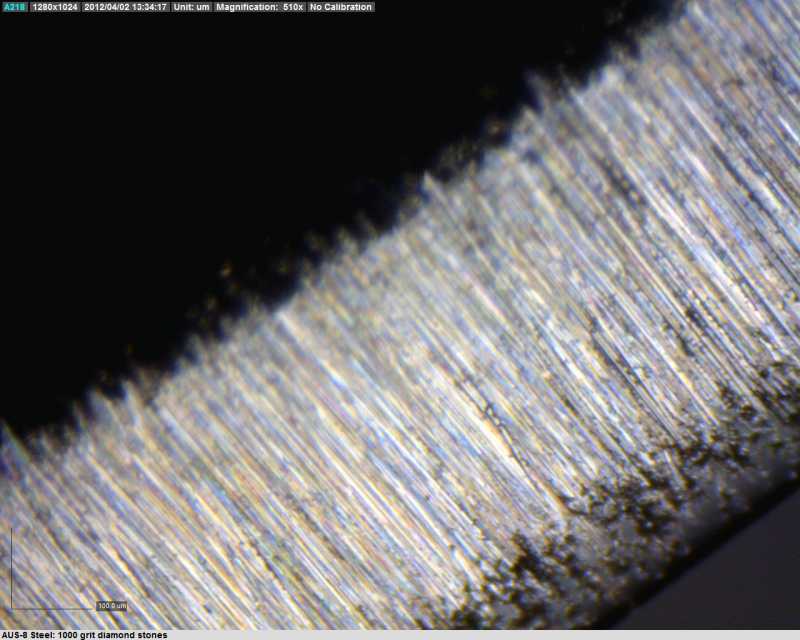
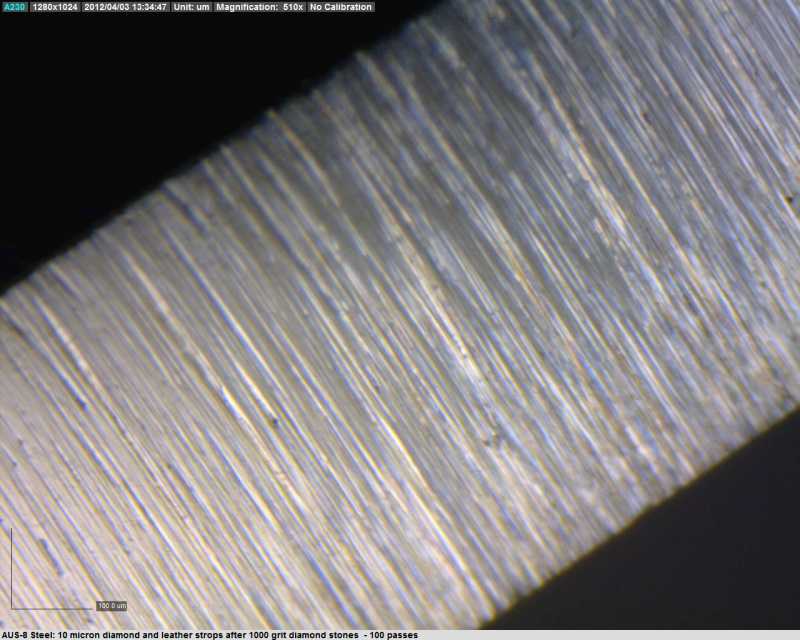
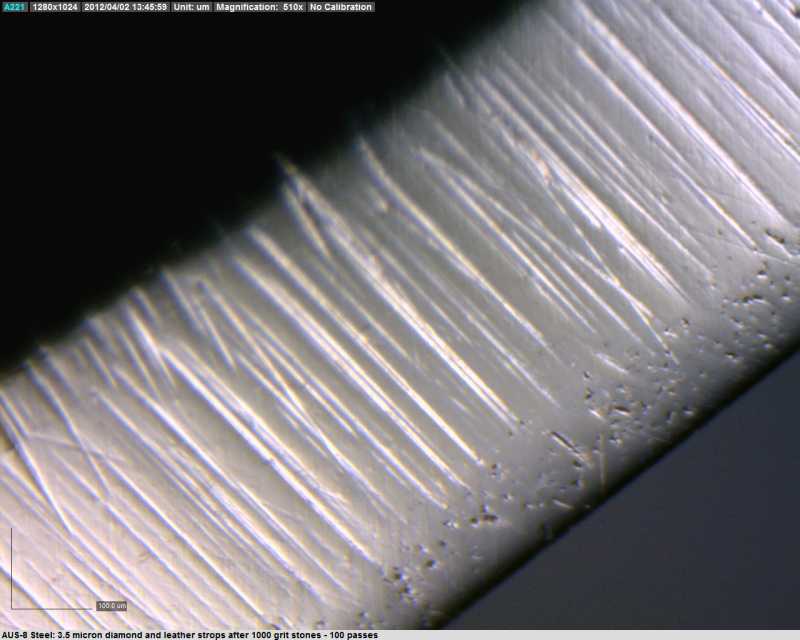
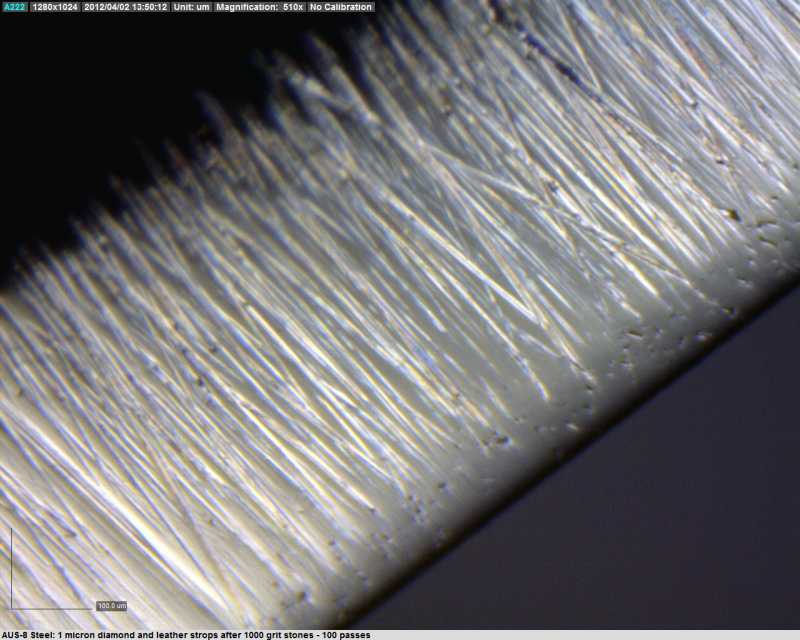
Next I wanted to examine what happens when you go straight from the 1000 grit stones to a specific grit e.g. 1000 grit > 10 micron, 1000 grit > 3.5 micron and 1000 grit > 1 micron:

510x - 1000 grit diamond stones after 3.5 micron diamond and leather strops finish

510x - 10 micron diamond and leather strops after 1000 grit diamond stones

100 passes with the strops after the stones.

Attachments:

After the 10 micron strops, I re-did the edge at 1000 grit diamond. Then jumped straight from the 1000 grit diamond to the 3.5 micron diamond and leather strops:

510x - 3.5 micron diamond and leather strops after 1000 grit diamond stones

100 passes with the strops after the stones.

Attachments:

I again re-did the edge with the 1000 grit stones before skipping straight to the 1 micron diamonds and leather strops:

510x - 1 micron diamond and leather strops after 1000 grit diamond stones
100 passes with the strops after the stones.

I went on and did another 200 passes with the strops:

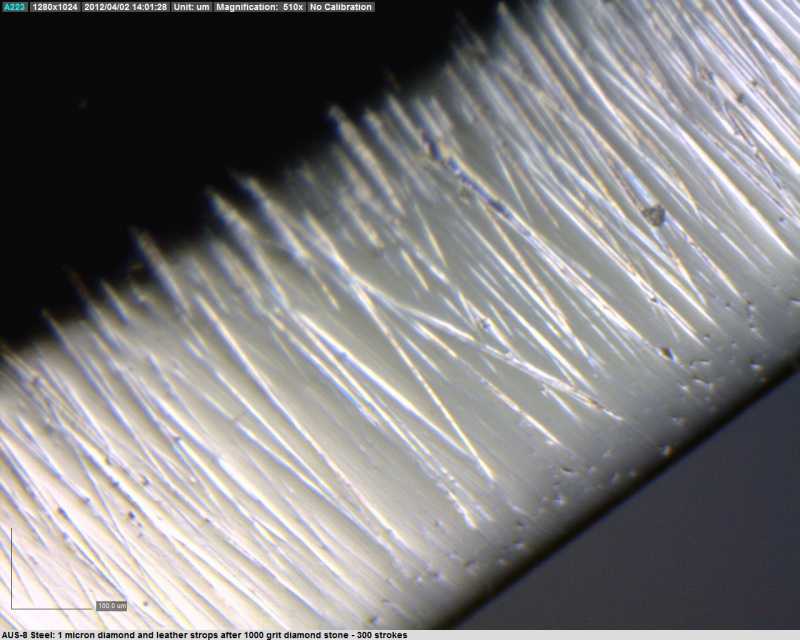
510x - 1 micron diamond and leather strops after 1000 grit diamond stones
300 passes with strops after the stones.

Attachments:

Next I wanted to see how the bevel turned out going incrementally but using the same number of passes as the direct 1000 grit to 1 micron test before, so I re-did the edge once more with the 1000 grit diamond stones and then did 100 strokes each with 10 micron, 3.5 micron and 1 micron diamond and leather strops for a total of 300 passes:

510x - 1000 grit diamond> 10 micron> 3.5 micron> 1 micron - 100 passes each

To compare, here again is the 1000 grit to 1 micron:

510x - 1000 grit diamond> 1 micron - 300 passes

Attachments:

I also took a couple of pictures by request:

510x - 1 micron with scale

510x - .5 micron with scale

This was a challenging set to take and I’ll have to try again to get more contrast and visibility with the scratches.

Attachments:

Great pictures again, Clay. And a lot. You must have had a fun night :lol:.

How many strokes did you do with the polishing tapes? If you did a large number, the results surprise me as well. (Well, I almost get used to stuff not working as expected according to grit size.) You might get clearer results if you made scratches (almost) perpendicular to the scratches of the 1000 grit stones. Or did you do this already? (In which case I am not surprised, but flabbergasted :woohoo:.)

[quote quote=“wickededge” post=2433]After getting the edge to 3.5 microns, I then went back to the polishing tapes:

510x - 3000 grit polishing tapes after 3.5 micron strops

510x - 7000 grit polishing tapes after 3000 grit tapes after 3.5 micron strops
I need to do a lot more work playing with the polishing tapes![/quote]

Yes, you cannot write them off that quickly. But this doesn’t look encouraging. The scratch pattern is… well, it’d hardly call it a pattern :(. I think you need a set of somewhat even and repetitive scratches for the tapes to be abrasive in an effective manner.

[quote quote=“wickededge” post=2435]Now on to 1 micron diamond and leather after the 3.5 micron diamond and leather:

510x - 1 micron diamond and leather strops after 3.5 micron diamond and leather
Looking good![/quote]

That is definitely looking good! Which 1 micron compound did you use?

I find these two pictures very interesting:

It seems the 3.5 micron compound causes a little more burnishing than the 1 micron compound. Not a lot, since 200 stropping strokes with the 1 micron diamond compound seem to create a better result than 100 strokes with the 3.5 micron compound. But still, the stiction is different.

[quote quote=“wickededge” post=2441]I also took a couple of pictures by request:

510x - 1 micron with scale

510x - .5 micron with scale

This was a challenging set to take and I’ll have to try again to get more contrast and visibility with the scratches.[/quote]

Thanks a lot :-). I am working on the scratch sizes as you might have seen. When I make pictures like these myself, one where the edge is almost white and another one in which the edge is quite dark, I find it very difficult to compare them. The scratches also seem different. How do you deal with this (other than by making the photographs again)?

I’m definitely going to redo the lapping film tests, starting from a polished edge and count strokes and possibly alternating stroke directions, maybe from polished down through 7k to 3k and then back up. I rotated the scope to get the dark and light images in an effort to see the scratches better but wasn’t very satisfied with darker image, have to keep experimenting with it. As far as the ‘stiction’ of the different strops goes, I think it might be a function of how much paste is on the surface and how much moisture it has.

Whoa! New scope Clay? Nice pics… what is it?

WOW! Those are some interesting photos and observations Clay! It would seem that there is no sense in going 10>5>3.5>1 when you get the same, if not better results with just going straight to the 1m! Is this observation correct?

[quote quote=“wickededge” post=2440]Next I wanted to see how the bevel turned out going incrementally but using the same number of passes as the direct 1000 grit to 1 micron test before, so I re-did the edge once more with the 1000 grit diamond stones and then did 100 strokes each with 10 micron, 3.5 micron and 1 micron diamond and leather strops for a total of 300 passes:

510x - 1000 grit diamond> 10 micron> 3.5 micron> 1 micron - 100 passes each

To compare, here again is the 1000 grit to 1 micron:

510x - 1000 grit diamond> 1 micron - 300 passes[/quote]

Also, it seems as if, when you started w/ the 1k grit and on you weren’t really hitting all the way to the edge of the edge, am I right?

BTW, Clay, which knife is that a pic of? I am curious as to how hard that Aus 8 steel is on the HRC scale…

Thanks for checking on the lapping film… still curious as to what your further testing will reveal :smiley:

That’s a good question and I’m not sure I’ve discovered an answer yet. I’d like to do a lot more testing because I don’t think I controlled the experiment enough. I think I need to at least repeat it but perform the exact number of strokes with the 1000 grit stones. I think I may not have done enough strokes with them when I rebuilt the bevel each time which could be skewing the results. You can see in the first 1000 grit picture that I didn’t do enough strokes to reach the edge, so I’ll repeat and see how it turns out. I’ll also need to control for age of strops and amount of paste applied.

The new scope is the Dino-Lite AM-413T5. I’m really liking it so far!