A theory of how the WE diamond pastes work

That is a good one. In my experiences the leather strops usually work a little better than the balsa strops for burnishing. However, I had one case in which the balsa worked better. That might be the reason.

I tried, by the way, to increase the stiction of a leather strop by making it wet. Not the slightest effect. Next up is stropping with chewing gum on balsa :lol:.

That is a good one. In my experiences the leather strops usually work a little better than the balsa strops for burnishing. However, I had one case in which the balsa worked better. That might be the reason.

I tried, by the way, to increase the stiction of a leather strop by making it wet. Not the slightest effect. Next up is stropping with chewing gum on balsa :lol:.[/quote]

Totally funny. I just redid some of the tests and the role of stiction seems to be huge. I’ll post more below.

Man, that is really weird why the lapping films were so slow working and hardly did anything… I can’t believe it! My assumptions were totally opposite… lol, it seems as if the only way you can get a fast cutting consistant edge at sub micron levels is with the shaptons… I just don’t have a grand to drop on stones right now :frowning:

  • edit: keep the test coming Clay! lol, there’s gotta be another answer! I haven’t given up hope!

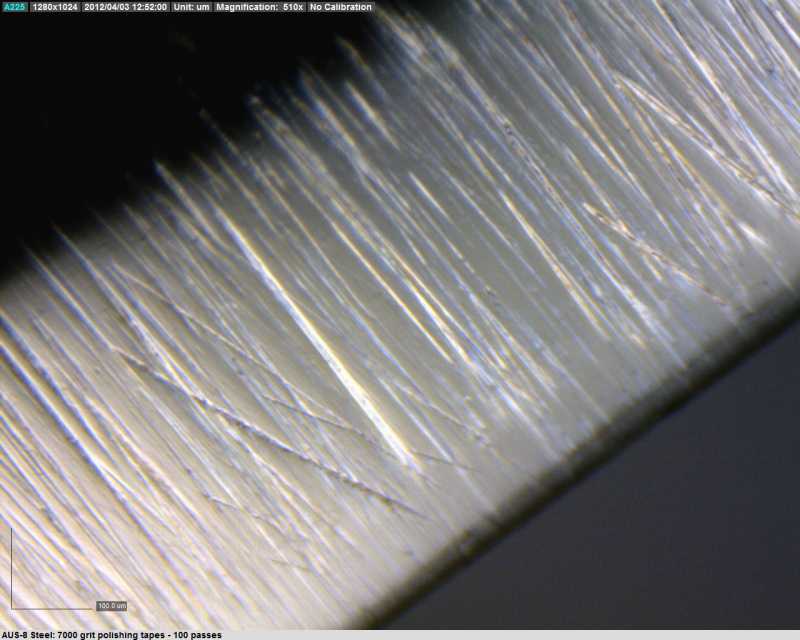
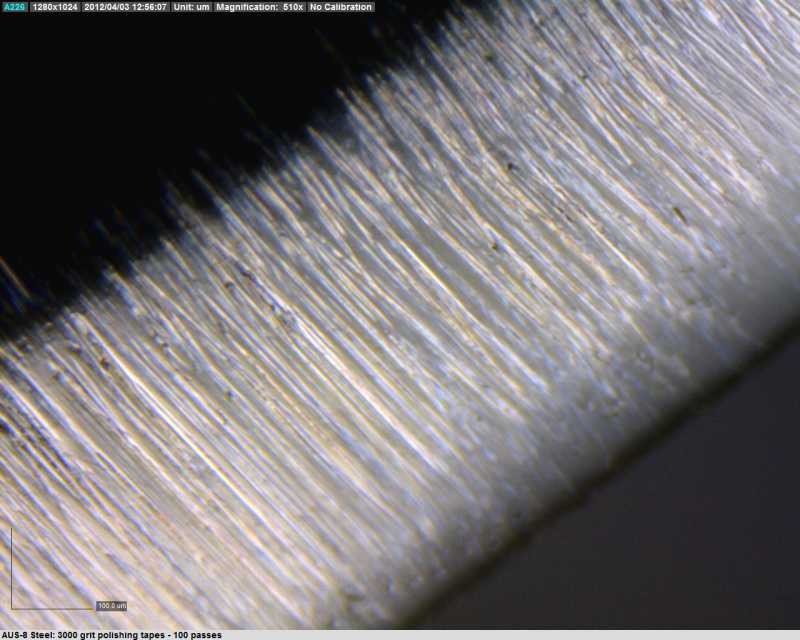
Slight tangent here - polishing tapes… I decided to retest the polishing tapes, starting from a polished bevel and counting strokes, so here goes, working backwards from 1 micron polish:

510x - 7000 grit polishing tapes after 1 micron polish - 100 passes

510x - 3000 grit polishing tapes after 7000 grit tapes - 100 passes

These look better than yesterday’s results but not overwhelming.

Attachments:

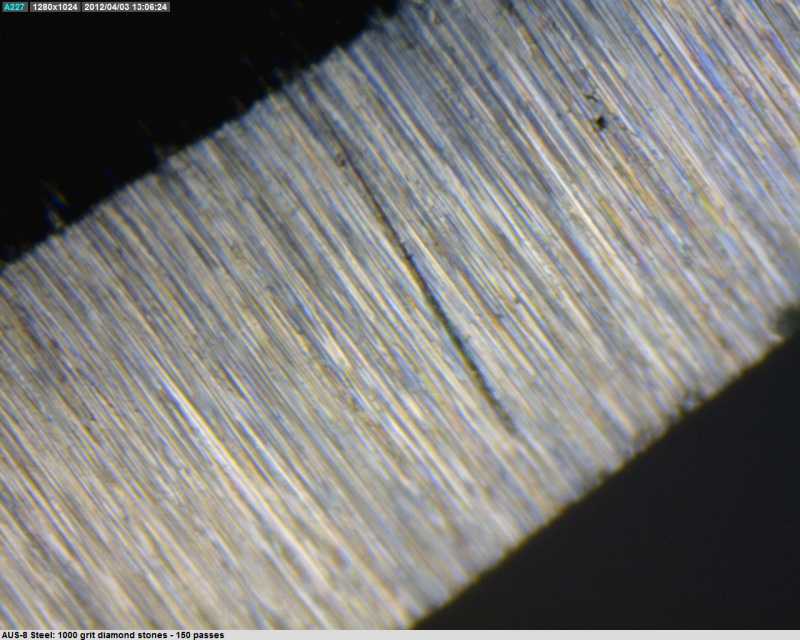
Okay, back on track now… Returned to the 1000 grit stone, worked the stone until I reached the edge:

510x - 1000 grit diamond stone - 150 passes

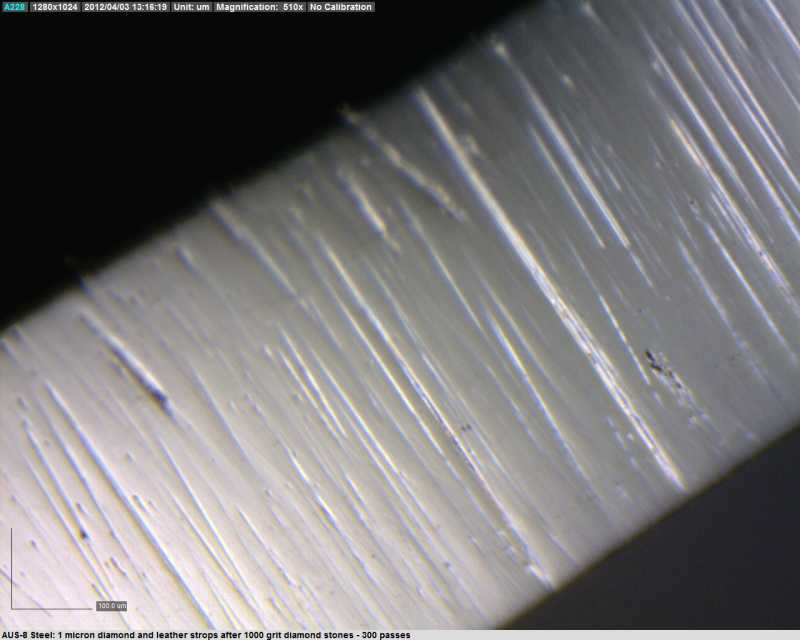
Then I took the 1 micron strops and completed 300 passes:

510x - 1 micron diamond and leather strops after 1000 grit diamond stones - 300 passes

There was an extreme amount of stiction with this strop, much more so than with the others, most likely because it’s the one seeing the most action. Pushing the strop against the blade was causing the Paperstone base to lift with each stroke.

Attachments:

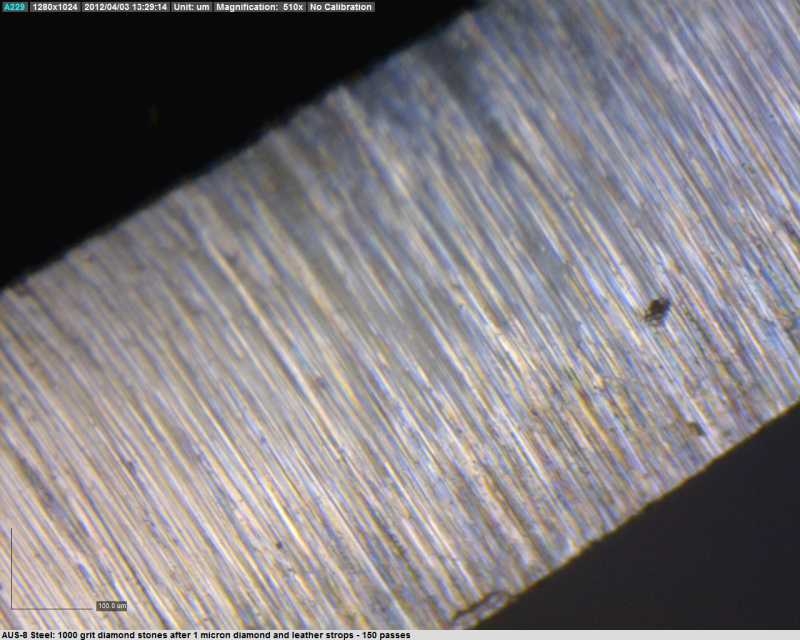
Back again to the 1000 grit diamond stone for another 150 passes:

510 x - 1000 grit diamond stones - 150 passes

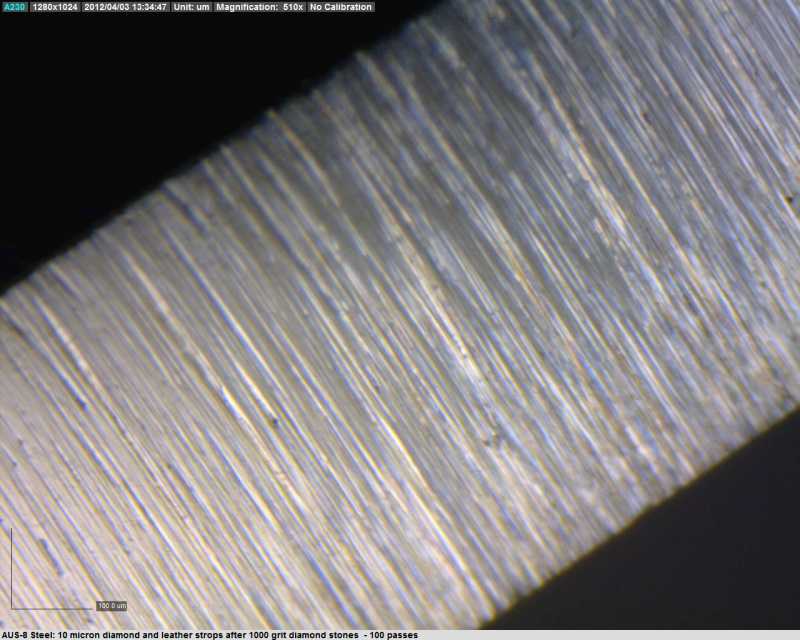
510 x - 10 micron diamond and leather strops after 1000 grit diamond stones - 100 passes

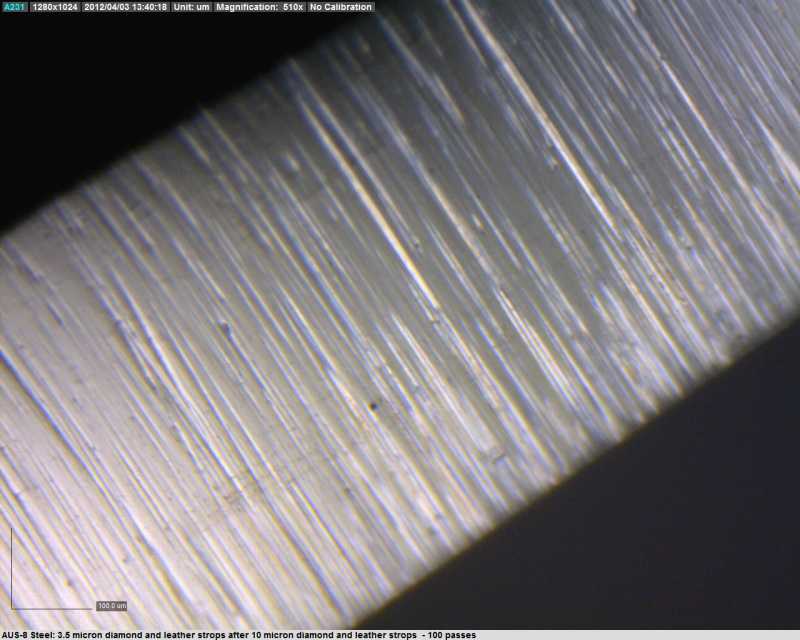
510 x - 3.5 micron diamond and leather strops after 10 micron diamond and leather strops - 100 passes

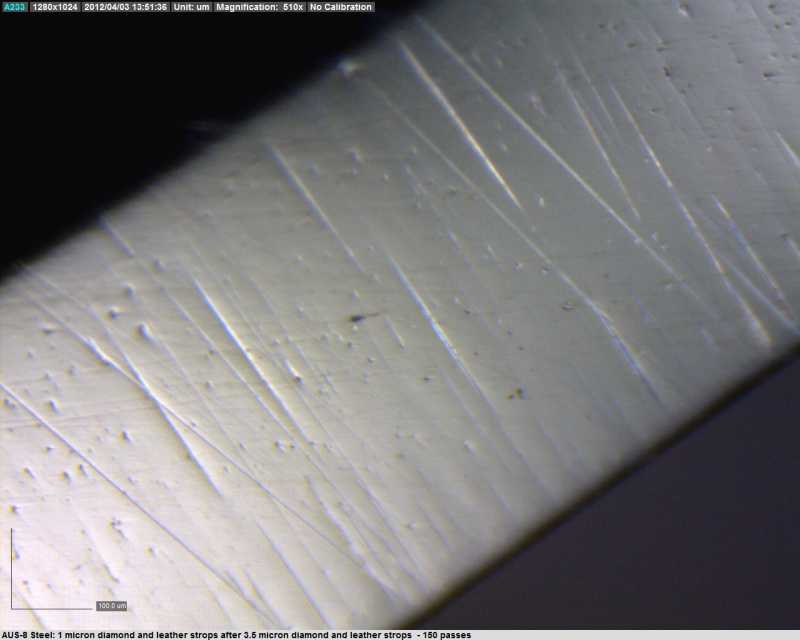
510 x - 1 micron diamond and leather strops after 3.5 micron diamond and leather strops - 100 passes

There was a very marked difference in resistance from the different strops with the resistance from the 1 micron set being by far the highest.

Attachments:

So, here are side by side the 1µ - 300 passes and the 10µ -100 passes> 3.5µ - 100 passes> 1µ - 100 passes:

510x - 1µ - 300 passes

510x - 10µ -100 passes> 3.5µ - 100 passes> 1µ - 100 passes

Attachments:

So far, it seems like we’ve confirmed that the best stropping effects come from burnishing, which happens when there is adequate ‘stiction’. Learning how to get the strops properly seasoned so that they have the right amount of ‘stiction’ is something we should study next.

I deliberately did a few strokes at an angle in the last progression to help us visualize the scratches from the finer strops which opens up a whole line of inquiry: what density of diamonds at which grit provides the best teeth for which jobs?

I’m going to try adding some of Keith’s 1 micron spray to my 1 micron pasted strops to see if I can keep the stiction but add more diamonds. More studies to come!

Thanks so much for this Clay! It would, in fact, seem as if the 10>5>3.5 progression yields better results in the end… wasn’t so clear in the first one.

Still curious… which blade is this you are sharpening?

[quote quote=“razoredgeknives” post=2466]Thanks so much for this Clay! It would, in fact, seem as if the 10>5>3.5 progression yields better results in the end… wasn’t so clear in the first one.

Still curious… which blade is this you are sharpening?[/quote]

That’s a blade I designed for hunting that we’ll be releasing soon. AUS-8 steel at 57-58 RHC. It’s nothing fancy, actually a very inexpensive knife that fills a particular need. Details to come soon… :wink:

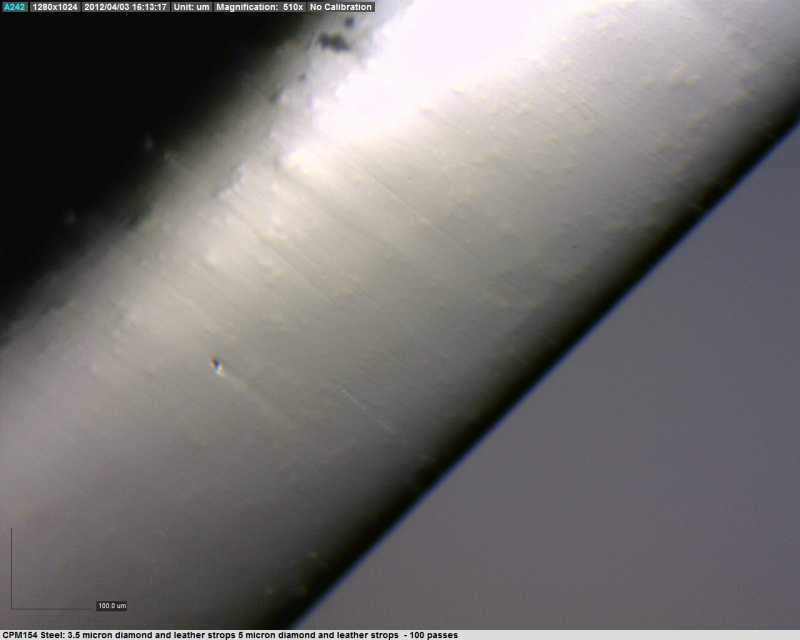
New study, different steel. This is a knife that I had made from CPM-154, hardened to 69-70 RHC.

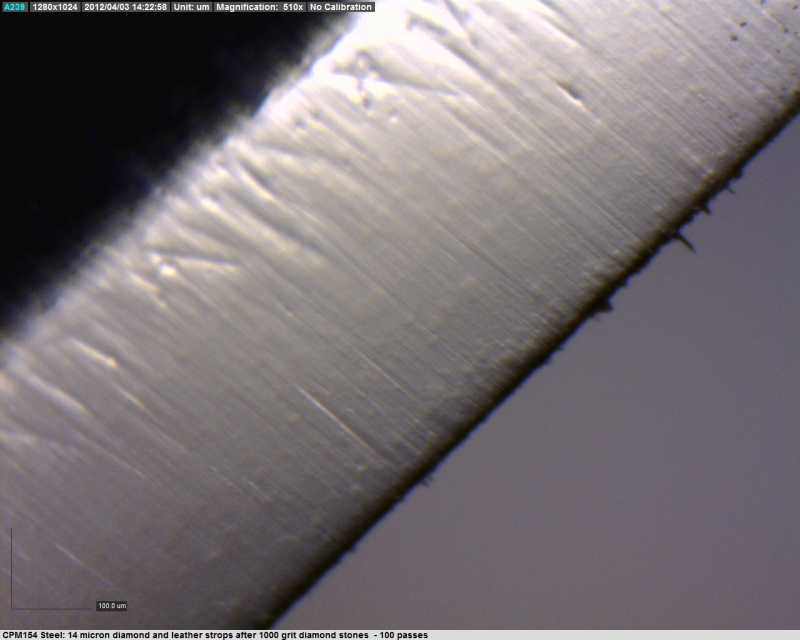
I started with a polished edge, then went back to the 1000 grit stones before progressing to the strops. Here is the edge after the 14µ strops:

510x - 14µ diamond and leather strops after 1000 grit diamond stones - 100 passes

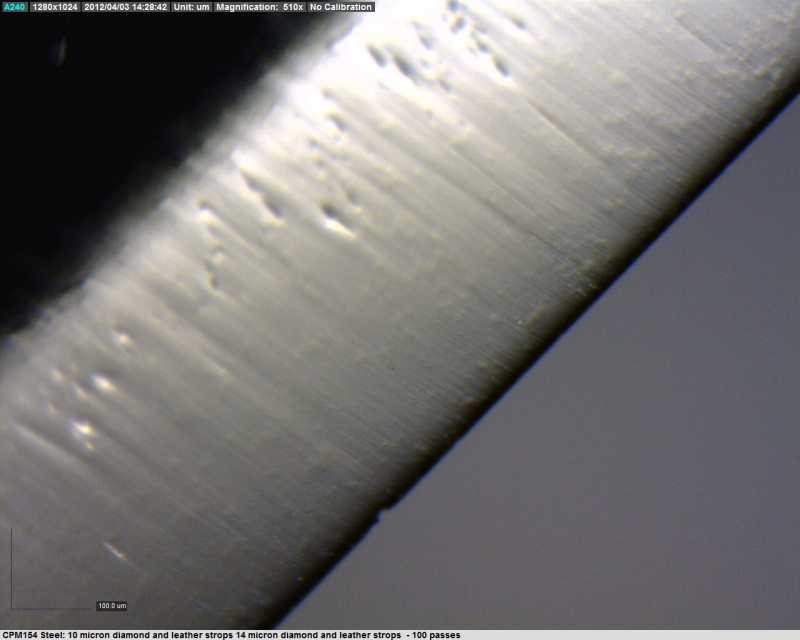
510x - 10µ diamond and leather strops after 14µ diamond and leather strops - 100 passes

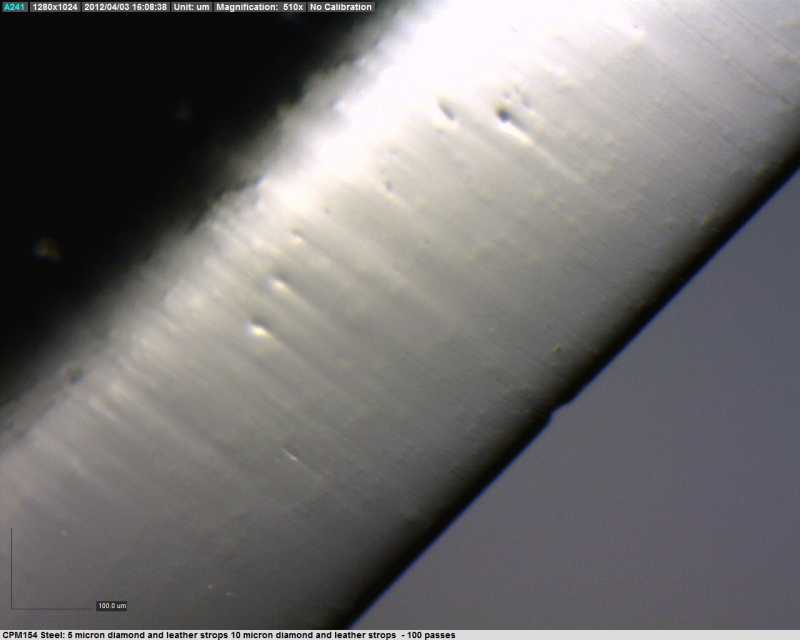
510x - 5µ diamond and leather strops after 10µ diamond and leather strops - 100 passes

510x - 3.5µ diamond and leather strops after 5µ diamond and leather strops - 100 passes

Attachments:

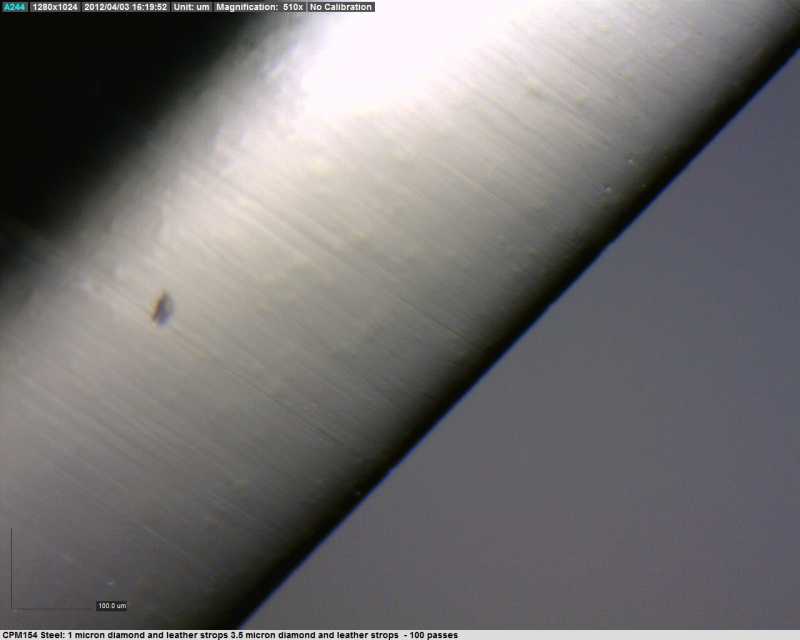
Next I decided to throw in a little side experiment - I sprayed some Hand American, 1 micron diamond spray on my already pasted 1 micron strops - big difference here, though not totally surprising:

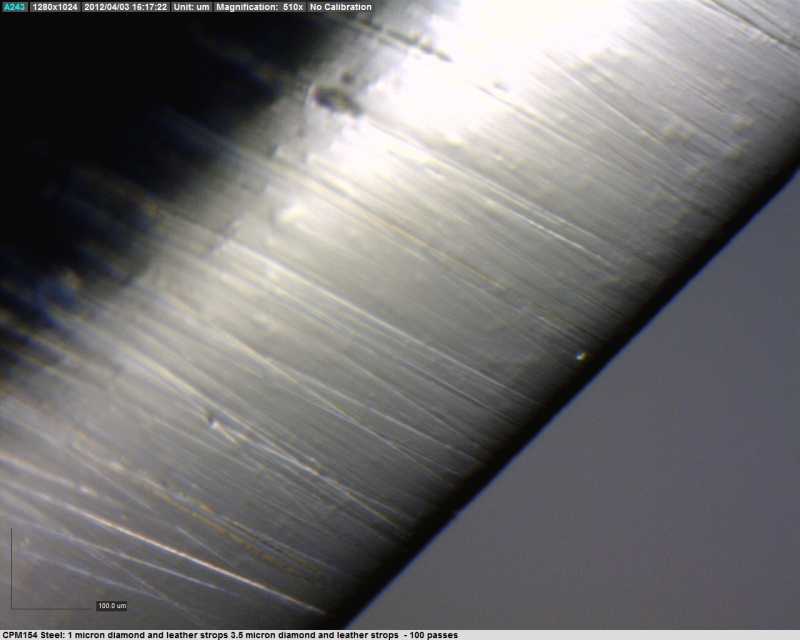
510x - 1µ diamond and leather strops after 3.5µ diamond and leather strops - 100 passes

There are clearly a LOT more diamonds than when I was using the strops with just the paste. Additionally, most of the ‘stiction’ was gone from the strops after spraying with the HA spray. I decided to do another 100 passes and started getting back to good ‘stiction’:

510x - 1µ diamond and leather strops after 3.5µ diamond and leather strops - 200 passes

For reference, here is a pic of the 1 micron pasted strops from a little earlier before adding the 1 micron spray:

Attachments:

[quote quote=“razoredgeknives” post=2460]Man, that is really weird why the lapping films were so slow working and hardly did anything… I can’t believe it! My assumptions were totally opposite… lol, it seems as if the only way you can get a fast cutting consistant edge at sub micron levels is with the shaptons… I just don’t have a grand to drop on stones right now :frowning:

  • edit: keep the test coming Clay! lol, there’s gotta be another answer! I haven’t given up hope![/quote]

If you can hold out til mid-May, I might have just the thing for you!

+3.

However, this is the Wicked Edge pastes. Tonight I took photographs of the edge after stropping with Dovo paste. But it is 0:40 in the night here and somebody in the next room is saying I must come to bed. Up tomorrow :-).

+3.

However, this is the Wicked Edge pastes. Tonight I took photographs of the edge after stropping with Dovo paste. But it is 0:40 in the night here and somebody in the next room is saying I must come to bed. Up tomorrow :-).[/quote]

Can’t wait to see your results!

Interesting experiments again, Clay!

[quote quote=“wickededge” post=2461]Slight tangent here - polishing tapes… I decided to retest the polishing tapes, starting from a polished bevel and counting strokes, so here goes, working backwards from 1 micron polish:

510x - 7000 grit polishing tapes after 1 micron polish - 100 passes

510x - 3000 grit polishing tapes after 7000 grit tapes - 100 passes

These look better than yesterday’s results but not overwhelming.[/quote]

Why do you think they are not overwhelmingly better? I clearly see scratches now that (I hope) are from the polishing tapes. They are also quite evenly spaced, creating a nice pattern almost like what a stone would do.

By the way, with current knowledge (it changes per day :slight_smile: ) I think this it the way to test the very low micron size compounds/tapes/stones: first burnish the edge until it is very smooth (e.g. using the 1 micron paste, but I wouldn’t be surprised if the 14 micron paste worked as well :slight_smile: ) and then do strokes with the fine stuff.

I think we should be careful in drawing such conclusions too early. In one post Clay noted that the 1 micron compound had by far the most stiction. That would imply that 300 strokes with the 1 micron paste should produce more burnishing than 300 strokes (in total) with the 10-3.5-1 micron pastes. But in fact the surface of the edge after the latter progression looks smoother.

I had similar results: sometimes a particular compound seemed to cause more burnishing than another compound, whereas in different circumstances the results were exactly the opposite. I think this might very well be the result of the way in which the strops were seasoned (and the amount of paste applied).

Are you sure that hardness isn’t a typo, Clay? But good to see the burnishing works just as good on harder steels!

[quote quote=“wickededge” post=2469]Next I decided to throw in a little side experiment - I sprayed some Hand American, 1 micron diamond spray on my already pasted 1 micron strops - big difference here, though not totally surprising:

510x - 1µ diamond and leather strops after 3.5µ diamond and leather strops - 100 passes

There are clearly a LOT more diamonds than when I was using the strops with just the paste.[/quote]

I am not quite sure what I see here. I I do see scratches, but not as many or as regular as those that would be caused by a 1 micron stone. Is that correct, Clay? If you’d increase the amount of spray applied, would the number of scratches increase and a more regular pattern appear?

Ooops, I did mean 59-60 RHC! :slight_smile: I’ll stitch the 1 micron paste image to the 1 micron paste + spray so we can compare them side by side.

Yeah Mark, you may be right… I guess I’m a little confused about which pictures were the right ones? These are the side-by-side comparisons that you posted Clay…

[quote quote=“wickededge” post=2464]So, here are side by side the 1µ - 300 passes and the 10µ -100 passes> 3.5µ - 100 passes> 1µ - 100 passes:

510x - 1µ - 300 passes

510x - 10µ -100 passes> 3.5µ - 100 passes> 1µ - 100 passes[/quote]

But then in the post above this one, you had another pic of a the same progression it seemed, ending with 100 passes on the 1m leather strops…

510 x - 1 micron diamond and leather strops after 3.5 micron diamond and leather strops - 100 passes

Unless I missing something, there is a noticeable difference in the first two pictures, but a HUGE difference in smoothness in the last one…

I am referencing post # 2463 & 2464.

In your post above, you’ve got images from two sets of tests, two on the AUS-8 knife and one on the CPM-154 blade.

Here are three from the CPM-154 knife:

[color color=#0000ff]3.5 Micron strops - 100 strokes:[/color]

The bevel is very smooth after the 3.5 strops.

[color color=#0000ff]1 Micron Strops - both paste and spray - 100 strokes:[/color]

There were many, more obvious scratches after adding the spray to the 1 micron strops. I had lost the ‘stiction’ here and seemed to be getting more abrasion and less burnishing.

[color color=#0000ff]1 Micron Strops - both paste and spary - 200 strokes:[/color]

I did another 100 strokes with the 1 micron strops after the spray had dried. The stiction returned and the surface smoothed out immediately. I believe that once the spray dried, burnishing resumed and abrasion was minimized.

Attachments:

[quote quote=“mark76” post=2399]When I first saw Tom’s microscope photographs of the edge of a knife after stropping with the 14 micron and 10 micron diamond pastes I was baffled…

But in short I think the following is happening:

[ul]
[li]Both the balsa and the leather strops are hardly abrasive by themselves. They do not cause much burnishing by themselves either.[/li]
[li]The strops become effective when loaded with the diamond pastes.[/li]
[li]The diamond pastes cause a lot of burnishing, but hardly any abrasion.[/li]
[/ul]
It is the pastes that do the work, not the strops. And these pastes are hardly abrasive, but have a strong burnishing power.[/quote]

Well, the whole subject of sub-micron particle stropping has me baffled in more was than one.. I question if it is even possible. See the following chart for a reality check on what worlds of size we are talking about then ask yourself. “what exactly is it am doing or trying to accomplish by putting this size particle on a sample of cow hide and hand applying that to a knife edge”.., Hummmm.

Thanks to http://www.standridgegranite.com/calibration.htm#19 Standridge Granite company for the chart .. There are very few people in the world that know more about “flat” than these folks/. It would be interesting if we could get one of their engineer to participate on this thread !