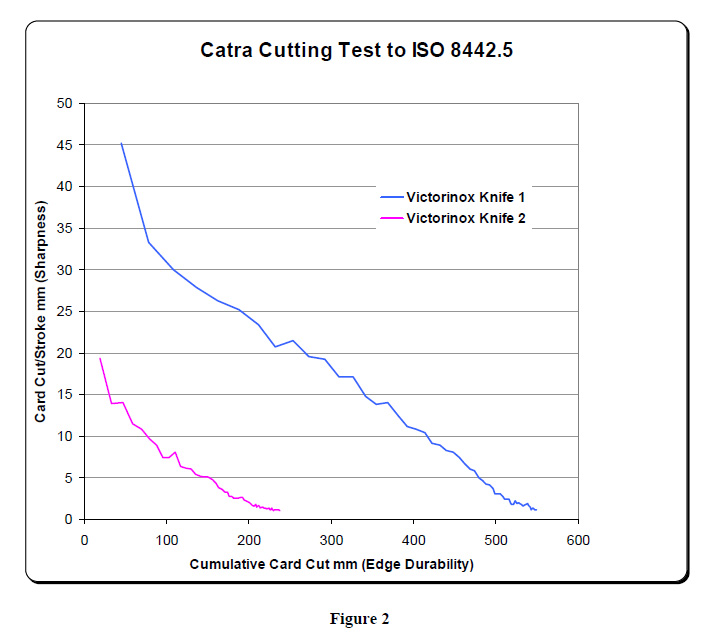
I recently completed a fun test for a white paper I’m working on. I purchased two Victorinox 8" Chefs knives, commonly used in commercial kitchens. I measured the widths of the blades and tested their sharpness on our testing machine. I then sharpened one with Wicked Edge Pro-Pack II and sent the other off to a professional sharpening service. I then re-measured blade widths, tested them on the sharpness testing machine and performed one last test - I cut a stalk of celery in half, then cut sections from each half, one with the Wicked Edge sharpened knife and the other with the sharpening service sharpened knife. Here are the preliminary results:
Original Width:
Blade 1 - 1.818"
Blade 2 - 1.765"
Post Sharpening Width:
Blade 1 - 1.741"
Blade 1 - 1.764"
Change:
Blade 1 - 0.077"
Blade 2 - 0.001"
Initial Sharpness:
Blade 1 - 307
Blade 2 - 313
Post Sharpening Sharpness:
Blade 1 - 584
Blade 2 - 127
Difference:
Blade 1 - (-277) 190% more force needed after sharpening
Blade 2 - (+186) 60% less force needed after sharpening
Any guesses as to which is Blade 1 and Blade 2?
For the finale, here are the images of the celery after 4 and 5 days in the refrigerator:
Any guess as to which knife cut which stack of celery?
A sharp knife does two things it will almost leave a glaze/sheen on the surface of the cut surface , cells are parted so there is less water loss the flatter surfaces create a better seal from creeping oxidation - this can be seen very rapidly on an apple cut & peeled with a sharp knife as opposed to a blunt one.
So I would say the more uniform coloured celery is the WE one.
It looks as if the outside sharpeners/ bluntners did just that (bluntened it) Victorinox are reasonable sharp out of the store .
I would think apple or tuna would illustrate this well too.
Blade 1 - (-277) 190% more force needed after sharpening
Blade 2 - (+186) 60% less force needed after sharpening
?[/quote]
Am I missing something here? I thought it was blade 2 that was the weps one… It looked like blade 1 had more steel removed in the sharpening process and required more force to cut something than the other…?
Blade 1 - (-277) 190% more force needed after sharpening
Blade 2 - (+186) 60% less force needed after sharpening
?[/quote]
Am I missing something here? I thought it was blade 2 that was the weps one… It looked like blade 1 had more steel removed in the sharpening process and required more force to cut something than the other…?
Sorry for the confusion. We sent the knives unlabeled and asked CATRA to assign the labels so that there wouldn’t be any testing bias. Prior to sending them out, we discreetly marked the blades so we could tell which was which when they were returned. Their numbering was not associated with our previous test.
 gotta love it!