I put a blade I’d previously sharpened under the scope yesterday and got a big surprise. There was an enormous wire edge that had started to peel away from the rest of the material. This was a blade I’d imaged many times and had never detected the wire edge. I believe that why it suddenly showed up is that I had been trying to image straight down onto the edge and the various objective lenses I was using brushed back and forth across the edge as I was trying to find it in the scope. They must have pushed over the edge, which clearly turns out to have been very fragile. Check it out:
The chips missing from the edge in the 200x image are from where I knocked them loose to give myself a reference point to be able to find the same spot in the scope.
Here are a couple more that show where the edge is folding over. There are cracks where I’ve placed the arrows. They’re hard to distinguish in the photos because they look like shadows, creating the illusion that there is a mass of metal that is built up, but it’s very clear in the scope that they are cracks.
Quite daunting this. Any idea how this came about? It is my experience that if, with the finder grits, I finish an edge with soft sweeps alternately on both sides I hardly/do not get a wire edge.
I think, based on the images of stropped edges at Todd Simpson’s blog, I’d drawn up a very thin edge, stretching the metal until the last 10µ-15µ of the bevel were at an angle that was much lower than what I was actually sharpening at. I really want to study it in cross section to see if I can verify that hypothesis. I’ll mill some sample blades to expose the cross section and then strop them a lot. Then I’ll get them under the scope and see how they measure.
[caption id=“” align=“alignnone” width=“1024”] “Straight razor edge view after Shapton Glass 8k. Prior to stropping; the razor is not sufficiently keen to shave; however, there is no burr.”[/caption]
[caption id=“” align=“alignnone” width=“1024”] “Edge view of the Shapton 8k edge following 10 stropping laps on a hanging latigo leather strop loaded with 0.25 micron mono-diamond spray.”[/caption]
[caption id=“” align=“alignnone” width=“1024”] “Cross-section view of the Shapton 8k edge following 10 stropping laps on a latigo leather strop loaded with 0.25 micron mono-diamond spray. The foil-like burr is approximately 100nm thick and 3 microns long.”[/caption]
[caption id=“” align=“alignnone” width=“1024”] “Cross-section of the edge after an additional 90 laps (total 100) on 0.25 micron mono-diamond on a hanging Latigo leather strop. The foil-like burr is approximately 20nm thick and 500nm long.”[/caption]
I think that this is essentially what happened with my blade and when I ran it back and forth and it hit the lenses, the foil collapsed and folded over.
Just out of curiosity, do you have to manually add the magnification level? For example, in your first post, the 1st image says 2000x, then all the others say 200x, even though they don’t appear to be (and clearly not the same as the one that is 200x). Just wondered.
Yes, thanks for mentioning it. I have to put input the magnification into the software when I snap the photo and sometimes I forget to change it back, which is the case on these photos. They were all, except the one, done at 2000x.
I think I am convinced that I need 2000x microscope to see the details I have been wanting to see independently. Of course, this is absolutely not nessisary to sharpen a knife. But if we wish to dig deeper “we need more power”- Yes, this was a lame Star Trek reference to Scotty. These images are amazing and exactly what I personally am shooting to achieve. And share. My tools are coming together. Clay, I can’t help noticing how similar these none SEM images are to Todds work. These images are starting to look 3D, does anyone share my thoughts? I have ordered my scope, I’ve got my smugmug worked out and worked out the bugs in my software. Now all I need, is some real time to play with all the parts.
Clay have you studied your diamond stones under this microscope? I’m really interested in your observations about your stones compaired to the DMT stones studied in Todds blog. If I am not mistaken, Todd observed the DMT 325 putting shallow scratches on the surface of the bevel as opposed to the higher grit DMT diamond stones that appear to put deeper and thinner scratches in the bevel? Simply because the surface area of the diamonds at lower grits was much larger and the diamonds are more uniform. This is counter to what we all believe and am interested in peer review of this information.
Please correct me me if I am wrong. It sounded like he was suggesting that the small diamonds at higher grits may be removing more metal than required and actually putting deeper scratches in the bevel surface? I think he used the “bed of nails” example. And indicated that the smaller grit stones may have ununiformed diamond sizes and the larger diamonds among the smaller ones may be digging into the bevel like a single longer nail would in a bed of nails that are supposed to be the same size??
Have you come to any of the same conclusions? This research is compelling. To be honest, these photos have really changed the way I look at bevels. As pictures speak a thousand words I think those of us looking really need to peer review these observations.
Please see the attachment. The diamond in this picture looks like a “big pink elephant” in a room of monkeys?
I can’t help but believe this would cause a significant gouge in the bevel surface, what do you think?
MirrorEdge - this image of Todd’s is almost certainly a new diamond plate because each of the stones has very sharp corners. Those corners get rounded off pretty quickly through regular use. He’s also found on great big diamond that found its way into the mix. I have taken lots of microscope images of our stones though it’s been hard because of depth of field issues. The bit of focus stacking I’ve done in the past with them hasn’t helped. Continuing the effort…
I’m confused…about the idea that a carbon steel metal can damage or round off the edges of a diamond? Isn’t it more likely to come loose from the substrate that it is stuck too than for the steel to damage the diamond?
See the attachment of missing diamond in the substraight.
In the post you’re referencing, the gouge can be either: from a large particle, either within the compound or on the surface of the leather, and could be either the abrasive being used or some bit of grit that’s contaminated the strop; or it can be a scratch that was present from a previous stone and is the last to be removed. I’ve seen it both ways very often.
The rounding of the diamonds is pretty well documented. I’ll try to image a new stone and an old one for you so you can see it.
Just so I know what I am looking at. These are images of two different wicked edge paddles. One that has never been used and a 100 grit paddle that is worn but not worn out. The diamonds I am looking at are not the same diamonds in each photo correct? Would you agree that observing the same diamonds on the same paddle (over time) would be more accurate?
I realize the extreme difficulty that trying to perform this comparison would be, however, would you agree that doing so would be the better way to document the rounding off of diamonds with carbon steel?
I am not a geologist in any since of the imagination, however, I always “believed” that diamonds where the hardest Carbon substance in the world and could only be cut with lasers or other cut, broken, or chipped diamonds? Am I wrong? If so please tell me. I admit I could be wrong. It wouldn’t be a first time.
FROM BLADE HQ: All that is needed to make basic steel is a combination of iron and carbon. However, over time it was found that adding different elements to this basic steel substance can increase its toughness or hardness. These added elements account for what is the major difference of most types of steel in blades. It was quickly discovered that there are advantages and disadvantages to each added element. For example, a certain alloy might make a blade harder. The more hard the steel, the longer it will hold its edge (and that means less frequent sharpening), which is great! However, if you harden the blade, you also make the blade less tough, which means the blade is less resistant to shock and impact (not such a good thing). Unfortunately, a blade cannot be both harder, and tougher; as you add toughness, you make the blade less hard and vice versa. Since not all of us have the basic training of a materials scientist, here are a few key differences in steel types that will help you decide what type of blade is best for you.
Ingredients of Steel
First, I will introduce you to the basic ingredients of steel and their uses.
Carbon - This ingredient is essential to steel’s creation; all steel will have some amount of carbon. It is the most important hardening element, but as it is added it can reduce the toughness of the material. Carbon reduces the amount that the knife will wear over time. So, the amount of carbon in the blade tells you a lot about the quality of the steel. Low carbon means there is (.3% or less), medium has between (.4-.7%), and high is (.8% and above).
Chromium - Combats corrosion. Stainless steel knives will have chromium as a major ingredient, typically at a minimum of 12%. Chromium will also increase the strength of a knife, but adding chromium in large amounts decreases toughness.
Cobalt - Strengthens the blade.
Copper - Combats corrosion.
Manganese - Hardens the blade. If added in high quantities it can increase brittleness.
Molybdenum - Maintains the steel’s strength at high temperatures.
Nickel - Adds toughness.
Nitrogen - This element is sometimes used as a replacement for carbon in steel.
Phosphorus - Improves strength.
Silicon - Increases strength. Also, removes oxygen from the metal while it is being formed.
Sulfur - Increases machinability but decreases toughness.
Tungsten - Increases wear resistance.
Vanadium - Increases wear resistance and makes the blade harder.
Isn’t it true that any alloy of metal is only as stong as it’s weakest part ingredient (mineral)? As far as I can tell, their isn’t any substance or mineral in this list that is more “scratch resistant” than the diamonds we are sharpening with.
I must be obsessed, sorry everyone. If you can help answer some of these questions for me, please do. I actually want to know what is going on.
Probably true however… If I’m reading you correct (may not be) you are using the same sort of argument I’ve heard others make. For instance, if hardened steel is harder than paper, why will paper dull steel after a while?


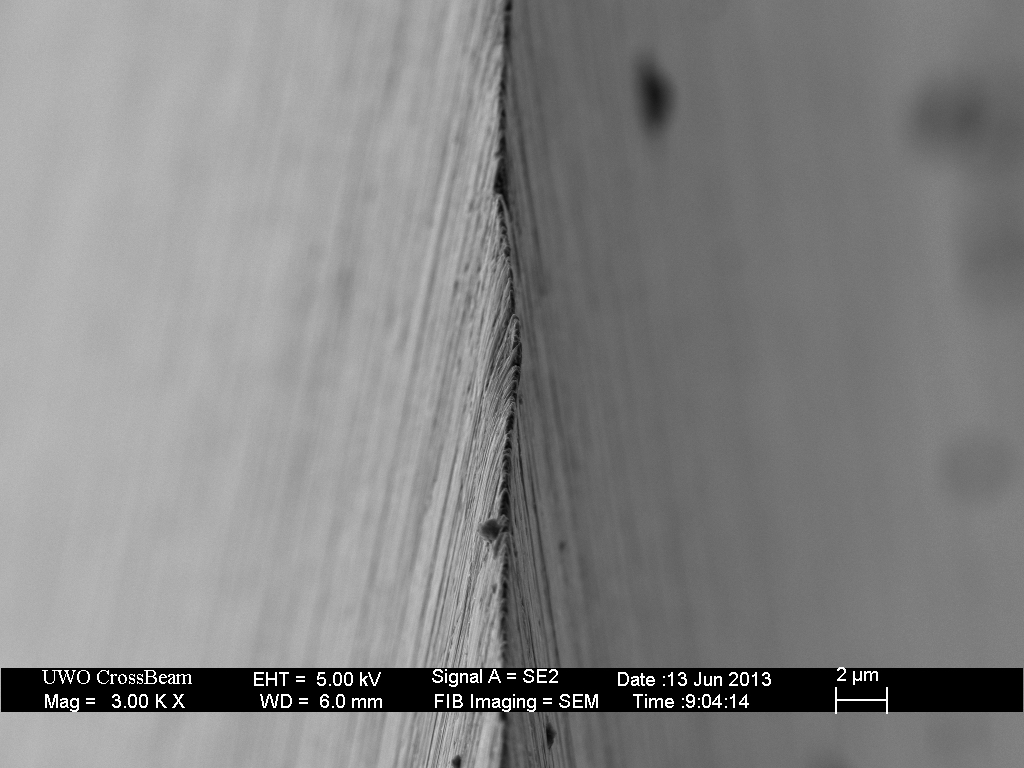 “Straight razor edge view after Shapton Glass 8k. Prior to stropping; the razor is not sufficiently keen to shave; however, there is no burr.”[/caption]
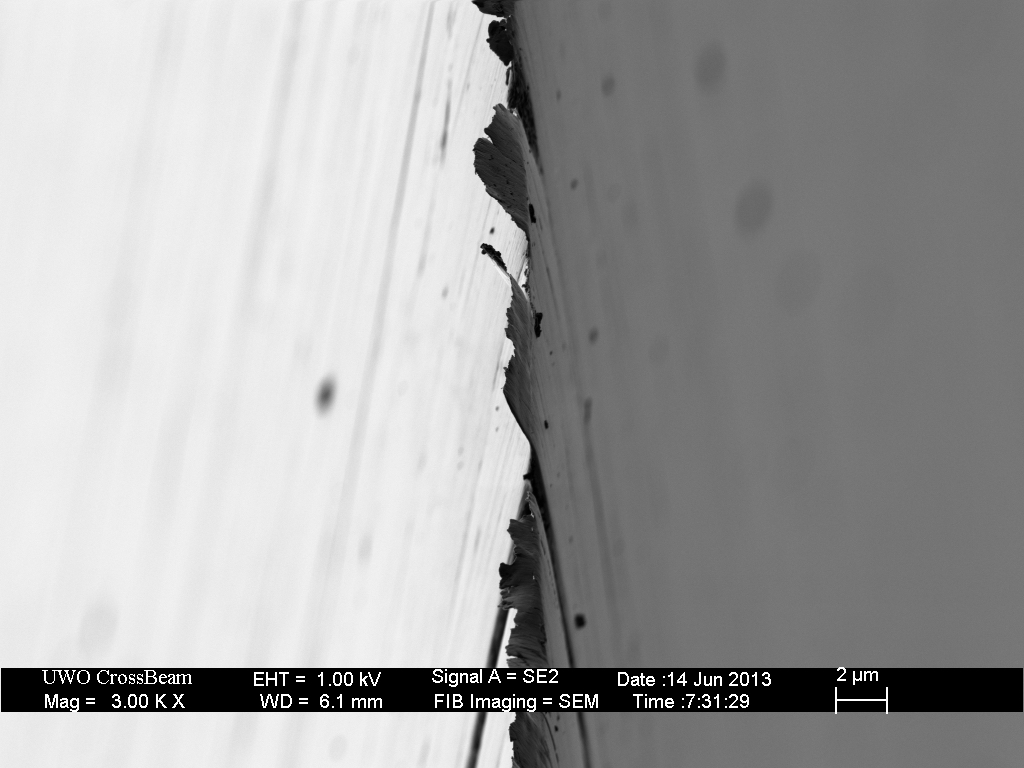 “Edge view of the Shapton 8k edge following 10 stropping laps on a hanging latigo leather strop loaded with 0.25 micron mono-diamond spray.”[/caption]
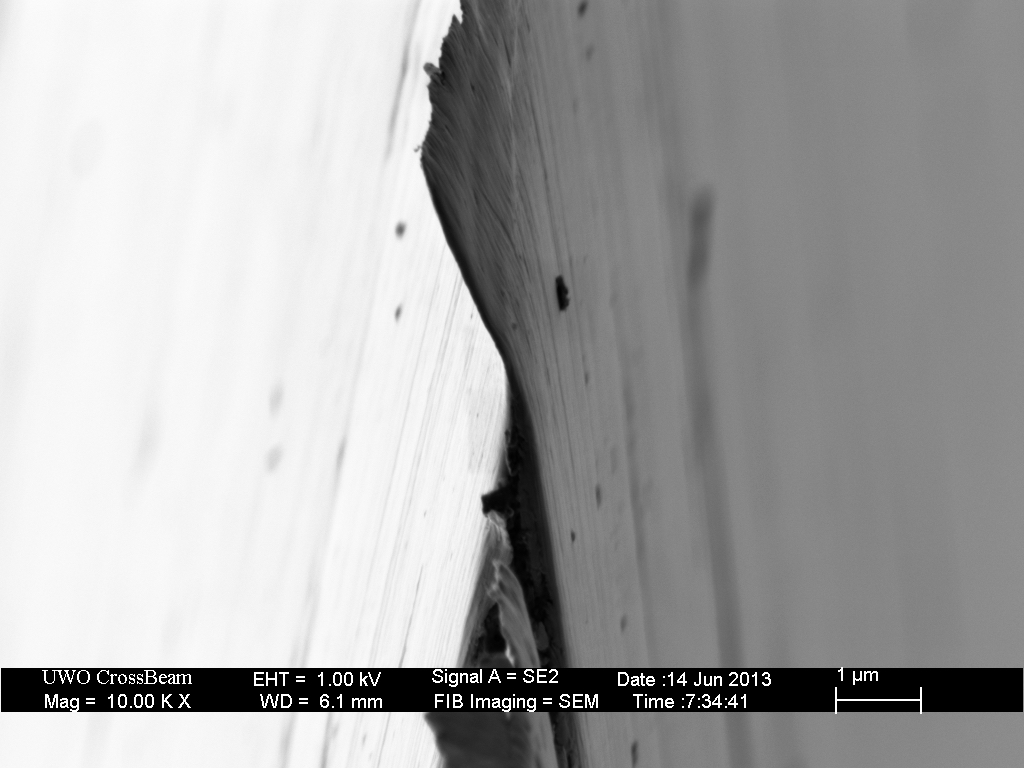 “Cross-section view of the Shapton 8k edge following 10 stropping laps on a latigo leather strop loaded with 0.25 micron mono-diamond spray. The foil-like burr is approximately 100nm thick and 3 microns long.”[/caption]
 “Cross-section of the edge after an additional 90 laps (total 100) on 0.25 micron mono-diamond on a hanging Latigo leather strop. The foil-like burr is approximately 20nm thick and 500nm long.”[/caption]