I think in the end, what is sharp, will have to be defined by the end user? When Clay made the sharp edge tester I made one at the same time. We both where running the same test on different edges.
As memory serves me we both came up with a 800 diamond stropped by 14/10 balsa gave the sharpest cut. The problem we found was the test only push cut and the medium to keep it standardized is 3m scotch tape.
Unfortunately the scale does not give real world data? It boiled down to the most “tooth” you can put on the edge is the best push cut.
A 10K chosera edge will not push cut as well as 10um balsa stop. So we are right back to where we started from. You can shave with a 10K chosera, but you can not cut tomatoes, bell peppers, ect. Take the same blade sharpen to 800 diamond, strop with 14/10um and it will cut through the veggies like there not even there!
So the answer in my opinion is the standard answer that Ken Schwartz or Tom Blodgett will tell you “it depends?”
If a list of the best knife sharpeners exist? I think you are going to find Ken Schwartz name in the top ten living knife sharpeners. He has answered with Tom on this forum many a time with " it depends?"
Maybe we will get lucky and the both of them will see this thread and chime in? I will send PM’s to both and ask that they might add there .02?
All this talk about sharping!!! Time to hit the WE and time to experiment!! Thanks again gentlemen !!
Great topic, great comments! I think the ultimate definition for sharp begins with edge thickness because effective cutting starts with rupturing the surface of a material. A thinner blade means more concentrated force at the point of contact. There is a physical limit as to how thin an edge can be with steel. I believe it is around .4 microns when the steel has a very fine grain structure. Steels with larger grains cannot reach such a narrow edge thickness. Glass and obsidian can be fractured to much thinner widths. Having micro-teeth is another way to concentrate force at the point of contact such that the knife can still initiate a surface rupture even when it has a larger edge width. Once the surface has been ruptured, other factors like blade geometry come into play. As LeoNav points out, a thick blade with wide shoulders will quickly bog down inside of a cut, creating friction and requiring more force to keep cutting. Thinning and rounding the shoulders helps. I’ve noticed that I can get a knife with a super polished edge to do quite well with tomatoes and such as long as the blade is thin and I’ve sharpened the cutting bevel to a pretty low angle. My thicker blades don’t do as well with a higher polish - they slide right off of zip ties and tomato skins. Thin knives that are highly polished can start a nice cut into a zip tie but don’t have the strength to cut all the way through without significant edge damage.
That clarifies some questions one that I am not totally clear on is is a toothy blade more suitable for softer steels like European knives where as harder steels are possible likely to chip ; then also a polished edge on soft steel is possible more likely to roll would I be correct in this assumption?
I read and have refined most of my Japanese chef knives to 3-5K but as Eamon points out a western chef knife will be perceived as wickedly sharp at 600-800 grit.
My best Japanese chef knife an Honyaki Nakira is refined to 16K and slices well .
The deeper we go the more confusing it is .
Then it also struck me is to have a polished bevel with a more toothy bevel so I had a play on some cheap knives and combined a flat bevel asymmetric with a convex more polished bevel the results you can see below I need to play around a bit more and maybe polish the convex side a little more it is polished at the edge since the convex was steeper at the edge and polished that with 5K the other side is 1K
it seems to cut quite well but I have just done it quickly.

Clay, You are the Master!! :woohoo:
I am not a metallurgist and there is an awful lot of technical material to read on the subject; but for instance if I shear a piece of steel would I be correct in the assumption that the bigger the grain- crystalline structure the lower the quality of the steel ?
If this a correct assumption then I see why if the blade on a cheap steel is over refined the edge will soon be lost and a toothy edge with big grains will wear better since the grains breaking away will suit that toothy edge.
A superior steel will support a more refined edge since if pieces brake off the edge they will be so much finer that the edge will endure a not flatten or round as with a cheap knife.
If someone knows more about this I would love to know and I could be wrong in my current understanding perhaps Clay or Anthony could clarify this I am trying to understand the suitable grits for different steels for knives that are used for general purpose in the kitchen or even EDC.
As said in a previous posting I said my forged Honyaki Nakira seems to work well with maximum edge refinement .
Here’s an example of edge geometry from my recent experience. I just thinned down several blades for a home chef… They should perform much better now! It went from around .040" thick to about .010". Even though you can’t really see the bevel in the last pic 


Josh
[quote quote=“razoredgeknives” post=16531]…It went from around .040" thick to about .010". …
Josh[/quote]
Very nice.
Just wondering… do you (and others?) put the micrometer on every blade?
They should work beautifully for slicing not on crusty bread though they could roll on that .
What make is the western handled Japanese parer ?
I think the important instruments are the mark1 eye ball and the fingers just pinch a blade near the edge to tell what it is good for or whether it needs thinning I imagine Josh has given these measurements to pre-empt the questions that many would like to know.
I firmly believe that it is important to rely on touch and sight as much as possible the more it is used the more useful it becomes I find even with lines or nuts & bolts the more I estimate them the less time is needed and the better the estimation becomes.
Even looking at bevels can be reasonable accurate at least to be able to say if it is
10,15 or a little under 20˚ or under 10˚.
I do of course set bevels on the WE using the Angle cube but it is handy to be able to judge the bevels by sight.
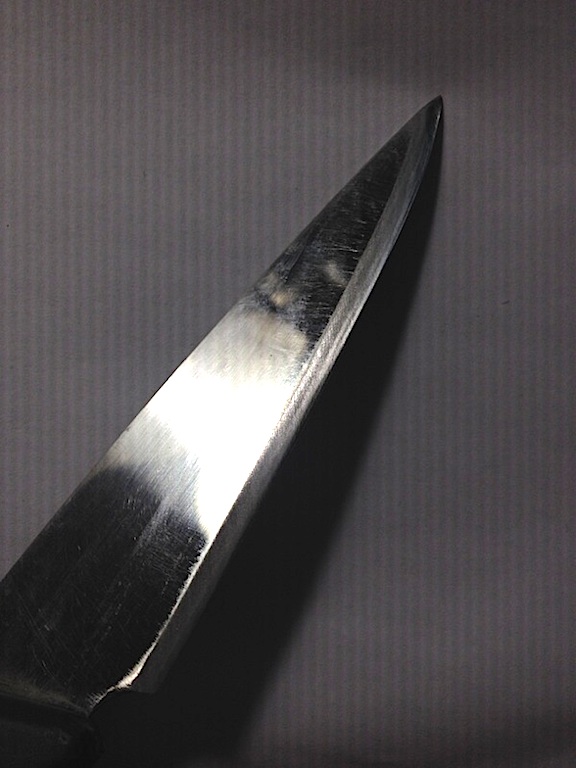
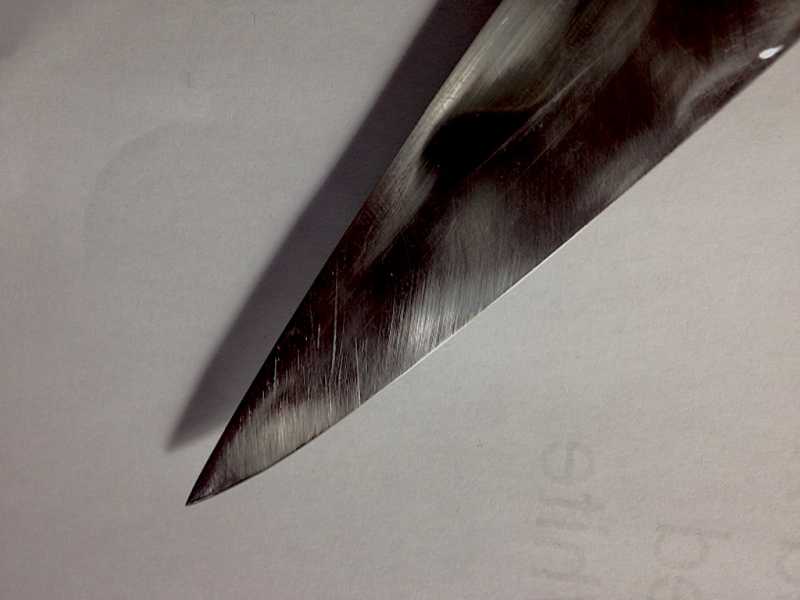
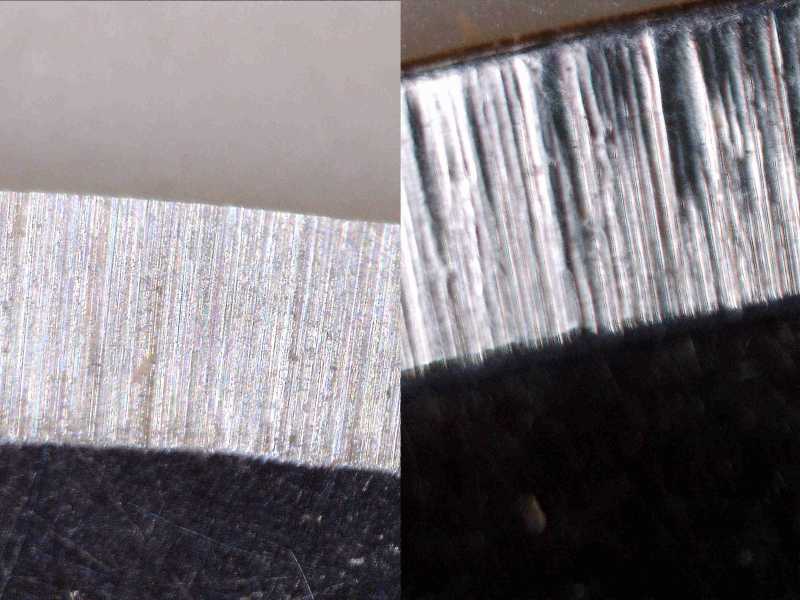
As mentioned earlier, I bought a box of scalpels from Amazon. I was just curious as to what made them so sharp. These blades only cost about 13 cents each, so I doubt if they’re the best available. Given the subject of this thread, I thought I’d share the photos with you.
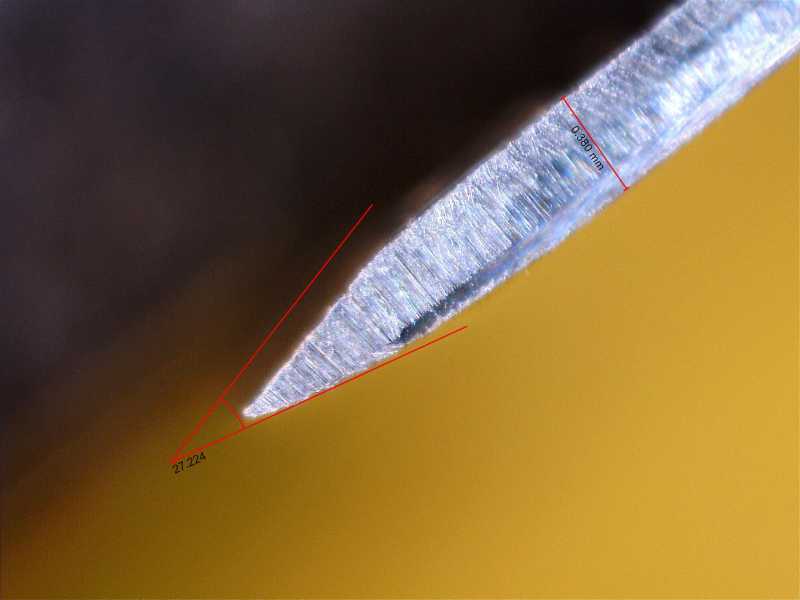
The blades are 0.015" thick and the single bevels are ground to an included angle of about 27 degrees. (An earlier disposable scalpel I’d gotten from a dentist friend was 0.040" thick and ground off-center to an included angle of 30 degrees.)
The first photo shows side-by-side sections of the scalpel as viewed from both sides. Both sides seem to be ground with about an 800 grit. You can see that one side is polished and the other side is not.
You’ll see in the second photo, which shows a cross-section of the blade, that the polished side has rolled what amounts to a heavy burr to the unpolished side.
When testing the blade on my thumbnail, it was immediately apparent that the blade would bite with the burr facing down. When it was facing up, I had to raise the angle quite a bit to get a bite.
After using my Wicked Edge system for a couple of years, I have to say that I’m not all that impressed by the “sharpness” of scalpels.
Here’s a “heads up.” Tonight, (late Thursday night) I watched an episode of “How It’s Made” on the Science Channel (DIRECTV CH284). They had an interesting clip on the manufacturing of Solingen straight razors.
They distinctly showed how the primary hollow-grind is done, but didn’t show how the secondary bevel was done. The secondary bevel was quite wide, somewhere between 6 and 8mm. Anytime you see a very wide bevel, it’s either a very acute angle or a very thick blade. They showed how thin the blade was along the edge by pressing it (flat side) against a wide metal ring the person was wearing. You could clearly see the edge flexing as the blade was pressed against the ring. They suggested that the edge approached the thickness of foil.
No doubt. Extremely thin blades with extremely acute secondary bevel angles make for extremely sharp edges. Also no doubt that you’ll have to have a high quality steel which will support that kind of geometry.
If you want to see this episode, it is being rebroadcast at 2:30AM CST Saturday morning on the Science Channel (DIRECTV SCIHD 284). If you have the Science Channel on your local cable service, check the listing
If you don’t have DVR service, we need to have a personal talk.
Solingen’s best steels are excellent. When I was 15 I bought a Solingen Bowie Knife for the princely sum of $9.95 at Lefevre’s Sports Shop in North Bay. Actually that was big money then, but I came back from Cadet Camp at Ipperwash with $20 dollars in my pocket. I put this knife through hell trying to get down the technique of throwing it overhand and underhand from 10 feet. Oh my! The bone handle eventually cracked, but that blade remained sharp and undaunted until one day it struck a nail in the wooden extension of my Dad’s old garage and it ricocheted and bounced off a boulder. The tip broke and the edge was a mess. Good steel that Solingen knife.
As for my Dad’s garage extension which was added to accommodate our new 1950 Chevy, it was so weakened by my efforts it had to be rebuilt and there went my other 10 dollars from Cadet camp. I also got the rest of the summer working at my father’s restaurant doing dishes and carrying pop cases and ice from the back to keep the Coke cooler full. Bad Leo!!
Leo
[quote quote=“tcmeyer” post=16562]
If you want to see this episode, it is being rebroadcast at 2:30AM CST Saturday morning on the Science Channel (DIRECTV SCIHD 284). If you have the Science Channel on your local cable service, check the listing.
If you don’t have DVR service, we need to have a personal talk.[/quote]
Or…
[quote quote=“GibCurry” post=16541][quote quote=“razoredgeknives” post=16531]…It went from around .040" thick to about .010". …
Josh[/quote]
Very nice.
Just wondering… do you (and others?) put the micrometer on every blade?[/quote]
Actually, I didn’t measure these at all (I forgot) but I know what .010" looks like
Josh
[quote quote=“LeoBarr” post=16542]They should work beautifully for slicing not on crusty bread though they could roll on that .
What make is the western handled Japanese parer ?[/quote]
Why would they roll on bread more than hitting a cutting board repeatedly when cutting vegetables? Just curious
I’m not sure… A name I hadn’t heard of before, I ground it off lol
I got feedback from my customer though! He loves them
Josh
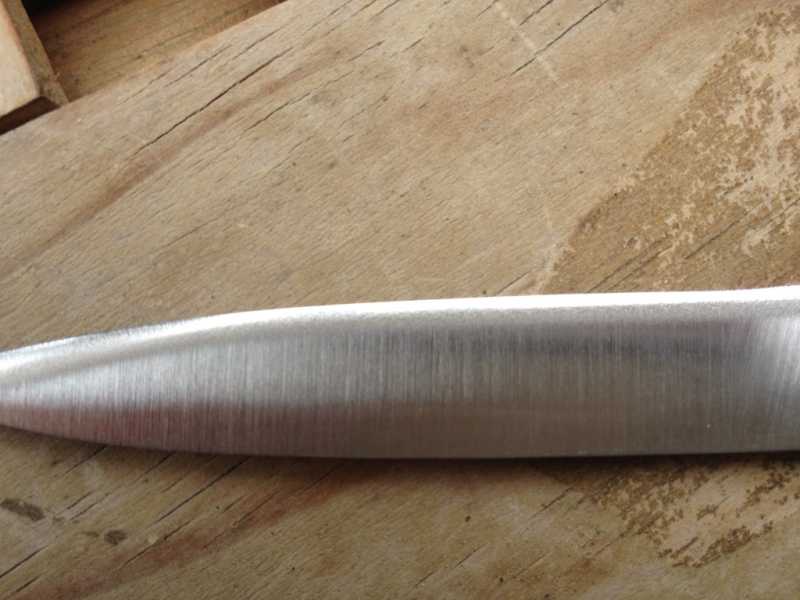
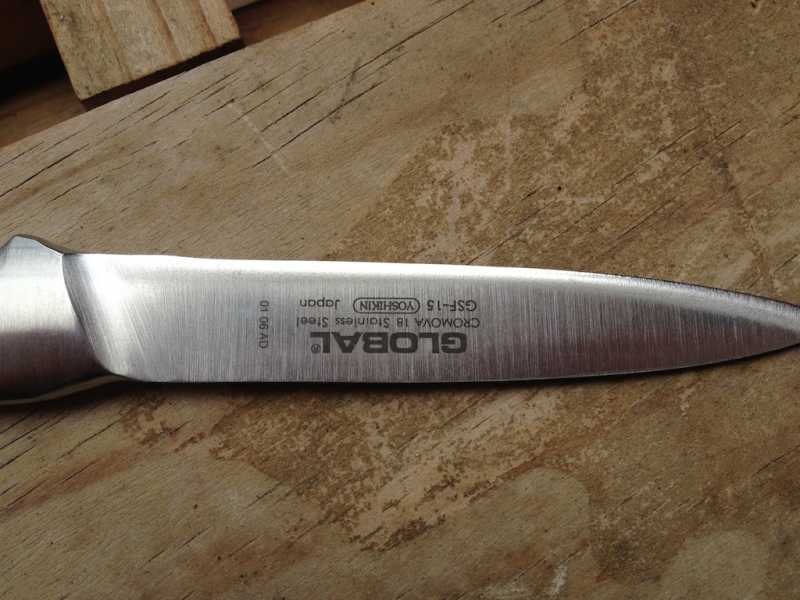
I thought I would share this I bought this little Global peeler I reckon it is sharpened with sub 400 grit and polished off a little on a leather belt it is quite handy for what is a sharp knife and what is adequate refinement for a low level Japanese knife or a high level European knife. Note it is a convex edge 10-15˚. I have sharpened lots of Globals but not seen how they are out the factory it supports Eamon’s observations not refining the edge too far.
The magnified view is 400X with a Veho.
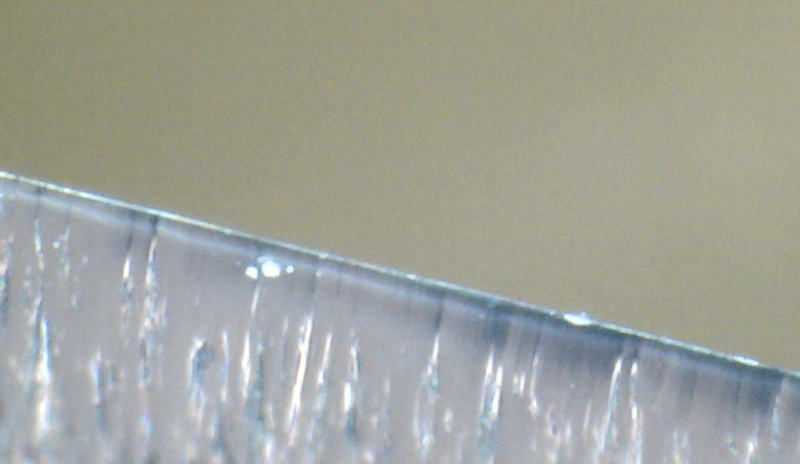
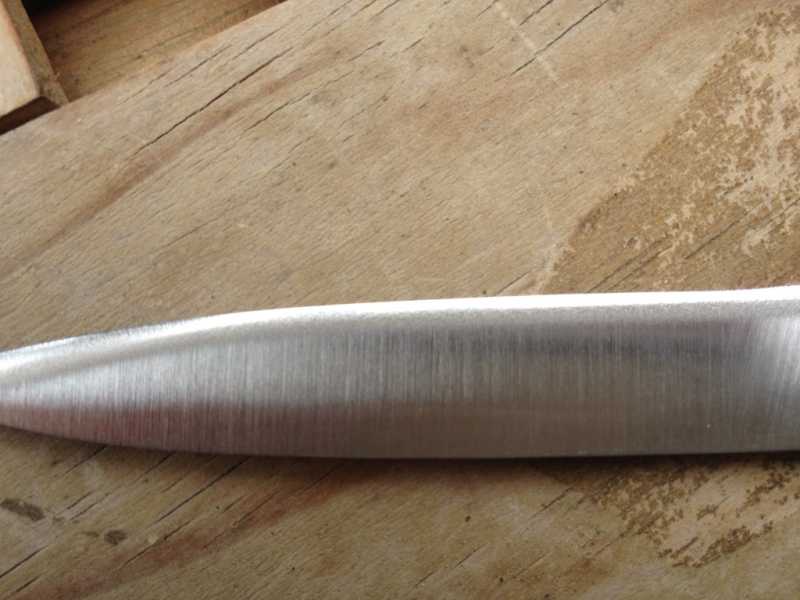
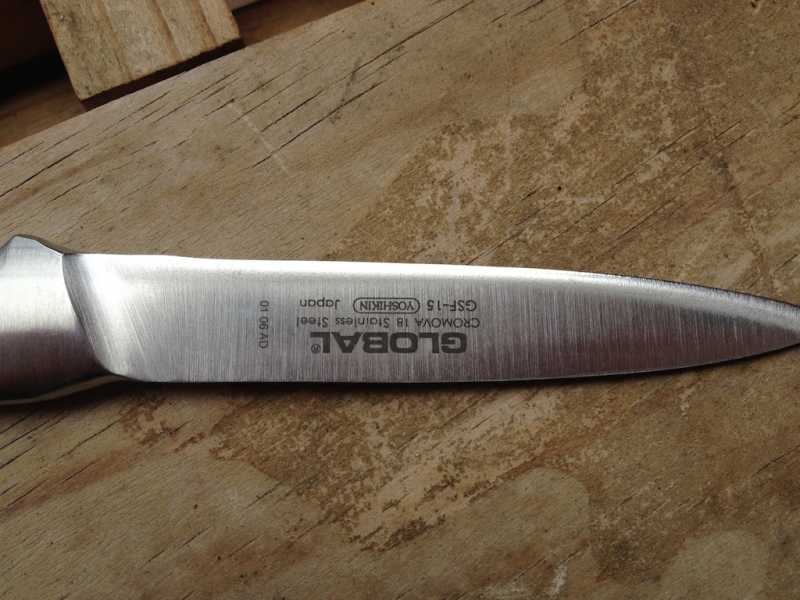
I thought I would share this I bought this little Global peeler I reckon it is sharpened with sub 400 grit and polished off a little on a leather belt it is quite handy for what is a sharp knife and what is adequate refinement for a low level Japanese knife or a high level European knife. Note it is a convex edge 10-15˚. I have sharpened lots of Globals but not seen how they are out the factory it supports Eamon’s observations not refining the edge too far.
The magnified view is 400X with a Veho.
I read somewhere recently that some rather crusty bread rolled a knife the board is less likely to since the crust of the bread was probable unevenly hard where as the board is an even hardness & it is more likely that a larger part of the knife hits the board.
They looked really good.