I did my first touch up on the WE and had to start a thread on it. I haven’t seen any discussion at all on this. There is a lot of talk about first time sharpening, setting the vice, getting the bevels correct, etc, etc… I was actually quite nervous about doing my fist touch up (putting a knife back in the vice for a 2nd time). Why? I spend so much time on the first setup that I doubted if I could put it back exactly the same way without having to re-grind. Mods - maybe you can find the right location for this.
Let’s end the suspense - I am beyond impressed with my results! :woohoo:
Background - The knife was a brand new Benchmade LE Mini Griptilian with CPM M4 Steel. I had just sharpened it weeks ago to 17.5 per side to 5k Choseras. Very nice results, super edge. This knife is a EDC but not a beater. I was opening an envelope and the knife slipped and the tip hit the granite countertop. It caused a slight roll on the edge just near the tip. First I tried hand stropping, no luck. Next I tried hand sharpening on a fine ceramic stone, just trying to straighten the rolled section out. I got the roll to move back and forth, but couldn’t get it out. Finally I loaded it up in the WE. I timed myself and it only took 10 minutes to get setup. This includes getting the setting the vice, setting the angle, taping the blade and other setup. (I actually spent more time taping up than setting the vice and angles). I started with 1k Choseras. 2 passes and the roll was gone. Spent about 30 minutes going through stones from 1k to 5k. Then some time with 5u and 3.5u strops. I was surprised that the 1k Chosera did not scratch up my mirror finish. My re-setting of the knife was perfect. I should have used a marker to verify, but I didn’t. I just made 2 passes and the feel of the stone was spot on. I did check with a loupe and everything was going well. In the end it was huge relief to restore the edge with minimal work and not having to start from the beginning with 100# diamonds.
What advice can I give - what did I learn?
[ul]
[li]You MUST use the WE knife database! This is the most important key. Putting knife back in the vice is easier than I thought if you know the original settings - but you MUST know those original settings. I also keep my own spread with these settings.[/li]
[li]The flat part of the edge was set parallel to the vice (as opposed to at an angle), so this was easy to clamp in the same way.[/li]
[li]That’s about all I have, hopefully others can add their tips. I would say just trust the WE. It is easier than I thought to put a knife back in just the same way as the first time.[/li]
[/ul]
I must also say I have never had such an easy touch up. Before I got m WEPS I tried to “maintain” sharp edges by hand stropping. Otherwise when a knife went dull it was pretty much a “full” re-sharpening required. I haven’t really gotten my knives dull yet (except for a kitchen knife) because the initial edge I get from the WE is just so much better than anything I had before. So go for it and don’t be afraid about ruining that perfect edge you got the first time. The 2nd time is even easier. :woohoo:
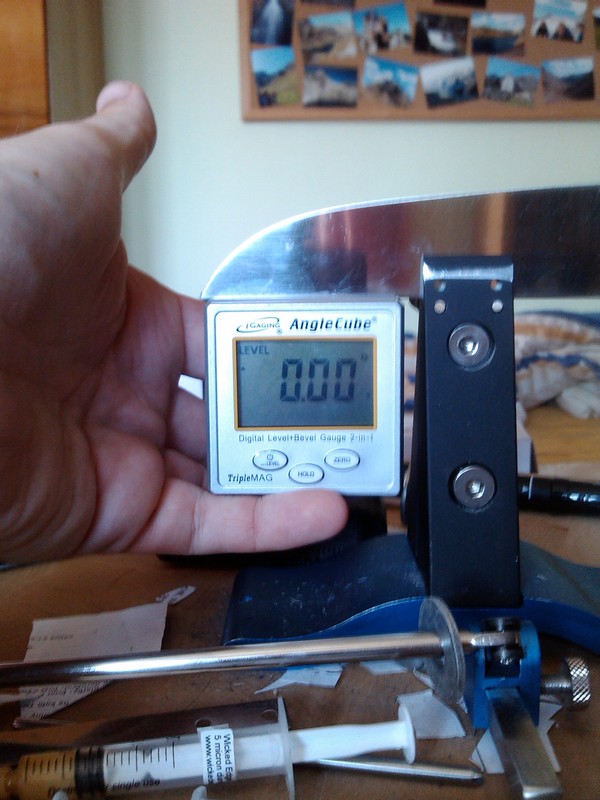
Thank you for sharing Geo. Do you have unsatisfactory results with hand stropping? I use steeling for Victorinox chefs knife (56 HRC stainless) and it works quite well. I need do this often, but i takes only part of the minute, much less than setting the WEPS. WEPS I use only once a time for bigger touch ups. I start with 1k diamonds usually. For harder steels I haven’t final process yet, still experimenting. Writing down your setting are crucial for touch ups with weps. For vertical alligment of the knife, I use the Angle Cube - it is simple when the knife has straight spine.
Clay’s “About Us” pageIf you read , it was one of the key concepts for creating the WE…
… and you should watch him do it… he’ll whip a knife in and out several times, especially when taking 'scope pics, and he’s so consistent he’ll hit the same spot every time. The more consistent in how you set up a knife, the easier to repeat. But you and Lukas are right, when sharpening and using a knife for a while, recording the setup is key.
Lukas, Great idea to use the angle gage to measure knife angle. You may want to start a tread on something like “knife angle placement”. There has been discussion about before about what angle to use, straight or offset. This method would be really key. I will start using it as I have to work real hard just to “eye-ball” it to get it parallel.
Stropping works well for me for general dulling from normal use. This case here I had fairly serious damage, not so bad to trash the blade or need a full re-grind, but way past what stropping would fix.
I also steel my kitchen knives. It works, it is fast. But I can also tell they still get duller and have to be sharpened eventually.
Yeah, Geo, using angle gauge improved my touch ups siginificantly. But in case of small pocket knives, it is difficult to attach angle gauge consistently. I remember discussion you mentioned. If you decide to use offset, using angle gauge is even more helpful to reproduce knife position quickly. For control I like to use small handy microscope over marker. I don’t only see if I am working on entire bevels, but also see possible minor damages requiring more strokes before proceeding to finer grids/stropping.
It seems that we have similar experiences with steeling. Can you tell your experiences with steeling vs hand stropping? In which cases do you prefere one over another?
What sort of steels do you use and are you using them to realign the edge?
There are polished stainless steel rods that are not too destructive and then there are various levels of grooved steels that can be harsh on the blade.
Then there are diamond steels that can take quite a lot steel away and then there are ceramic steels that are often between 1200-1600 grit.
If you have softer Western steel knives with fairly steep bevels and are used to chop a lot and generally see a lot of abuse then a steel is probable worthwhile.
If you are using Japanese knives then possible a couple of gentle run overs with a ceramic hone will realign the blade although hopefully they would not be misused only slice cutting so the blade should not roll so I would just hone it on some newspaper or a leather strop before it is put away since steel is precious.
I have noticed that Japanese chefs seem to use a chopping board more as a table but things like fruit and some vegetables are cut in the hand so the knives do not touch the cutting boards as much as we use them so once again the knives are not pounded into cutting boards nearly as much.
In general I do not like steels especially when perhaps you have put a bevel accurate to 0.1Ëš a steel is probable one of the most difficult things to maintain the bevel achieved on the WE especially since they are quite narrow in section.(not so bad on a steep angle but very destructive on a shallow angle).
Hi Leo, I agree that coarse grooved steel is harsh on the blade. I use polished or smoothly grooved steel. No experience with diamond/ceramic steels, i don’t like that they take the metal off.
But polished/smoothly grooved stainless steels works fine for me in case of softer Western kitchen knives. You dont need to put a bevel accurate to 0.1°. I don’t want to remove any metal, just straighten the edge which is bend from usage. Using light pressure is important.
For hard Japanese knives steeling don’t seem such effective. Their edges probably bend less or different. Stropping with WE seems better for me. But it takes some time to set up WE.
I like steeling for my Western kitchen knives for its speed. I have steel in my kitchen at hand, so I can steel my knife in seconds before/during cooking.
It sounds like you know how to steel so many don’t and end up with a hollow near the heel of the blade
, the ceramic hone steels are actually very good since they are smooth although for Western knives steel is probable best funnily enough rod rigging from yachts is perfect if you know any riggers who have replaced some rod rigging since it is smooth which is perfect to realign the blade without removing steel I havn’t seen many smooth steels otherwise.
Here is a poor photo done quickly on the phone with the rod rigging & a 1200 grit ceramic steel.
I only steel my kitchen knives, which are all Western. My steel has slight groove, but not severe. I have a ceramic rod, shorter and thinner than the one in your photo. I use it occasionally to sharpen kitchen knifes. I can then them a little sharper, but it is far from ideal. I have “crock sticks” but don’t use them any more. (Crock sticks are what I call ceramic rods that come with wood base and pre-set angles). I rounded a few tips off knifes on ceramic rods before I realized what I was doing.
Leo, what do you mean by "hollow’ at the heel of the blade?
Now that I have experienced how quick and easy touch ups on the WEPS are I will start touching up my kitchen knives more often. I still steel every use or so. I now just have 4 kitchen I use on a regular basis so that is not so many to sharpen - a chef’s knife, a santuko, and 2 pairing knives.
A lot of people who steel overzealously start near the heel of the knife which also means they exert maximum pressure there so the knife gets worn most at this point which means that if the edge is laid flat on a board there will be an area of the knife that does not touch the board which renders that part of the knife useless .
Often it is best to virtually ignore this part of the blade when using a steel and to be careful even when sharpening since to remove the hollow necessitates re-profiling almost two thirds of the knife.
Did a touch up today, a little more than just a “touch up” though.
Resharpened a Benchmade Ritter Mini Grip in S30V. I felt sharp to the finger tips, but no longer carved up phone book or receipt paper.
Clamped it in the vice, pretty quick, looked up my settings and about 30 seconds to get it clamped in. This has always been the one part I disliked at about the WEPS was how much time I have to spend setting up a new knife, getting the position just right, finding the sweet spot, etc.
However, once you do it the first time all future set ups are a breeze.
I “distressed” the edge by rubbing an old ceramic stick on the edge with moderate pressure for 5 stokes. I could feel a burr (edge roll) after doing this.
Next I started with 800# diamonds. I didn’t think I was making progress so dropped down to 600’s. These started cutting steel right away. Then 800, 1000 diamonds. Then 400 -> 1000 Choseras. After the 400 chosera it was really sharp. When I was done it was scary sharp to the touch. I don’t remember it being this sharp the first time. I ran 5m strops in leather and balsa and that was it. Didn’t feel like spending time on a heavy user EDC to go through all of the Choseras and strops.
If you think the WEPS is amazing on the first sharpening you haven’t seen anything until to sharpen a knife for the 2nd time. It is just so easy and efficient. I like sharpening on the WEPS. Sometimes I just want to get a knife sharp and back in use.
[quote quote=“Geocyclist” post=16035]
Next I started with 800# diamonds. I didn’t think I was making progress so dropped down to 600’s. These started cutting steel right away. Then 800, 1000 diamonds. Then 400 -> 1000 Choseras. After the 400 chosera it was really sharp. When I was done it was scary sharp to the touch. I don’t remember it being this sharp the first time. I ran 5m strops in leather and balsa and that was it. Didn’t feel like spending time on a heavy user EDC to go through all of the Choseras and strop[/quote]
Geo,
I’m really curious as to your reason behind your progression? (I swear I’m not being a smart ass) Whey start at 800/1000 then drop back to 400 chosera? The reason I ask is a lot of times (lets say I want mirror?) I will work up to 1000 diamond then transition to chosera 800 or mostly 1000 chosera and up from there? Are you cleaning up the edge to recreate the burr? Curious??? Always looking to learn a new trick.
Thank you, Eamon
Mike your not butting in here? We are all friends. (I hope) Okay I have not tried to get more polish that way? But I’m going to give that a try tomorrow even if I have to dull a knife! :S
Eamon, somewhere I’ve read that you get a better polish when dropping to the lower grit water stones , and restarting a progression with them.
If my understanding is correct, the Choseras breakdown and release grit that inturn creates a polishing slurry and helps erase/polish the edge. Let the diamonds do the hard work, then come back with a lower grit waterstone and start polishing away the diamond scratches. More polish, and less work(I think) for a mirrored edge. Less wear and tear on the water stones.
Mike,
Thank you very much! Now that you have said that outloud I seem to faintly recall that myself??? I’m going to put it to the test latter today. :unsure: I’m sure you guys are right and it will turn out better! As a young man I had to learn everything by being beaten with a 2"X4". Now I like to listen and learn. :woohoo:
This has always been my progression - 1000# the 400 Choseras.
“I don’t always use Chosera’s, but when I do I always start with 400’s” Stay thirsty my friends. B)
I don’t have the grit specs here by memory.
What I have learned from experience is that the 400 Chosera’s are black (more than the other Choseras) after use. Visually the edge is definitely much more polished to the naked eye. I have a 10x lupe, but no scopes. I can’t say if the edge is more or less refined.
While I have never “mixed” stones in progression, I can say based on feel (stone feedback) and appearance that I would not want to go diamonds, chosera, back to diamonds, then more choseras.
For all the new guys out there the 2nd best thing about WEPS is being able to perfectly put a knife back in the WEPS and touch it up/sharpen again very easily. Once you get the hang of the WEPS, how to get a good edge and how to mount the blade then future touch ups/sharpening is a breeze. The only key is to keep records of how you mounted the knife first time. They WE knife data base is great for this: to keep your own records and give help to others.
I trashed an already sharp edge the other day by stripping the coating, forcing a patina, then doing it all over again. I had to start back at 200 diamonds to restore the edge, it was that bad. I put it back in the vice, same as before, took a minute to mount then a bit to work through the stones. The edge was exactly as before, no need to reprofile.
I spend tons of time sharpening the first time, to reprofile, get a mirror edge, etc. It is wonderful to be able to quickly restore an edge. Especially on hard use knives like the kitchen knives where I just want a sharp edge fast and don’t care about a mirror polish.