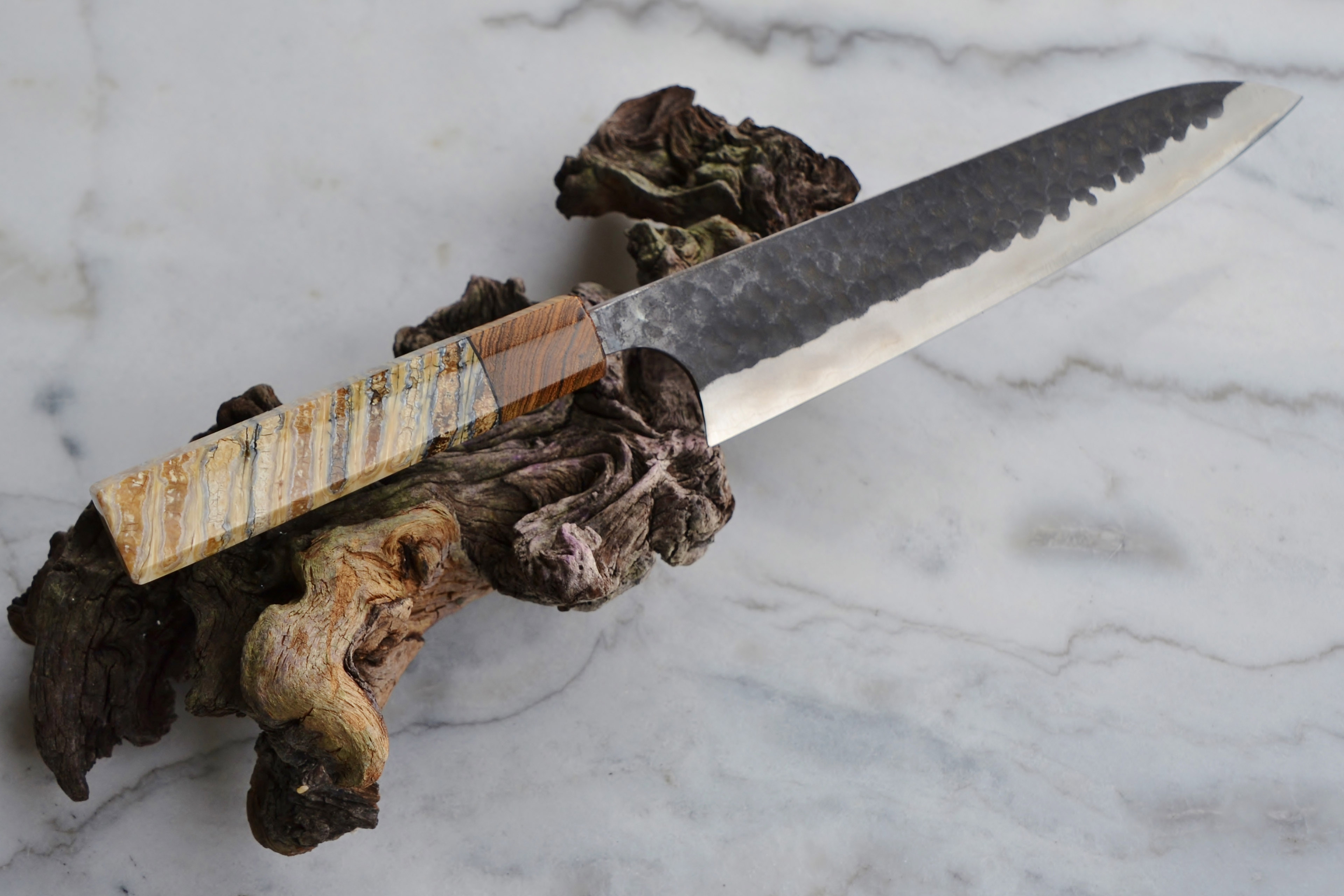
I am having trouble sharpening my super blue steel masakage koishi on the wicked edge, I am using the diamond stones 100 all the way to 1000 grit but it does not seem to be sharpening correctly.
half way down the blade the edge seems to get rough, looks like micro serrations,
It sounds to me that the coarse 100g stone may have chipped out the edge, which can happen on harder steels. It’s best to try not to go all the way to the edge with a coarse stone to prevent this.
Others may chime in who have specific experience, but my suggestion would be to just try and clean up the edge with the finest stone you have a bit more, and see if it smooths it out. Might take a little time, but you should see improvement as you progress.
I hesitate to recommend ceramics since I don’t have experience with that particular knife, but in general they will perform better at a finer finish, so it would probably result in a better edge overall.
Thanks for the replys! Yes maybe i chipped it with the 100 grit as I did make sure to make a Burr either side all the way along heel to tip with the 100 grit.
To answer a few questions to help figure out whats going on, Im using a angle cube set to 17 degrees either side. Im using the Pro pack one so its more like, 16.95 left and 16.85 on the other because i can’t fine fine the angle. The tip and the heel of the knife will easily slice paper but the middle section will not.
The knife is new ( 3 weeks old) reason I put it on the wicked edge is because I got a chip on the top and wanted rid of it which i did no problem.
I did scrub up and down a bit to help get a burr, I used the sharpie tip to see if the angle was around what I was doing it, i think its about right not too sure but i did reprofile as to get rid of the tip. unsure of how to use it to find where the position of the knife should be.
Has anyone any experience with this steel or any carbon steel? as im wondering are the stones suited for sharpening this kind of steel, i’ve only ever used it with stainless steel type knives and i’ve got some good results.
Congratulations on your knife choice! It’s a great kitchen knife. I happen to have it, too :
I think accidentally chipping the knife is the most likely diagnosis for your problem. Blue super steel can take a lot (also reasonably good toughness), but here it is very hard (HRC 64, according to Masakage). If it happens more often, you could start at 200 grit or 400 grit. But I’ve never had this problem even with hard carbon steels.
The diamond stones are suitable for any type of steel. I personally like the edges on my kitchen knives slightly more refined than 1000 grit, so I usually use the ceramics after the diamond stones. And you may want to try an even more acute angle on this knife. The steel can take it.
The fact that you sense the roughness of the edge is the clue that you are indeed producing serrations in the edge with the coarse grits that you are not removing with the normal progression.
I only use my 100/200 stones on a reprofile, and then as cbwz34 says, try to never touch the apex with them. As a grit particle approaches the edge, it reaches a point where the strength of the steel to resist cutting suddenly drops off. At this point, a chunk substantially larger than the depth of the scratch may break off, leaving a deep notch in the edge.
I find that when I go on to the 400s, it takes a lot of work to clean up the edge. After that, each grit goes pretty fast. On 90% of the knives I do, I start with my 400s, so I wear out my 400/600s faster than any other grits. It may take 50 strokes on the 400s to form a good bevel and to smooth out the edge, but only 10 strokes on each grit thereafter.
Really appricate all the replies guys. Mark76 yes it’s a fantastic knife, very happy with out of the box edge and feel of the knife. What’s angle do you have yours set to?? Do you know the masakage factory angle?
I am going to try wit the same angle but just start at 400 and work up to 1000 grit. Will let ye know how it goes and maybe get some pics up.
Also going to buy and 1200 /1600 grit soon, what grit are the next ceramic stones as I only see coarse and fine printed on them? Are they much more refined than the 1200/1600?
Anyone any experience with Japanese waterstones for the WE, overkill for kitchen knives?
I wanted to take some time and provide a visual reference for what Tom was talking about regarding taking the coarse stones all the way to the edge when you’re reprofiling. Here is an image of a blade I prepared at 16° per side and then added a 20° micro-bevel, then stropped it at 16° down to .5µ:
In the above image, the edge is very clean and straight. Next I started sharpening with a used set of 100# diamonds and slowly approached the edge. Because I’d put in a micro-bevel, I could sharpen at 16° and know that I would not be hitting the edge right away. Here are some shots of the process at 2000#:
It’s interesting to see the scratch lines approaching the edge and the edge starting to deform even before the scratches make it all the way. I checked the other side of the blade to be sure that the scratches there weren’t making it to the edge early and causing the deformation. Nope, they were about the same as the first side.
Overall, the edge leading strokes leave the edge looking cleaner. There are still big chunks gone, but there is less bending and twisting. This little study is hardly conclusive though; I didn’t rebuild the edge and start with a clean slate before switching from trailing to leading strokes and I didn’t control for pressure or any other variables. Still, our sharpness testing results also indicate a slight advantage to edge leading strokes when finishing a knife. Normally I’ll use trailing strokes when progressing through the grits and then switch to leading strokes at the very end when I’m finalizing the edge.
Very good and interesting pics, Clay, that show well what the 100 grit stones do to the edge.
An interesting additional question in this case would be (since the OP might have sufferred from chips that could not be removed by the 200 grit stones): will the 200 grit stones (and then the 400, 600, …) clean up this “damage”?
Great demo, Clay. It would be interesting to me so see how much work would be needed to remove this damage when you go from 200 to 400, as it is from my experience the most difficult transition. And the one most likely to leave an edge with rough spots - especially where the operator doesn’t have a microscope or other visual aid.
From my experience, it can take a hundred strokes with the 400’s to clean up a 200-grit edge, but (I’m repeating myself) only 10 strokes with each grit thereafter. It took me a long time (more than two years) to break in my 100/200s because I was so reluctant to use them.
I’m focusing on this because it seemed to be the root of Darragh O’Flaherty’s rough edge problem. Maybe we could come up with a device or technique to help in deciding when the rough edge is gone - that it’s time to move on to the 600s.
Just out of curiosity, I once tried to sharpen a ceramic knife with my 400s. After hundreds of strokes and no apparent change, I finally gave up and switched to my 200s. In a single stroke, it was as if the edge exploded. Huge chips popped off and it was clear that the 400s would take many, many hours and possibly never repair the damage. I tossed it in the trash and was happy to be rid of it. Not the first $30 experiment that I’ve trashed.
I was just on the Woodcraft web site and see that they are now selling Wicked Edge stuff. Good to see that the word is getting out there!
 :
: