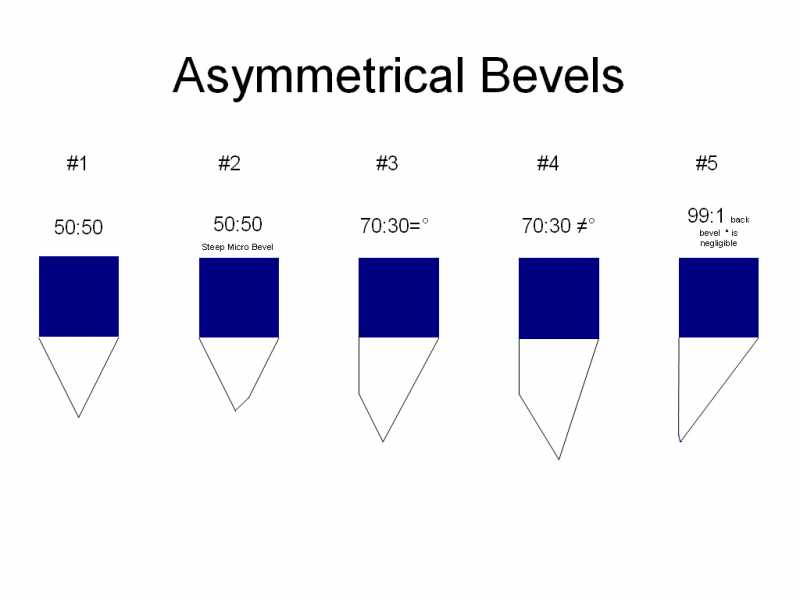
Click on pdf to open
Attachments:
Click on pdf to open
Leo,
Thank you’d for sharing this. I’ve tried to understand the breakdown of bevel ratios and how it dictates the angles I set for each side of the blade.
50/50 is a no-brainer. 15dps. Easy.
80/20…
70/30…
Etc…
???
…Is there a formula?
Thanks in advance!
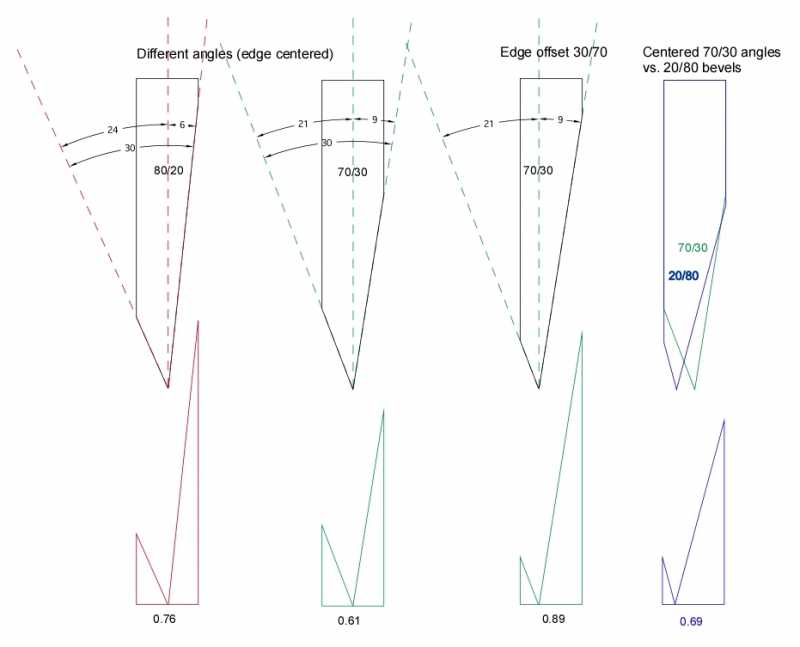
As i understand it the bevel ratios relate to the ratio of the bevel width compared to the other, what I have not tried is to draw it in degrees on paper to check whether the degrees as a percentage will produce the same result as the ratio of bevel ratios..
I was a able to calculate the degrees by working on an assumed total of the two sides then dividing it by 100 to represent 1˚then multiplying by the ration for each side so- say total of 30˚is 0.3˚ for 1˚ so say 70-30 will be 0.3 X 70% = 21˚ & 30 - 0.3 x3 0% = 9˚.
I have posted this as I understand it to be there may well be a better formula but firstly most quality Japanese knives are asymmetric but are sharpened by setting the ratios by eye so that two knives with the same asymmetry may well not have absolutely the same bevels but using the WE or some others angle system like the Edge Pro it is possible to set these bevels accurately . "We all know that most factory bevels even when 50/50 are rarely exact since often they are not set using controlled angles .
T|ime and time again on this forum people discover claimed factory angle and actual angle are often not the same.
I hope this is helpful.
The formula and example you provided are EXACTLY what I was hoping for! Although I was incorrect in what I was referring to, your wisdom and knowledge allowed you to see past my error in order to provide the relevant information. For that, I am grateful.
Thank you, good sir!
There is a correction due here the 70/30 say is 21˚ & 9˚ the 9˚ will be on the right side producing a wider bevel & the 21˚ would produce a smaller bevel for the left side.
So the 70/30 for a right hander is correct for bevel proportions !!!
But opposite in proportion as far as degrees are concerned SINCE LOWER DEGREES WILL PRODUCE A WIDER BEVEL.So when referring to ratios of bevel widths which is the normal method it has to be reversed when using degrees.
I hope this is not overly confusing it should not be to a knife sharpener particularly a WE user we see why bevel width is achieved through the choice of angles.
Gotcha!
And, no, it’s not overly confusing. Like anything math related, in order for one to FULLY understand, one MUST apply the formula to a real world application; which in our case is cutlery. Oooooh, yeah B)
Just saw this.
Much obliged Leo, good info.
Been running into asymmetrical Japanese knives and have been duplicating the bevels on them, but suspected they were off as the owners tried their own sharpening at times.
Always felt things were off and adjusted as best seemed to fit when they said it was 90/10 and such.
Good reference, Thank You.
zig
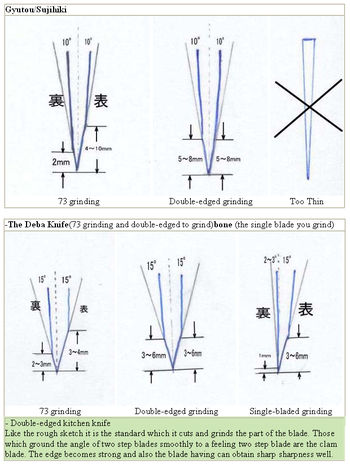
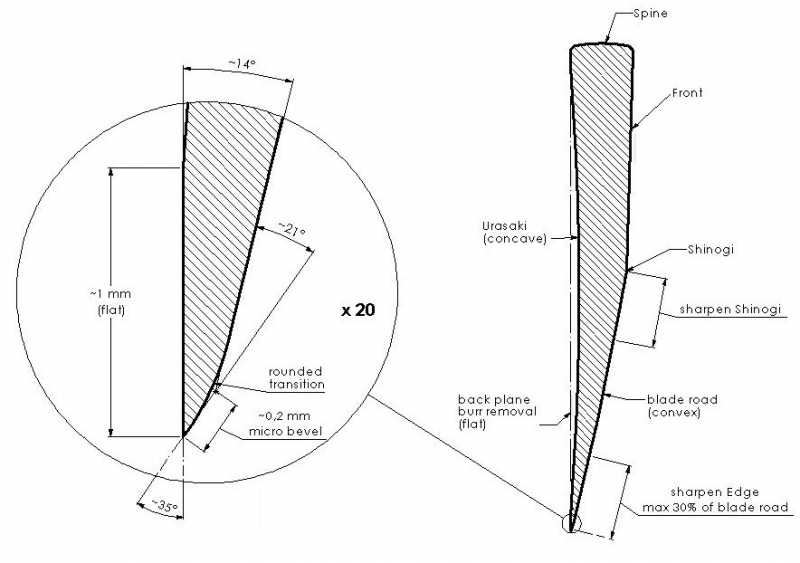
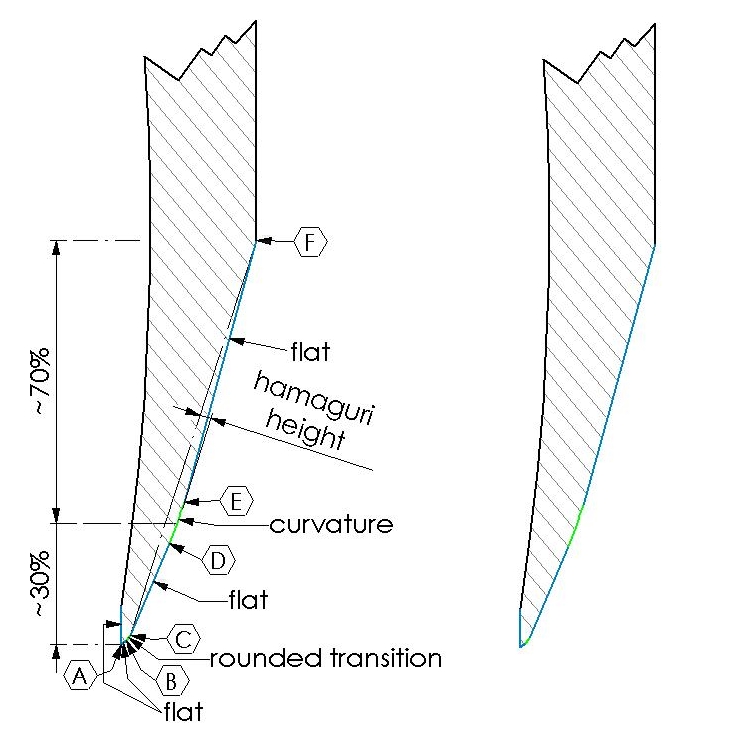
These visuals are helping me understand asymmetry the more I look at them and apply the formula Leo provided.
Hope it does the same for you!
Great diagrams where did you source them? The detail on the Deba or Yanagi with the curved transitions show how important it is to understand the correct shaping of the blade for optimum efficiency I do these freehand but there is no reason why they should not be done on the WE or an EP there are various notes on this site about how to produce convex bevels .
The Deba may also benefit by a micro bevel and a short length starting at the heel which is double beveled 50/50 since this is used to push cut through vertebrate so the edge is stronger for this purpose.
I searched Google images with the following keywords:
Asymmetrical knife edge geometry
Asymmetrical bevel geometry
Asymmetrical knife sharpening
I always look at Google images first for whatever I have in mind. If something catches my eye, I’ll then visit the page hoping to come across some good content…
I forgot to mention one thing in regards to the overall topic and the diagrams I provided - The more I use my WEPS, and delve deeper into the actual SCIENCE of knife sharpening, the more I realize it all hinges around a micro scale of the edge itself.
… If that makes any sense?
Perhaps someone more qualified can chime in and elaborate. (Fingers crossed!!)
The way I determine the asymmetry I would like is first understand the inclusive angle I want, then side with the shallowest (lowest) angle will be a lower percentage of the total inclusive angle, then just subtract that angle from the inclusive and you’re there.
Example: If I want a 40 degrees inclusive angle, 50/50 is 20dps. If i want a chisel grind bevel, then one side is 30 degrees, the other zero. All others would be in between these.
Sorry if this is just repeating what was already discussed.
Very Interesting pictures Thanks!
Now for the Dummy here learning about knife geometry. Why?
And I ask this in the sense of why would you want to have the asymmetrical bevels in kitchen knifes? Now they are Right handed and Left handed..
What do these different asymmetrical bevels bring to the table…heh..pun kinda intended..
I always thought you would want the sharp part of the blade centered over the spine and equal on both sides so when you cut the blade does not wander and it helps you to cut straight. All these asymmetrical stuff seemed just to be a way to make something cool and different..
On EDC knives like folders and such I sometimes see it also..extreme example is the Emerson edges where they say it makes keeping it sharp in the field easier..and yer safety razor blades to shave with are made this way..it is the best in some peoples opinion. I have no clue what is hype or function or just made to be cool and different..
EVERY knife I have ever tried to sharpen and just follow the factory angles…sometimes just to help make the sharpening process faster..they are never equal. I just associated that with them all being hand done on belt sanders. But I wondered if some of the higher end knifes it was done on purpose..
On the knifes I care to take time on and all of my knifes I have been making the bevels equal. Maybe I am messing some of them up eh?
After all that…really I am wondering if there is a real legitimate reason to have these asymmetrical grinds in the kitchen or in my pocket..I totally understand for wood working and specific stuff.
[quote quote=“Zamfir” post=20612]Very Interesting pictures Thanks!
Now for the Dummy here learning about knife geometry. Why?
And I ask this in the sense of why would you want to have the asymmetrical bevels in kitchen knifes? /quote]
In my opinion - It comes down to waste. I’m thinking in terms of breaking down fish product yields, precision, control, etc.
The edge geometry selected depends on the knife’s use, metal, etc…
For instance, chisels utilized for woodwork are edged using a geometry that enhances the ability to…well…chisel. Kitchen knives are edged typically using a thinner blade stock and shallow (low angle) geometry in order to quickly slice through raw and cooked food. EDC knives are a middle ground typically to handle a variety of tasks.
There are differing theories as to what is the best geometry for the same particular task. For example, you will find a lot of military/survival knives come with an equi-angle geometry (50/50 bevel); however, Grayman’s fixed blades most often come with a chisel bevel (not so much a chisel grind, but the edge is chisel anyways). You will find when cutting through material or wood, this blade will begin to curve a particular direction as material is moved over the angled side. Some find this helpful…others don’t.
They all have benefits and drawbacks…again, depends upon use. The study of the purpose of particular edge geometries is key to this…then and only then do you understand when to use what. After that, getting the geometry on your blade will be much easier to accomplish.
I think the reason most quality Japanese knives for cooking are asymmetric is firstly the harder steels will support lower angles so this allows for very low angles that will give a sharper edge the steep angle on the opposite side is to give strength to the edge .
These blades may well have a centreline that is not vertical but trails off to the left or right depending whether it is for a left or right handed user.
If these knives are not sharpened correctly they will not track properly when cutting. It should be understood that in general these knives are more specific in their applications and been made of harder steels they are unsuitable to sloppy wham bam use.
Certain edc knives may benefit from asymmetric edges say for feather sticking to dressing meat in the field. virtuovice prepares many of his Bark River knives in this way refer to his you tube channel .
Asymmetric knives come from the obvious such as a Yanagi or a Deba whereas Guyutous or other knives may range from 60/40-80/20 in short when sharpening unknown Japanese knives they require careful inspection as most except the pop knives like Shun / Global / Mac are not symmetrical.
A double bevelled knife parts the flesh even like a wedge a single or say asymmetric knife applies pressure more to one side the side which is not held this does considerable less pressure damage to the food both raw fish or food like fruit is not bruised resulting in less cell damage therefore a better flavour crushed celsl rot quickly which will not be pleasant with sashimi and even an apple hacked with a blunt knife or bruised with a broad double bevel knife will discolour more rapidly.
So, I can see for a sushi restaurant where they have a big piece of fish, and they are cutting off pieces for a serving and saving the rest for later. I am guessing for a right handed person the bevel would be on the left or the wider bevel? If a chisel grind, the only bevel on the left when holding the knife. This would then cause the damage to the piece being cut off and eaten quickly and it preserves the larger piece from extra cell damage? Is this what you are talking about?
The bevel with the wide bevel is on the right side as you look down from the spine for a right handed person so this half wedge pushes on the part of the fish or fruit or whatever is not been held so there is minimum pressure damage since it is purely pushing it away from the main body as it is liberated by the cut hence minimal damage since the flat or concave side is exerting very little pressure3 on the main body which is held.
The less the food is damaged the better the flavour even if the food is then cooked.
A piece of steak cut with such a knife prior to cooking will hold in the flavour much more than a damaged slice of steak.This is why there are left and right sided single bevel knives for left or right handed people the slopped side is always on the opposite side to the main body of that which is been sliced.
That makes sense. Interesting. Thanks!