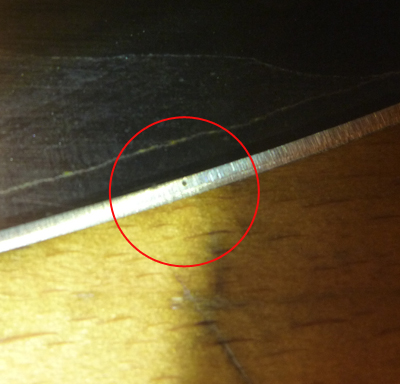
I know I’ve been blathering about chips in Shuns and my theory that it is bubbles in the VG-10 or interior metal itself.
Finally took a pic, crappy but you get the idea.
Edge was all chipped, stripped it down and in process of rebuilding the edge.
Low and behold, as metal gets taken off, these holes start to show up and enlarge.
Here is a shot of 1, there are several on this chef’s knife.
Its my belief that as the edge wears, the holes in the metal are exposed and then form a chip.
Any thoughts?
Yepper Josh. You can poke a pin in it and wobble it.
They are the beginnings of a larger hole, than smaller if you grind through.
They appear as chips on the edge, but I think are actually air pockets exposed through wear at the apex.
Once opened, they turn into chips.
This problem has been 90% consistent with the VG-10 as well as the Kai series for me.
If not for close inspection, it just feels like a tiny bump on a paperpush, or a snag.
yeah that’s really weird ziggy… i have never experienced that myself and I have tested several blades. I will try to get some pics w/ my usb scope on the next few I do. What magnification level is that?
No Clue, just used my small pocket panasonic I use for fishing and zoomed in all the way and held a flashlight to it
I was in the middle of knocking out the batch and wanted a quick shot, get them done, bagged and tagged.
Didn’t want to break out the SLR Macro gear and flash.
It is really small to catch while sharpening … glasses and good lighting gives them away.
I’d say about 6 are on the one side alone.
I’ve seen the same on Globals, not much you can do, I don’t want to eat all that VG-10 to get to it, it’ll only expose more.
Next time you get a set, slide the edge of a razor over the edge, you’ll feel them right away, than see them is your eyes are good.
I just rip the edge off once spotted and reprofile.
If I can get to 1K without a chip on the edge I’m happy, customer is happy
Than give it a polish.
First, I would like to congratulate you on the experimentation, few people go that far, most would have just wrote off the steel and/or brand, nice detective work.
I have seen that commonly on heavily used knives, especially knives used in salt water as it is pitting damage and can be present even when it isn’t visible - but there are usually signs of it on the main blade.
What you have isn’t like corrosion as you would have seen evidence of it on the blade I would imagine. There are things which can cause the same problems in steel, non metallic inclusions for example.
Chips are there 90% of the time, especially the Kai line.
I knew there were chips, this and other holes were exposed during reprofile.
They start out in the wall small, then larger, then smaller as you take away more metal, so am thinking air pocket of sorts.
That new steel so you’re not looking at pitting.
Funny thing too, this batch was fatigued at the edge.
I flattened till I hit rockhard, then started the reprofile.
Bur was flaking off … in actual flakes until I hit hard steel.
Someone also had a grinder to these before, not super bad, and even grind, but too high up the sidewall. Line was pretty well set, so I’m not thinking freehand on a wheel.
More like 2 wheels making a hollow grind set in depth.
I always see a correlation to those types of grind and fatigue.
Oh, this was at maybe 200 grit, before next steps.
If there was a power grinder used then there are many things which could be causing the problem related to very high heat and possible non-stainless contamination. It could be nothing more than burnishing/welding of non-stainless steel which then rusts out.
Have you seen it on knives which were not power sharpened?
yepper,
even seen it if I was the first one to sharpen them.
goin back now about 3 years I’ve been catching these.
the grinders i think kill the steel and cause the fatigue I think but not the internal air pockets, just my guess.
Very much like when you get a beat up serrated knife and the scallops never stop dropping burs until you’re well into them, same feeling.
Caphalon makes a line identical to the Kai, guessing same manufacturer (Kershaw?), just a retread.
Same exact problems with pockets.
I would be interested in checking with Clay to see if you could send it to him and he could get some pics at 800x or 1600x and maybe that would clue us in more…
Ok… so yesterday I was sharpening some KitchenAid knives on my belt sander.
I noticed that the edge kept chipping out on a few of them, no matter how much I “destressed” the edge! So finally I just finished them… but when I was looking with the naked eye I could see little inclusions in the edge, so I snapped a few photos.
This is what they look like further down the bevel:
And this is what they look like at the very edge:
Very strange indeed… it’s like they didn’t use clean steel when starting??
Quick update.
Today got a few fairly new Wusthof Classic Ikons, already hard honed down to nothing so no chance trying to get the original angle. Nice Knives BTW, very ergo in the hand, solid German feel. Sad that they are getting beat up with the steel so fast, but that’s another story.
Anyway, gave the customer a call, note said he had questions on honing.
After talking, (yeah, he was honing the heck on a ribbed steel at unknown angles, usual stuff) mentioned he had more knives to sharpen, new customer.
Said one he wants to send in is a Shun Santuko, fairly new.
Asked him, “is it VG-10 and do you notice any chips on it”? … yep and yep.
Said it has seen barely any use, just soft veggies, and they thought it odd to have chips and that they did something to it somehow.
Aside the hard honing, his knives are in stellar shape, well taken care of.
Long story short, he’s bringing it back to Williams Sonoma.
Seems they still are pumping the same ol out.
Long term, sooner or later you’re gonna hit into the Damask cladding.
Wonder what happens then? … they have that high VG-10 polished exposed sidewall.
Wonder what thinning will to it
[quote quote=“razoredgeknives” post=18406]Ok… so yesterday I was sharpening some KitchenAid knives on my belt sander.
I noticed that the edge kept chipping out on a few of them, no matter how much I “destressed” the edge! So finally I just finished them… but when I was looking with the naked eye I could see little inclusions in the edge, so I snapped a few photos.
[/quote]
Quick question.
Did you try giving them a near perp pass and just take away the edge?
I do that a lot, can see what I call “fatigue” come off and feel it.
When I hit hard metal, thin it, reprofile, I can get a solid edge back.
During process near the end, I’ll debur and slice a catalog page slow … and catch those “soft” spots … if we are dealing with the same thing.
I then take the apex off, run through the steps, and most times can find a hard edge that holds.
Since I do usually hit paydirt eventually, I then chalk it up to weak metal from use.
Is that a possibility you think?
In my case, if dirty metal, than I’d have little chance of getting to some solid.
[quote quote=“zig” post=18419]
Yep, its common.[/quote]
Yep, it is. And it is really bad we cannot do much about it.
I have a Fallkniven A1 knife made of VG10. I regard Fallkniven very highly. But even this knife has a microchip.
What do you guys think of VG10 in general? There seems to be a kitchen knife brand (Hattori?) that has got their heat treatment right. But otherwise I hear (and experience) pretty bad stories of VG10.
[quote quote=“mark76” post=18428]
What do you guys think of VG10 in general? There seems to be a kitchen knife brand (Hattori?) that has got their heat treatment right. But otherwise I hear (and experience) pretty bad stories of VG10.[/quote]
I can appreciate its edge retention.
That said, I think it has its place in a worker capacity if its only air pockets and not cracks.
Give me a Camping Knife that I’m not worried about a small chip here or there when battening at a fair price and I’d be happy.
Heck, make an axe out of them.
Sell me a slick high end expensive dolled up piece with chips … no dice.