Hi everyone,
I’ve been absent for a while without good reason other than too many things on the go, including a good deal of knife buying, selling and trading. Much of that culminated with the acquisition of a Tom Mayo medium TNT with a Stellite 6K blade.
For those of you that haven’t had the privilege of handling one of Tom’s knives…do it if you ever have the chance. Over the years, I have had the chance to handle and use many, many hand made knives. I have never, ever encountered a hand made knife as precise or as beautifully finished as a Mayo. They fetch premium dollars, and I think they’re worth every penny.
One thing that Tom is well known for is his use of Stellite 6K for many of his blades. I think it could be argued that he’s used more of it for blades in the last 15 years or so than any other knife maker.
Stellite is an interesting alloy. It contains no steel, and is not magnetic. It’s made primarily of cobalt and chromium with small percentages of other elements. On a Rockwell scale, it’s soft, in the low to mid 40s. It’s not terribly sensitive to different heat treat methods, and it’s wear resistance is very high regardless of temperature.
I’ve wanted this knife for years. It’s beautiful to look at, it’s very functional art, and the stories of the longevity of an edge on 6K are almost legend. I wanted to own one, carry one, and see if everything I’d heard about this alloy were true.
When I received this knife, it had never been sharpened despite it having been through several owners and had been carried. It was still sharp, however it was more a working edge than anything.
I carried the knife for a while before deciding to sharpen it. There’s something intimidating about tackling an exotic alloy on a knife that you’ve invested a lot of money in. There’s very little available in the way of info on sharpening it, and contacting Tom Mayo didn’t improve that a lot. He sharpens by eye on the grinder, and other than saying the burr could be “troublesome”, couldn’t add a lot of knowledge to the process for me.
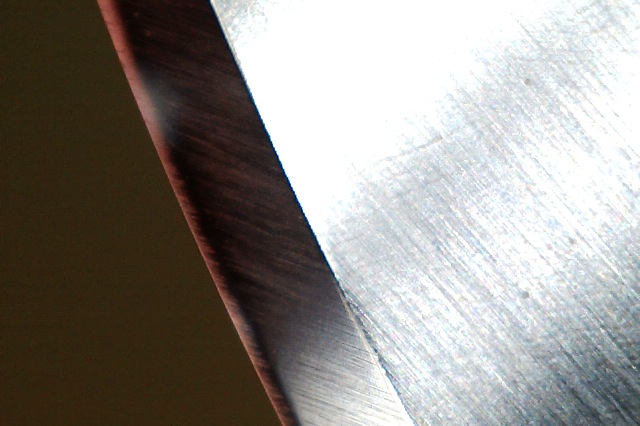
When I mounted the knife, it was sharpened to 24 degrees front and almost 23 degrees on the back. I decided that I would re-profile it to 22 degrees front and back, and set to it with the 100 grit stones.
It’s a strange material to work with. initially, there was none of the normal feel or sound of the stones actually doing anything. It took several strokes before the stone started cutting into the edge, and it developed a burr very quickly after that. It was at that point things got “interesting”
Once the burr was formed and the scratches were even along the edge, I switched sides, and the burr rolled to the other side very easily. I ran through 100 strokes and then began to sharpen both sides to eliminate the burr.
Not happening. After 100 strokes of sharpening, I had a really nicely formed, 44 degree inclusive edge, with a nicely formed, very even burr, running full length along the edge. I could not get that thing to break away, regardless of what I tried! Eventually, I just decided to progress through the stones a bit further and see what happened.
I proceeded up through the grits. after one full cycle up to 1000 grit, the burr was shrunken, but still present almost the entire length. I dropped back down to 200 grit and repeated the progression again…same basic result…at 1000 grit the burr had shrunken again, but was still present.
At the end of the afternoon, I have a VERY sharp Mayo TNT 6K. It took three complete progressions through the stones to 1000 grit to eliminate the burr, along with a good deal of “tinkering” at various times and points along the edge to get things balanced and keep them that way. Once sharp, I went on with strops and diamond paste down to 1 micron spray.
A few observations; I am ASTONISHED at how tenacious the burr on this edge was! If that is any indication of how well the edge lasts and wears, I will be VERY happy.
Stellite strops to a beautiful finish. I went for a fairly high shine since this is not a blade that’s going to be used for hacking at cable ties or sawing trough boxes. I have knives much better suited than this is.
Overall, it is a frustrating material to sharpen. The end results are great; the relative softness of the cobalt/chromium allows the scratches in the edge to polish out very nicely. I’m hoping I don’t have to do the whole thing too often though.