:woohoo:
Did I just miss a covert announcement? :mrgreen:
:woohoo:
Did I just miss a covert announcement? :mrgreen:
I just posted this to www.knifeforums.com, but I thought it would be of interest here as well:
About the company Coorstek that is mentioned as the manufacturer of ceramic stones for WEPS:
I believe Coorstek is a company that branched off of Coors, the beer company. It sounds weird, but years and years ago, Coors used to make ceramic tools, including ceramic hammers. Why a ceramic hammer? well, it’s for those applications where positively absolutely you cannot afford to generate a spark. If you work in the natural gas industry, or explosives, then you know why this is a good idea.
Metal hammers spark when you chip off a tiny tiny piece of iron, and it combusts (to form iron oxide; or rust). Many ceramics are metal-oxides, so well, they’re already burnt and cannot burn again! (Okay, not under “normal” situations.) The problem with this is, most ceramics are brittle, which is not good for a hammer. So the hammer is made of a special type of ceramic: transformation-toughened zirconia. This is the same ceramic used in almost all ceramic knives (Boker in addition to zirconia, also has some knives in other types of ceramics).
Want to know more about transformation-toughened zirconia? You can read about it in the awesomely wonderful book: Why Things Break by Mark. E. Eberhart.
http://www.amazon.com/Why-Things-Break-Understanding-World/dp/1400048834/ref=sr_1_1?ie=UTF8&qid=1336605192&sr=8-1
“Though Coors is well known as a brewer of beer, it is less well known as the world’s largest producer of specialty ceramics producs. This particular hammer was made from transformation-toughened zirconia, a polycrystalline material made from the oxide of zirconium.”
–Why Thinks Break by Eberhart (2004)
This snippet and more can be read from Google Books:
http://books.google.com/books?id=e6eVD2MDGLMC&pg=PT146&lpg=PT146&dq=coors+ceramic+hammer&source=bl&ots=gqH8n0Msxl&sig=TAM3oV4DP-Rv9WZqlFSc_Shj0rE&hl=en&sa=X&ei=RfaqT_jWLYTetgfbl6mUAQ&ved=0CHEQ6AEwAg#v=onepage&q=coors%20ceramic%20hammer&f=false
A picture of a Coors ceramic hammer:
http://ceramicsmuseum.alfred.edu/exhibitions/conspicuous/hammer.html

Isn’t that cool? Now go have a beer. 
Sincerely,
–Lagrangian
“What grit sharpens the mind?”
–Zen Sharpening Koan
That is so cool, thanks for sharing it!
I’m really excited about these stones. We don’t have a name for them yet or photos or prices. We’re sort of stuck on the name part because we already used Superfine Ceramic and these are finer than our current stones. They will be a great next step after current ones and will also be wonderful for maintaining a well polished knife.
:woohoo:
Did I just miss a covert announcement? :mrgreen:[/quote]
How about:
Microfine Ceramic Stones
-or-
Microgrit Ceramic Stones
And if you come out with an even finer line of stones, you could call them Nanofine or Nanogrit.
How about ultrafine, megafine and uberfine? :lol:
I like “megafine” !  It’s almost like saying something is “mega-small” or “hugely tiny”.
Yes the history of Coors Ceramics is fascinating, and a shining example of the kind of people and early entrepreneurs that ‘made America great’. It is so interesting a story that Coors themselves realize that people everywhere want to know more about it and have given a page on their web site to help tell you that story. Here is a link: http://www.coorstek.com/history.asp
If you follow the tracks in the yellow brick road the hobby of knives will take you to many interesting places, like the Coors example above shows so well. I was interested to see your reference to the explosives industry above. It is not well know to most knife makers and users, but the reason that they have in their hands high quality powder metallurgy steels is because of the explosives and solid rocket fuel industries need for high specification powdered metals. It is these high precision powdered metals that form the base material for the product of companies like Crucible and Bohler-Uddeholm. If it had not been for the need to develop these very pure and high quality powders for explosives and solid rocket fuels you might not now have the blades that you put into your WEPs for sharpening!
I’m thinking “atomic” for the ceramics :silly:
Roger, You did some great documentation! B)
I think steeling works for short term touching up because your overall geometry is still “sound”, despite the microbevel of the steeling itself, as you’ve shown.
Diamond steels and stones can be misleading, and tend to create what I call a false-positive for sharpness because the diamonds cut cleanly through the thickness of the knife’s edge, leaving a very clean, yet serrated edge that passes all kinds of sharpness tests, yet the edge of the edge itself is not thin enough to actually be as sharp as it seems. I see this all the time with straight razors passing the HHT at the 1K diamond level, and is the likely reason IMO to explain why the diamond steel edge failed the tomato slice test.
Hi BassLakeDan,
Wow neat! Thanks for that link on Coorstek history. I also did not know about the connection between rocket engine development and powdered metallurgy; also interesting!
[Off Topic] I can’t resist, so here is a small story from the space race:
I forget who was trying to spy on whom, but I think it was the Soviets spying on the British (could be wrong about this). Anyways, there was some kind of tour, or open-house for a (British?) jet-engine or rocket development factory. I think it was the Soviets, who, at that time, had trouble with their metallurgy for aerospace engines. So they sent a guy to the open-house. As a spy, his real mission was to get physical samples of secret high-tech metals. How? The bottom of his shoes were soft and sticky; as he walked around these picked up any tiny metal shavings which are everywhere in a metalshop. Afterwards, his shoes were sent off to a metallurgy lab.
I could’ve gotten wrong who spied on whom for this, and I forget if it was for rocket or jet engines, but the idea of sticky shoes always amused me.
Sincerely,
Lagrangian
I kind of like the “nmicrogrit” or maybe “microfine” that could be followed by a number indicating the grit size. as in Microfine 0.625. This would also cover any finer grades that may come later.
Phil
You guys are awesome! Thanks again for all the fascinating info and history. I love this forum, thanks for making it great!
Here’s a follow up on smooth steels.
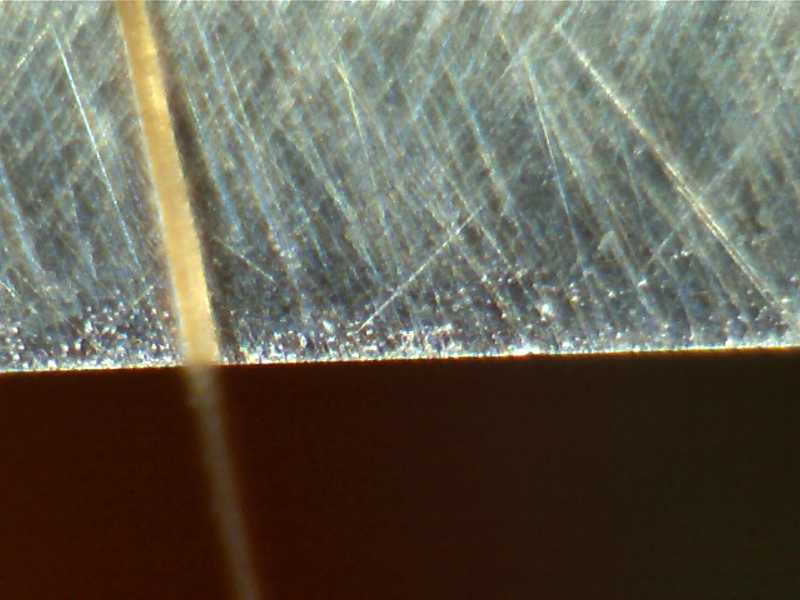
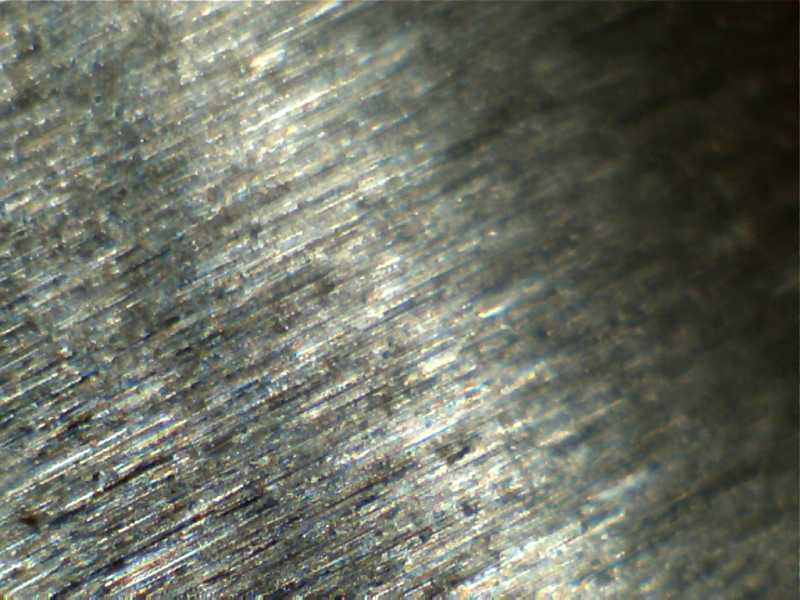
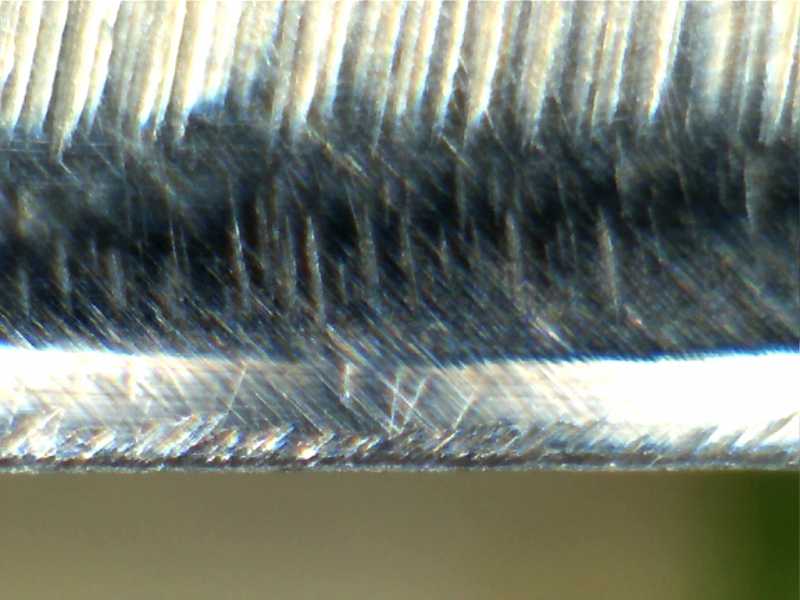
I received a Victorinox “smooth” steel, and tried it on a couple of knives. They immediately seemed duller ! A look at the steel even with the naked eye showed a substantial surface texture, with the texture running across the rod (instead of with it, as in a normal grooved steel). So out came the microscope.
Here’s a picture of a freshly honed blade, with a hair for reference:
Here’s a picture of the surface of the Victorinox “smooth” steel - same magnification as above
Here’'s the blade after a few light strokes with the “smooth” steel. Note the roughed-up edge. So disappointing !!!
Conclusion: If you’re looking for a smooth steel, this isn’t it ! I’ll return it and try a “F. Dick” steel, as PhilipPasteur mentioned in his post on this topic.
Great pictures. Objective evidence of what is going on with these steels is good stuff.
Remember, being a proud member of the sharpening OCD club, I took my “F. Dick” steel and put it on the buffer using 5 different grits and ending with red jewelers rouge before I used it. I am not sure this was required, but I was looking for a “mirror” finish, and I got it pretty darn close. In any case, I know it was much smoother than when I started!
One other thing I always think about is pressure when steeling. Because of the curvature of the steel, any force applied to the knife edge ends up being higher than you think when considered from the force per square area perspective. I think that a very light touch is the best way to steel. Of course you always hear , relative to stopping on leather, to not use much more than the weight of the blade for pressure. The same is not widely discussed with a steel, but I can’t see any reason not to use the same sort of technique. A light, smooth, consistent, touch has always gotten my best results when steeling.
I know that the people that do it are convinced that is works, but I would really like to see some micrographs of the blades afte steeled by one of these folks that do 120 strokes per minute… so fast your eye can’t follow the blade. I have an idea that it would not be pretty. It does look very impressive when they do it though
Phil
Thanks for the info on the Victorinox steel. I looked at that one on Amazon and almost bought it because I liked the black handle better than the F. Dick orange handle, but in the end went for the F. Dick instead. I figured this was a proven instrument, whereas there had been no information posted on the Victorinox. Very glad I bought the F. Dick!
I haven’t given the F. Dick steel a real test yet, and haven’t looked at it under magnification. I tried a few swipes of a blade that had been honed with a ceramic honing rod, which wasn’t a good test. But it alerted me to the fact that this steel is a little more difficult to work with than the ceramic honing rods I’ve been using. There’s no resistance at all, so it’s more difficult to keep the blade properly position and to keep the steep vertical. Then narrow point of the steel can slip on the counter, too, so you need to use a wooden cutting board or a piece of rubber underneath.
Although I haven’t confirmed it yet, I agree that a very light touch is the way to go with the F. Dick steel. If the edge has been properly prepared, I don’t think it’ll take much force to straighten out any rolls.
The pictures of the steeled edge at the beginning of this topic are pretty much what a moderately aggressive (grooved) steeling looks like. Once I get an F. Dick smooth steel I’ll do some analysis of light stroking with both smooth and grooved rods on lightly used blades and post the pics.
Ultimately, I’d like to find a way to do light touch up on the edge without butchering it to the point that I shouldn’t have bothered fine honing it first place. Then again, if you’re only going to hone a knife to 750 grit, then a quick flail with a grooved steel will give you a usable edge that won’t scare your guests.