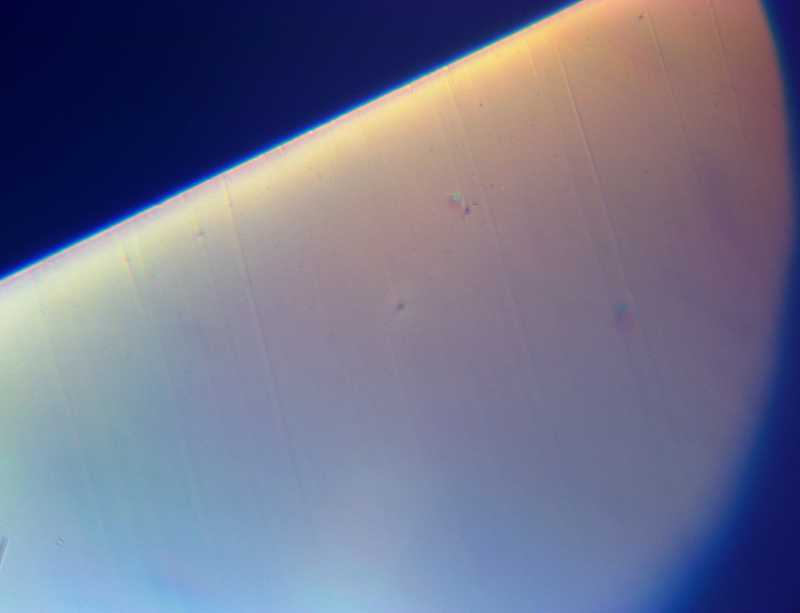
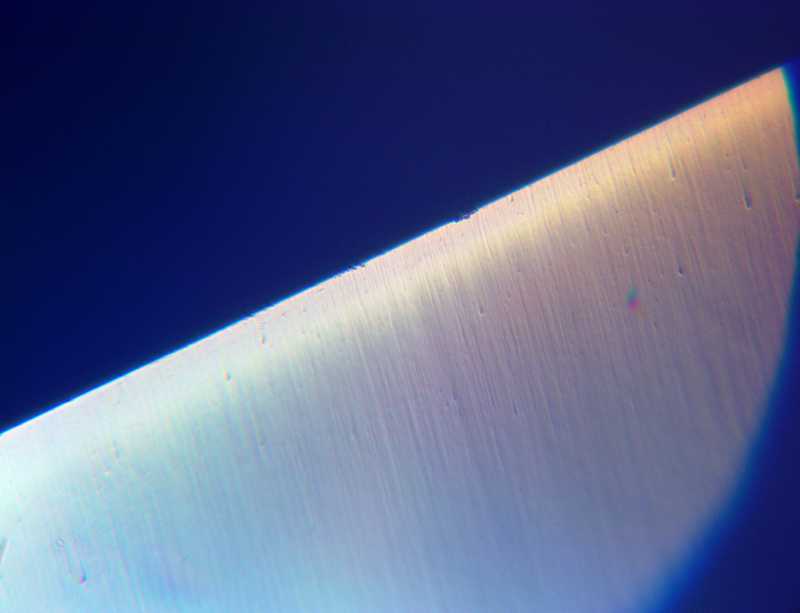
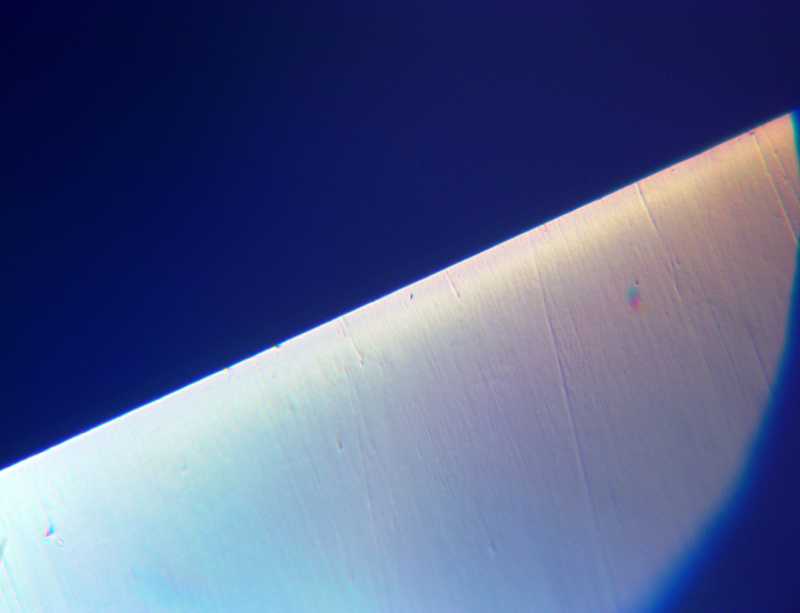
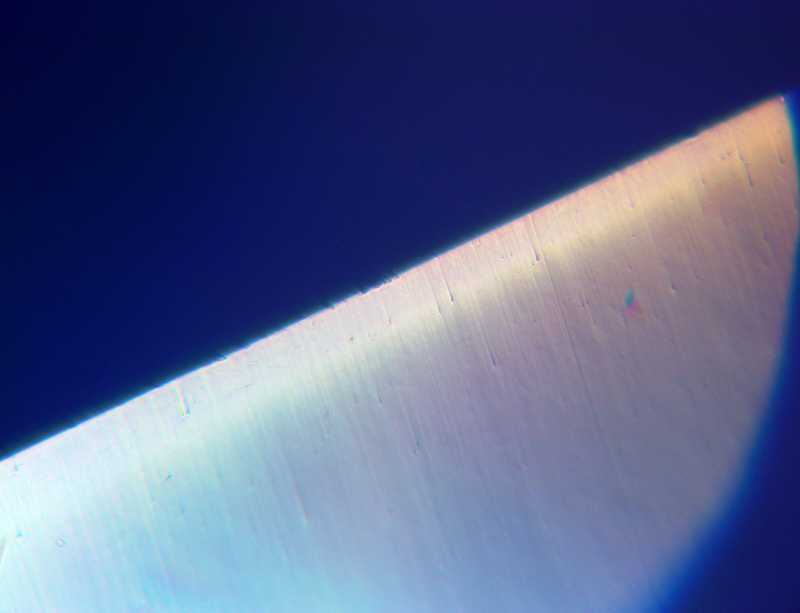
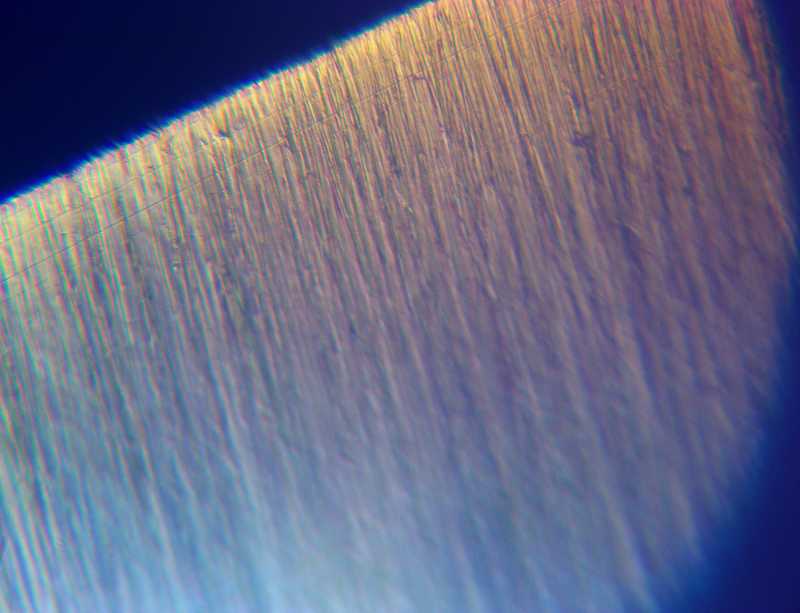
Finally started today with some of the nano-cloth studies. I want to thank Ken Schwartz for generously providing enough nano-cloth strops mounted to aluminum blanks to conduct the study.
I started by preparing a bunch of samples with super polished bevels so we would be able to clearly see the effects of various abrasives. Here is the first sample polished clean (or clean enough):
I then used various abrasives on the nano-cloth, hoping to isolate pure abrasives, restoring the edge back to smooth in between each iteration.
Here they are in ascending grit size, fine to coarse:
Very interesting results, Clay. Your experiments show us things we could, until now, only speculate about.
The roo strops work as incredibly as they did before. (Assuming roo was used to create the first picture). However, there’s quite a few things I don’t quite understand.
[ul]
[li]The .125 um CBN spay seems to create a regular pattern of tiny scratches, probably like one would expect. However, the .5 um CBN spray doesn’t seem to add a regular pattern of coarser scratches. Instead we see only a few, but quite large scratches.[/li]
[li]The .5 um diamond spray creates a regular scratch pattern again, as one would expect. However, the 1 um diamond spray hardly seems to create any scratches; at least they seem tinier than the ones created by the .5 um diamond spray[/li]
[li]The 15 um CBN spray then again works as I expected: a regular pattern of quite coarse scratches.[/li][/ul]
Have you got any idea what is going on?
What I also wondered is what the effect is of the .25 um spray (I assume) on the roo strops. The edge is almost fully smooth, which I’d attribute to the burnishing power of the (somewhat wet?) roo strops. How come no scratches are visible like they are with the even finer .125 um diamond spray on nanocloth strops? Is the burnishing power of the roo stops so much stronger than the abrasive power of the .25 um spray?
Thanks Mark - I can’t say I was surprised by the results, I’ve seen them before, but I am still uncertain as to the mechanism. My best guess is as you say - the roo is extremely effective in burnishing the surface, smoothing ridges above what the .25 diamonds it’s loaded with are able to cut. I think we’re seeing about what I expected from the nano-cloth - straight abrasion consistent with the particle sizes though I’ll wait until the bigger objective lens is operable before trying to measure the scratches. I will conduct another test, hopefully tomorrow with plain kangaroo, lightly moistened. If it burnishes effectively without any abrasive compound then I think we’ll have part of our answer.
[quote quote=“mark76” post=4712]Very interesting results, Clay. Your experiments show us things we could, until now, only speculate about.
The roo strops work as incredibly as they did before. (Assuming roo was used to create the first picture). However, there’s quite a few things I don’t quite understand.
[ul]
[li]The .125 um CBN spay seems to create a regular pattern of tiny scratches, probably like one would expect. However, the .5 um CBN spray doesn’t seem to add a regular pattern of coarser scratches. Instead we see only a few, but quite large scratches.[/li]
[li]The .5 um diamond spray creates a regular scratch pattern again, as one would expect. However, the 1 um diamond spray hardly seems to create any scratches; at least they seem tinier than the ones created by the .5 um diamond spray[/li]
[li]The 15 um CBN spray then again works as I expected: a regular pattern of quite coarse scratches.[/li][/ul]
Have you got any idea what is going on?
What I also wondered is what the effect is of the .25 um spray (I assume) on the roo strops. The edge is almost fully smooth, which I’d attribute to the burnishing power of the (somewhat wet?) roo strops. How come no scratches are visible like they are with the even finer .125 um diamond spray on nanocloth strops? Is the burnishing power of the roo stops so much stronger than the abrasive power of the .25 um spray?[/quote]
This is some really cool stuff. Now I’m up in the air about my first round of upgrades and addons to my kit.
Is there a good rule of thumb for which level of abrasive is the entry level for the nano-cloth giving optimal results, or can you use just about anything on them equally well? Would both kangaroo and nano-cloth perform equally well for the coarser polish?
Perhaps the next comparison could be showing the same compound on each type of strop? It would be really interesting to see how the standard pro kit 5/3.5 micron diamond pastes look on each leather type and nano-cloth. No rest for the Wicked (Edge) I suppose
Good questions. I think the kangaroo is best used in the finer ranges, maybe 5 microns and lower. I haven’t done any testing yet with the kangaroo at coarser grits, but off the top of my head, I think it wouldn’t be the best use of the roo’s awesome burnishing properties. I think the nano-cloth should be appropriate for any grit, especially when you don’t want burnishing and want the micro teeth to extend all the way to the edge.
[quote quote=“ApexGS” post=4730]This is some really cool stuff. Now I’m up in the air about my first round of upgrades and addons to my kit.
Is there a good rule of thumb for which level of abrasive is the entry level for the nano-cloth giving optimal results, or can you use just about anything on them equally well? Would both kangaroo and nano-cloth perform equally well for the coarser polish?
Perhaps the next comparison could be showing the same compound on each type of strop? It would be really interesting to see how the standard pro kit 5/3.5 micron diamond pastes look on each leather type and nano-cloth. No rest for the Wicked (Edge) I suppose :)[/quote]
Thanks for the info, Clay. I’m pondering my first bundle of goodies for the kit, possibly including a set of each or just jumping to two nano-cloth sets since there’s some price difference. When you’re on a budget a few bucks counts
All this info on the nano-cloth has me leaning toward them, since I can certainly pick up more later!
Very interesting Clay. I find Mark’s observations to be on point… hopefully we can figure out what’s going on! Thanks for spending the time on the different experiments… you have the dream job! lol, how does your wife ever put up w/ you? :lol:
Fascinating pictures! I’m curious, how did you “super polish” the edge to begin with?
Sincerely,
–Lagrangian[/quote]
I progressed through the usual diamond plates, then on to the Micro-Fine ceramics and then used 1um diamond on cow leather, .5um diamond on cow leather, .25um diamond on kangaroo and then .125 CBN on kangaroo. I didn’t spend so much time as to remove every last scratch, just the vast majority.
[quote quote=“BassLakeDan” post=5225][quote quote=“wickededge” post=4700].. super polished bevels..
..[/quote]
Clay,
I have been meaning to ask, 1.) what steel is this that you were using for these tests, and 2.) what RC? Just curious … thanks[/quote]
I’ve been using a bunch of utility blades from the same 100 pc pack so that they are very similar. They’re listed as “high carbon” though I don’t know exactly what the composition or hardness is. If I had to guess, I’d put the hardness around 57-58 HRC.
Fascinating pictures! I’m curious, how did you “super polish” the edge to begin with?
Sincerely,
–Lagrangian[/quote]
I progressed through the usual diamond plates, then on to the Micro-Fine ceramics and then used 1um diamond on cow leather, .5um diamond on cow leather, .25um diamond on kangaroo and then .125 CBN on kangaroo. I didn’t spend so much time as to remove every last scratch, just the vast majority.[/quote]
So you did ship the Super fine 1200/1600 in this case? Did it take you much longer with the next ceramics since you did skip the fist?
[quote quote=“SvenSchläfke” post=5246]
So you did ship the Super fine 1200/1600 in this case? Did it take you much longer with the next ceramics since you did skip the fist?[/quote]
In this case I did skip them and it took a little longer, but not too bad, partly because my diamond plates are so well worn in now that they’re already doing a lot of polishing before I even get to the ceramics.
These are with the 2000x metallurgical scope though only at 800x. I’ve only just started getting decent images at 2000x today. I’m hoping to get some more posted next week.