[quote quote=“tcmeyer” post=17873]I think the general principle in finding the sweet spot for a belly curve is to imagine it as a circular arc. A line going thru the center point of that arc should fall on the pivot point for your slide rods. This should provide the best average conical sweep along the belly, resulting in an angle and bevel width which are most consistent.
[/quote]
On page two of this thread, I tried to make my point about taking a low grip to keep the stones from tipping as you pass over the edge. I had checked the amount of “slop” in my handles quite a while back, but didn’t think my stones were “as delivered.” I had scrubbed the bores with a .243 bronze bore brush and thought maybe I’d contributed to the slop.
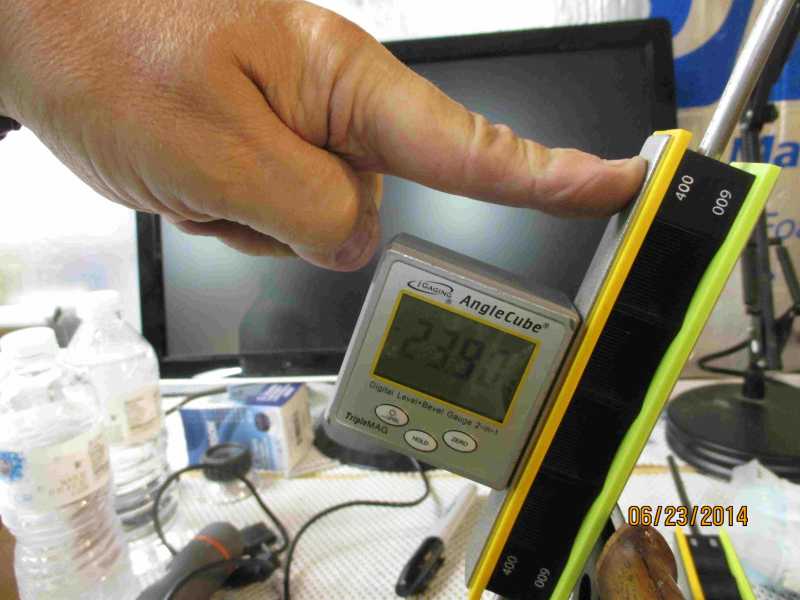
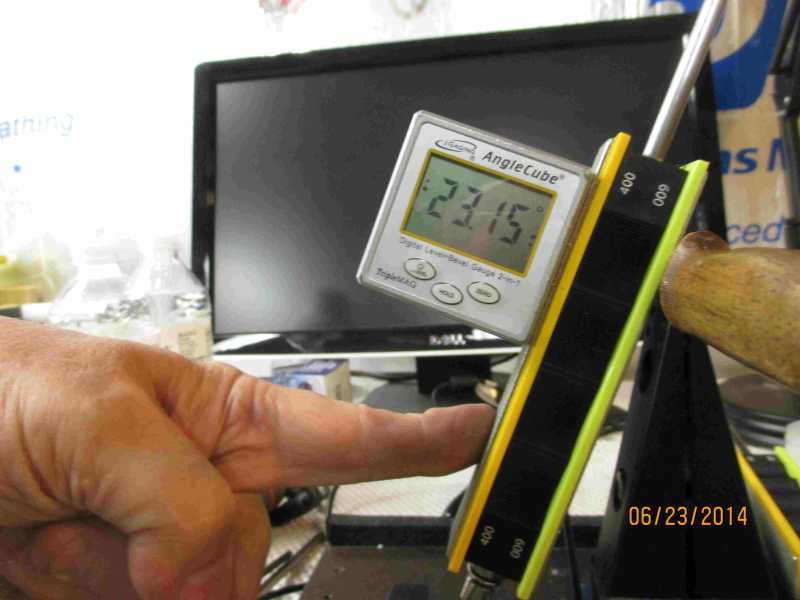
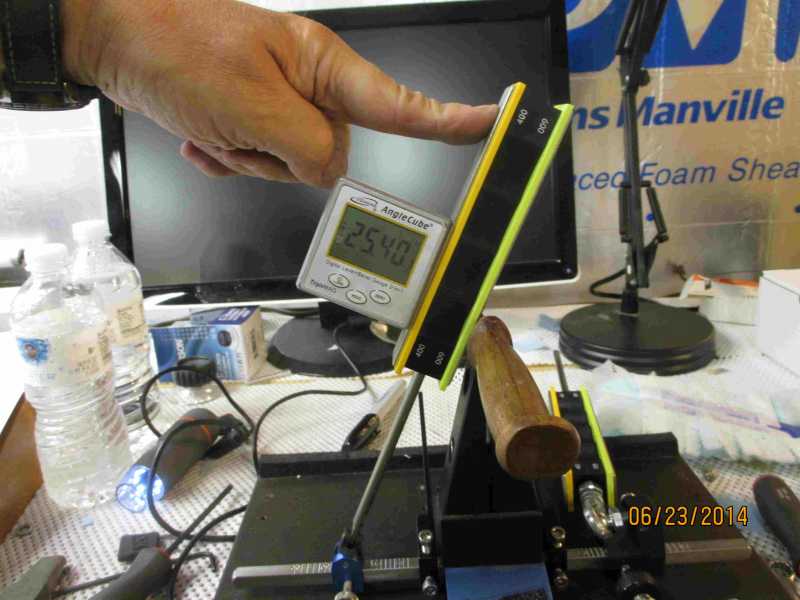
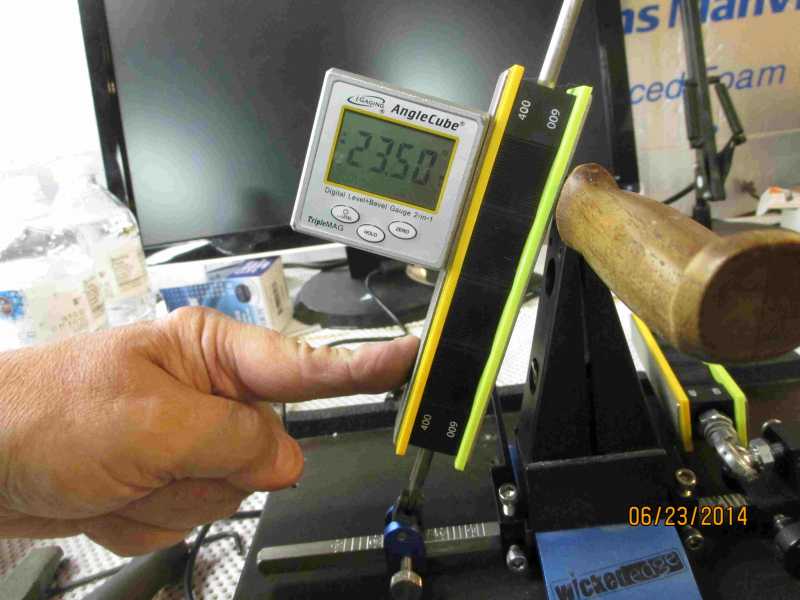
But I recently received a new set of 400/600 diamond stones and set about checking their inherent slop. Surprisingly, the amount of slop was the same, and alarmingly large. Here are some photos I took to demonstrate the results. You’ll see that I applied pressure (not all that much) above and below the fulcrum of the edge.
The first two photos are of my Pro Pack 2 assembly. I have replaced the rods with longer versions, but the rods are exactly the same diameter as those supplied by WE, at 0.250". The stones have never been used up to this point. See the AngleCube readings; about three quarters of a degree.
The second pair of photos are of one of my original PP1 assemblies, which have rods measuring 0.236" in diameter. Would you believe one point nine degrees?
Admittedly, the angles shown are probably exaggerated by the focused points of applied force, but as you can infer, the amount of inherent slop (let’s call it looseness) could easily negate the amount of effort we put into making micro-adjustments, unless you concentrate on perfecting your technique with an eye toward avoiding any “rocking” motion.
It also occurs to me that if you change from an “up and away” stroke to a “down and away” stroke, you could easily be altering your bevel angle without knowing it. Gee, and that accounts for a number of times when it seemed I simply wasn’t making progress.
Yeah Tom I notice the same thing… It is really only noticeable though when I am sharpening a wide bevel and change from edge trailing to reversing direction and going to edge leading. currently you have to alter your technique when you do this to account for the slop. It would be nice to reduce this play somewhat, but I don’t know if it can be completely eliminated without a lot of extra work on Wicked Edge’s part. And it’s not a huge deal since we all get some beautiful and perfect edges with the existing arms and paddles.
We could include bushings in all the handles but it would drive the cost up significantly. One option I’ve toyed with is going with just a singe handle set and making it so the stones are easily swapped. Then we could include the bushings but we’d lose some of the speed and convenience of switching stones that having multiple, double-sided handles offers.
[quote quote=“razoredgeknives” post=17885]
yeah, i see the trade off. What do you mean “singe” handle? got any pics for reference? why would it work in a singe handle and not a regular paddle?
thanks for the input clay![/quote]
If we had to include the bushings for multiple handle sets it would get expensive. If we went to a system that just had on handle per side with a holder that allowed for swapping out the stones easily, it could be more affordable. We could use a regular paddle with two stone holders… One advantage to going with a single stone paddle design would be that we could make a more ergonomic handle and build out the tray to be a little more protective. At the same time we’d build out the stone holder portion so that there wouldn’t be any trouble getting in to the heel of Spyderco knives.
Oh Lordy, please don’t go off changing your product line because some idiot from Wisconsin says “Hey, looky here!” I think what you’ve got is just fine and maybe could benefit from a little tweaking.
I don’t want you to think that my post was meant to be a complaint. For exactly the reason Josh puts forth: “It’s not a big deal since we all get some beautiful and perfect edges with the existing arms and paddles”.
I was just trying to point out why improper technique and in particular hand position can/will cause you problems.
That said… I think it’s great that we can talk on a forum like this and have the guy in charge respond so positively. Clay, have you considered boring the centers out and pressing in a sleeve with a closer tolerance? Or having the handles molded solid or with a smaller bore and then gun drilling 'em?
OK.. So now I went down to the dungeon and checked my “bushing stones” for slop. The same procedure as shown in my photos yielded 0.20 degrees, at least half of which comes from slop in the ball joint. I had measured the ball joints a few months back and found them to have about 0.005-0.006" of horizontal slop. Checked on my granite plate (not my WE base) I show 0.002 - 0.005" of vertical shaft movement in my bushing stones when laid flat.
Now I’m going to start checking all my stones for parallelism between each face and the bore.
And just to emphasize a point, I’ve never been happier with my WEPS, now that I started using the Variable Stone Thickness Adapter (SWAT). Even with the slop in the stones, consistent technique is the answer. It’s an absolute pleasure to use my handheld scope and see clearly that the stones are cutting exactly where I want them to.
I’m just thinking ahead to the next generation sharpener which is in the design phase now, so I’ve been toying with the idea of changing the paddles around a little. The main reason is that, at the restaurant show where we were showing off the Professional Series, a lot of the customers were concerned about safety. So we’re looking into a larger shield that could take the place of the existing tray. Having the larger shield would make it impossible to have stones on both sides, therefore the removable stones etc… But for now it’s just a thought.
I’ll say I really like the double sided stones. I guess if we had our way, we’d prefer them to be a little taller to get in those choils, but I don’t have a lot of Spydercos anyway. This is a great system, and the more I use it the more I like it. Only thing I’d add is a rear support and I’d say the system is about perfect. Really enjoying it.
man Clay that’s great that you are always thinking ahead! You may want to start a new thread for brain storming and see what ideas we can come up with - you can keep what you actually do hush hush (due to patent reasons) but it may help get some ideas of what people would like to see? Thanks for making a great system and always trying to improve it!
Just got the 50/80 stones, and I really like them. These will definitely save my 100’s. I’ve pretty much got my technique and comfort level down with my thumbs in the second groove with pinkies on the stones, and I’m getting some laser edges at 1k grit.
A couple of questions regarding angles.
I was doing a knife that had a lot of chips in the edge with the 50/80s and a good bit of material needed to be removed. My initial angle set on one side was about 16.5 degrees due to it being FFG and math to get a true 18 degrees. When I finished at 1k grit, I checked the angle again and it was 17.1 on that side. I guess it makes sense since the edge is diminishing in height the more you sharpen while it’s fixed this creating a more obtuse angle. Do you check angles at every grit to compensate for this? A standard resharpening on a good edge with not much metal removal wouldn’t be this extreme regarding angle change.
Second question is I have a Benchmade Volli in the vise. It has flats to clamp to, but they’re not flat. They’re angled back towards the spine so definitely not 90 degrees. I clamp it in and measure the vertical angle of the blade in the vise. I’m measuring on the main grind of the knife. The knife is a high flat grind. Let’s call towards the right the positive direction and towards the left the negative. Angle on left side of the blade yields +1.7 degrees. Right side is -4.7 degrees. So math says the apex is vertically 3 degrees to the left. 1.7 - 4.7= -3
Since it’s not clamped on the main grind like a FFG, I’m thinking if I want a 20 degree even bevel, put the left side at 17 and the right at 23.
Like I used to do with the EP. I measured the angle of the main grind while laying on a flat base. The main grind of the knife is 8.3 degrees, 4.15 degrees per side, but not sure if it’s relevant in this case?
Thanks for the Email Jordan! I will put the reply here in case any other guys have the same questions
[quote quote=“uofaengr” post=17913]Just got the 50/80 stones, and I really like them. These will definitely save my 100’s. I’ve pretty much got my technique and comfort level down with my thumbs in the second groove with pinkies on the stones, and I’m getting some laser edges at 1k grit.
A couple of questions regarding angles.
I was doing a knife that had a lot of chips in the edge with the 50/80s and a good bit of material needed to be removed.[/quote]
One quick side note… you don’t need to apex your edge with the 50 or 80’s… it would be good if you could delay the apexing until the 200-400 grit range. if you do apex this low you will have some chips that will need to be removed. To do this, take your 400 grit stone and put it perpendicular to the edge and grind the edge flat. this will remove the ‘peaks’ in your edge and then you can apex it with your 200’s or 400’s for a nice, smooth, chip free edge.
[quote]My initial angle set on one side was about 16.5 degrees due to it being FFG and math to get a true 18 degrees.[/quote] Not sure I understand… did you set your angles to be 16.5 or 18 dps?
Unless you removed a TON of metal with your lower grit stones then this shouldn’t be the case… What I suspect is that your FFG knife shifted in your vise and was not a true ‘original angle’ anymore. You need to make sure that it is stable before working on it…
[quote]Second question is I have a Benchmade Volli in the vise. It has flats to clamp to, but they’re not flat. They’re angled back towards the spine so definitely not 90 degrees. I clamp it in and measure the vertical angle of the blade in the vise. I’m measuring on the main grind of the knife. The knife is a high flat grind. Let’s call towards the right the positive direction and towards the left the negative. Angle on left side of the blade yields +1.7 degrees. Right side is -4.7 degrees. So math says the apex is vertically 3 degrees to the left. 1.7 - 4.7= -3
Since it’s not clamped on the main grind like a FFG, I’m thinking if I want a 20 degree even bevel, put the left side at 17 and the right at 23.[/quote]
you are one the right track, but just a little bit off… The method you are writing about is the proper method for getting a true asymmetrical angle on your edge. So if your knife is tilted 3 degrees to the left, then you need to take your target angle for your edge (say 20 dps) then you will need to put 18.5 degrees on the left side (20 - 1.5 [half of 3] = 18.5) and 21.5 degrees on the right side (20 + 1.5 [half of 3] = 21.5) for a total of a 3 degree spread. This will give you a proper 20 dps. You had a 6 degree spread, which is not correct. The way you are doing it you will have a greater/wider bevel on the left side (the 17 ds) than on the right. hope this helps?![/quote]
[quote]
Like I used to do with the EP. I measured the angle of the main grind while laying on a flat base. The main grind of the knife is 8.3 degrees, 4.15 degrees per side, but not sure if it’s relevant in this case?[/quote]
If I understand correctly you would zero your angle cube out on the EP table and then lay your knife on the flat part of the primary grind (i.e. not the flat near the spine). When you took that reading it would be a total of 8.3 degrees. Let me know if this was your method and we can discuss…