[quote quote=“Geocyclist” post=8201]How to you set a micro bevel?
I assume you completely finish the knife first, stropping etc.
- In reference to the primary angle how do you set the micro bevel? I.e. 2 degrees greater than the primary angle.
- What stone/progression/number of strokes to you use?
- Do you strop the micro bevel?
- How do you “touch” up an edge with a micro bevel after moderate use? Can you strop? Do you touch up at the micro bevel angle? Do you re apex at the primary angle and apply a micro bevel again?
- Anything else I need to know about how to make a micro bevel?
- When do you use a micro bevel and when not?[/quote]
Excellent questions!
A micro bevel has two general definitions, IMO.
The first is a raised (more obtuse) angle formed with minimal amounts of strokes after the majority, if not all, of the sharpening is finished. For example, if you sharpen a knife at 20 degrees per side through a progression of paddles and then take the final grit and raise the angle 1 or 2 degrees for 10-20 strokes, you will have a micro bevel.
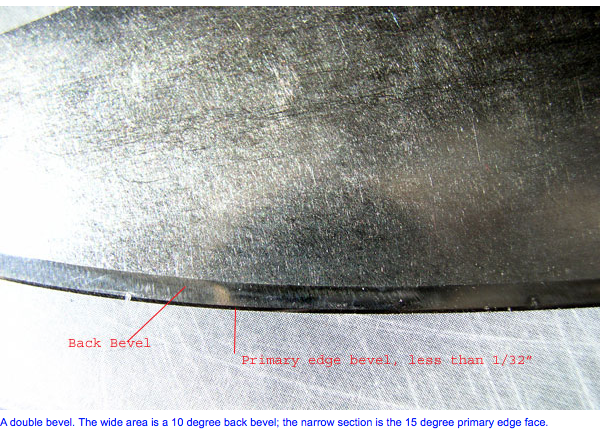
The second is an actual secondary bevel, formed before the final grit, or is retraced at the higher angle after the full progression is completed at the lower angle. For example, if you sharpen (or thin) a knife at 18 degrees per side on the diamonds, then increase the angle to 20 degrees on the ceramics/Choseras for the final edge. OR, if you progress at 18 degrees per side throughout the full progression, then raise the angle and redo the entire progression (or majority of) again at 20 degrees. This creates two distinct bevels.
Technically, they equal the same thing, but the first micro bevel is used more to confirm that the edge of the edge has been abraded, or the burr has been fully removed . The second is for more durability, strength and ease of cutting.
The third, and less talked about micro bevel is when the arm or knife slips and you don’t realize it! 
When touching up a micro bevel, it should be done at the micro bevel angle, since that is the one with the cutting power. If the edge is still intact (no chips) and is just dulled, then a few strokes of the final grit should suffice (there is no official number, but I’d start with 5 light alternating strokes, then increase in sets of 5 if necessary).
The micro bevel in both definitions will eventually become too obtuse and will need to be fully redone, but you should get several touch ups before that happens. If you have the time and inclination, you could also equally strop the lower angle as a maintenance step to try to keep the same ratio of thickness at the edge and behind it, but that kind of makes touching up like work, IMO.