Sometimes the smallest personalization can have a big impact on enjoyment, satisfaction, and easy of use. Hands down the micro-adjust knob has done that for me.
I love the individual styles people have turned out in making there own so please share yours below for others to see and take inspiration from as well!
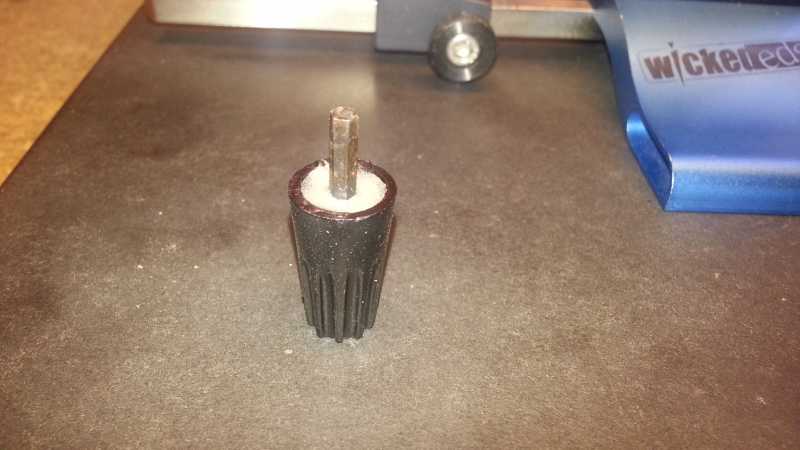
My version(like most of mine) was found digging around in the shop for loose parts. Found a couple larger orange wire nuts shown painted black here. Probably just begging to be plasti-dipped.
A quick hacksaw & some JB weld and done! Measured about 3/8" of exposed Allen wrench extending to give a full range of adjustment with the screw.
Love that shiny metal “terminator” look to yours man.
Steven, do you think a coat of plasti-dip would hold up n looks good on wire nut style? I’m seriously considering it after seeing you doing some work with it…
[quote quote=“CliffCurry” post=21971]Love that shiny metal “terminator” look to yours man.
Steven, do you think a coat of plasti-dip would hold up n looks good on wire nut style? I’m seriously considering it after seeing you doing some work with it…[/quote]
Haha, thanks Cliff!
Yeah, man, Plasti-Dip is weird in the sense you are trying to create a strong bond with the first few coats rather than just making sure they’re even and pretty like paint. This applies to larger surface area a more so than small pieces like your wire nuts. That said, I’d GO FOR IT!.. Worst case you’d just wait for it to dry and peel it off… No sweat B)
I actually plan on Dipping my micro-nuts since they’re a little too sharp after I put in some jimping. I could just round off the edges but I think it’ll be more comfortable to the fingers… And it’ll look cool.
So sorry for this… I started reading that last paragraph and got to, “…dipping my micro-nuts…” and the double meaning just cracked me up — so to speak. And then, the more I read the funnier it got…
I sure some “Darwin” somewhere has actually tried dipping his micro-nuts…
Again. you may not find it as funny as I did… Sorry for the distraction…
So sorry for this… I started reading that last paragraph and got to, “…dipping my micro-nuts…” and the double meaning just cracked me up — so to speak. And then, the more I read the funnier it got…
I sure some “Darwin” somewhere has actually tried dipping his micro-nuts…
Again. you may not find it as funny as I did… Sorry for the distraction…[/quote]
Lol!!! :oops: Yeah, I would go back and edit this part but it’s already out there.
Even if you’re the only one who calls me out, let’s be honest, everyone’s already thinking the same thing… Hardy-har-har, Gibb. :silly:
Said in a Monty Python voice,“The knobs shall henceforth be called Micro-Nuts and dipped in plastic they shall be, so as not to be to sharp and comfortable to the fingers!”
OK, I posted this new mod a while back, but I’ve made some improvements…
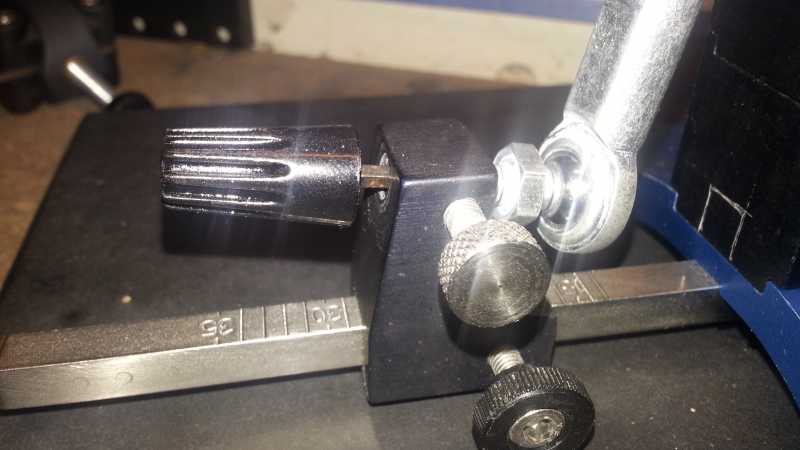
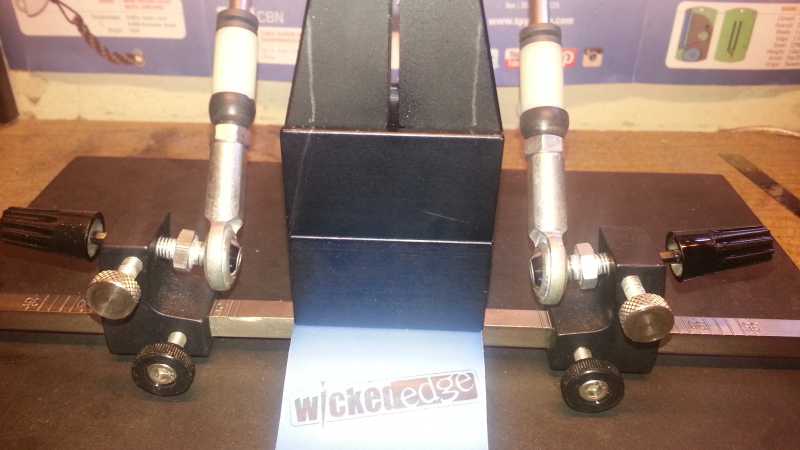
My adjustment knob looks the same as Lance’s, but there’s a couple of differences. I’ve replaced the micro-adjust screws with a 2" long SS set screw which I’ve epoxied into a standard ball joint rod end coupling. I’ve attached a SS knurled knob on the end with a set screw and added a knurled locking (jam) nut. Now I’ve added a printed strip of paper marked in tenths of a revolution, which I’ve found to be a huge improvement.
With the extended screw length, I get plus/minus 1.5 degrees of adjustment, for a total of 3 degrees of range. After several calibration measurements, I find that each turn is very close to 0.29 degrees. This means that each marker division on the scale will produce about 0.029 degrees of change. Round this up to 0.03 degrees, and if you can do simple math in you head (I was trained in slide rules, so that’s not a problem) you can make very rapid, accurate adjustments. For instance, if I need to make a plus 1.25 degree adjustment, I divide 1.25 by 0.3, which equals 4 and 1/6 turns in the out direction. Turn the knob four turns plus about two marker divisions and you’re very close to where you want to be.
The 0.3 degrees per turn is based on an edge 5/8" above the vise jaws. Any substantial difference in height may change the amount of angle change per turn.
For sure this would work just fine without the knurled jam nut if you wanted to stay with the WE 10-32 screw, but it’s really fast (spins very freely on the set screw) and is very positive. Leaving the knurled nut off would add between one and 1.5 degrees of range.