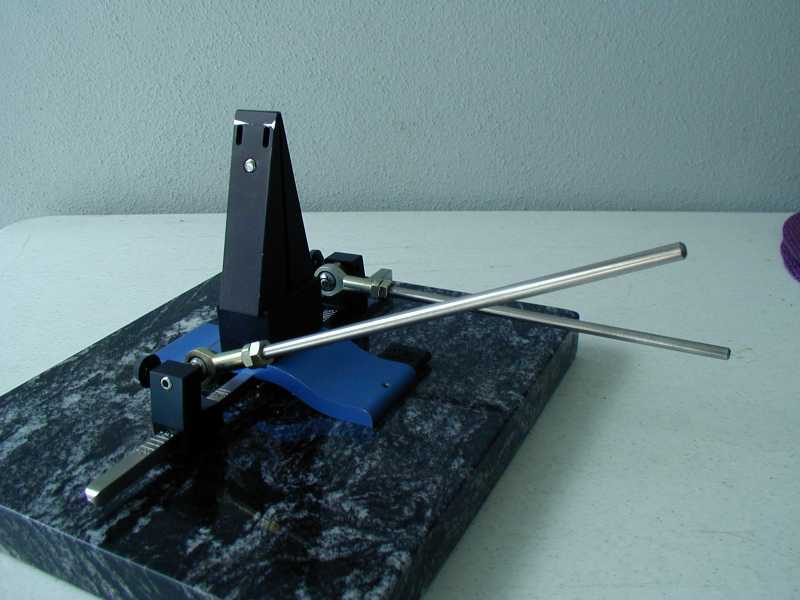
As you can see in attached photo, the arms are “sticky” and don’t fall to the base like they did when they were new.
What type of lubricant should be used?
Attachments:
As you can see in attached photo, the arms are “sticky” and don’t fall to the base like they did when they were new.
What type of lubricant should be used?
I cleaned mine out with dawn soap and hot water. Dried with a blow drier and low oven heat…and even canned air. Squeaky clean. Then I used a dry graphite lube. So far so good.
I’d just leave it alone and “use” it, they’ll break in after the first couple uses. I’m guessing they fall when the stone is on the rod? 
I haven’t seen this as an issue, in fact, I like the fact they “stand up”, makes stone changing even easier. (I actually tried to fashion a clip on the original arms to do this).
I don’t think they need lube, but if you do, I would do what Fred used… something dry, that won’t attract debris. Otherwise it might become gunky?
[quote quote=“cbwx34” post=7873]I haven’t seen this as an issue, in fact, I like the fact they “stand up”, makes stone changing even easier. (I actually tried to fashion a clip on the original arms to do this).
I don’t think they need lube, but if you do, I would do what Fred used… something dry, that won’t attract debris. Otherwise it might become gunky?[/quote]True that it makes changing stones easier but they are getting “gunked up” and might ultimately cause an abrasive wear problem.
They will also “stand up” with the stones.
I keep mine covered with plastic food wrap to keep debris out.
I guess there should be a definite answer to this question as I’m sure many people will ask this into the future.
I was told by a bearing supplier that the version used by WE has a “nylon” race, so don’t use anything that can damage, swell, react, with nylon.
Don’t overheat the nylon via an oven etc.
Perhaps a product can be identified and approved for lubrication by WE.
Something mineral or oil based might cause problems by attracting grit or breaking down the nylon?
A dry lube graphite spray may be the best option, or teflon/silicone, not sure?
It would be great to get a determination here.
Thanks.
I don’t know much, but the chart on this web-page might be useful:
Bechem Lubrication Technology GMBH
“Compatibility of lubricants with elastomers and plastics”
http://www.kutzendoerfer.at/files/compatibility-lubricantse-elastomers-plastics-english.pdf
http://bechem.com/uploads/produkte/en_lubricants_elastomers_plastics.pdf
If you want to try a pure 100% mixure of Teflon and fluorinated oils (PTFE, PFPE, etc.), then you could try Extreme Fluoro Grease. But I don’t know if it would attract dirt/grime/swarf because Extreme Fluoro Grease is not a dry lubricant.
http://www.amazon.com/Finish-Line-Extreme-Fluoro-Syringe/dp/B002L5UL92/ref=sr_1_1?ie=UTF8&qid=1355920029&sr=8-1&keywords=extreme+fluoro+grease
However, based on the chart above, it seems Teflon and Teflon-like lubricants have the broadest compatibility with plastics. This makes sense to me, because Teflon is chemically very inert. So inert, it is often used as the lining of pumps used to move acids and other caustic liquids.
That said, I know very little about lubrication and plastics/polymers. Hopefully some engineer can chime in, or someone can find a lubricant which is designated as compatible with nylon.
Sincerely,
–Lagrangian
[quote quote=“AnthonyYan” post=8010]That said, I know very little about lubrication and plastics/polymers. Hopefully some engineer can chime in, or someone can find a lubricant which is designated as compatible with nylon.
Sincerely,
–Lagrangian[/quote]
Great research there, perhaps people can continue to post any experiences about this here?
Hard to make a definite recommendation from info via the net.
Not a normal environment.