I can see really wanting one in my future.
I am afraid that I would really have to increase my sharpening revenues to justify buying one though..
A few questions.
Will there be a way to select different depths for mounting a blade? I don’t see that in the pictures. It looks like that would be a fixed depth, at least from the current pictures.
What about setting the position fore and aft in the clamp. Is some kind of gauge planned?
What do you foresee being the achievable angle range, say using the current standard (is it 5/8") width blade.
Are angles continuously adjustable, or are there detents for specific angles?
It doesn’t look like there would be much in common other then the ball joints (doubtful if you look closely at the pictures that Clay posted) and the arms.
Wishful thinking… on the retrofit I am afraid…
[quote quote=“PhilipPasteur” post=11459]I can see really wanting one in my future.
I am afraid that I would really have to increase my sharpening revenues to justify buying one though..
A few questions.
Will there be a way to select different depths for mounting a blade? I don’t see that in the pictures. It looks like that would be a fixed depth, at least from the current pictures.
What about setting the position fore and aft in the clamp. Is some kind of gauge planned?
What do you foresee being the achievable angle range, say using the current standard (is it 5/8") width blade.
Are angles continuously adjustable, or are there detents for specific angles?
It does look mighty fine…
:ohmy:[/quote]
Great questions.
[ul]
[li]I’m working on a couple of ideas for the depth control, hopefully built into the machine so no tools will get lost.[/li]
[li]For the fore/aft positioning, I’m imagining a hinged gauge the can be rotated up to position the blade and then dropped back down out of the way. I might even try to add a sliding but lockable stop along the length of it.[/li]
[li]We still have to do some work on the gearing system so that there are detents for each angle. [/li]
[/ul]
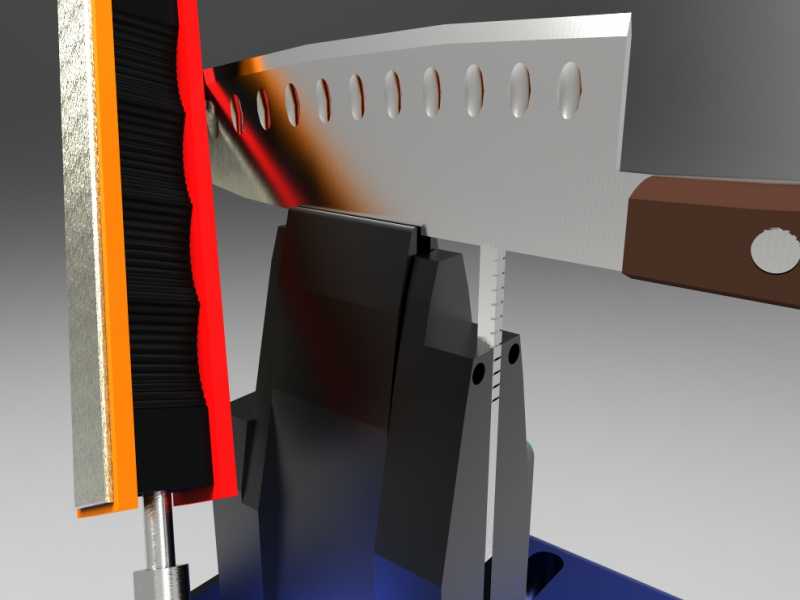
Just did a little drawing of a possible depth gauge and sent it off to the machine shop. The drawing only shows a gauge on the front of the clamp though I’m sure we want one on the back as well so we can control the pitch of the knife. I’d really like to find a way to tie both the front and rear gauges together so they move together when being positioned. Maybe a steel rod or bar that connects them and passes through the jaws of the clamp would work, though it would have to be very thin, thinner than whatever blade is being clamped so it doesn’t prevent the blade from being clamped, but then I wonder if it would be rigid enough to do the job of moving the rear gauge along with the front. Here is the drawing of the front depth gauge in place:
Looks nice.
Could you do the connecting rod external to the clamp? Sort of a drawer handle type of connector between the two rods. Remove the entire thing when not in use ?? Sort of defeats the purpose of having everything self contained …and no parts nor pieces to lose.
One thing about the whole depth setting idea. As it stands, at least from the photos, there just is not much distance between the “shelf” and the tips of the jaws to make much in the way of height adjustment. Maybe that is fine. As long as you have a reference to go back to, it all should be good.
What do you plan as the max and minimum angles available?
Are those different ball joints? They sure look like it.
The shelf on the frame where the spine rests is 0.285" from the top of the clamp though we can make it deeper. I was thinking about two more positions, essentially splitting the distance in thirds. I think it might be possible to include the connecting rod underneath the fulcrum so there wouldn’t be an interference issue with the clamping action.
In its current configuration and the regular standard of 5/8" of blade extending from the top of the clamp, the minimum angle is 15 degrees and the maximum is 30. I’d like to get the angles down to at least 12 degrees and would really prefer 10 though I’m not sure how hard that will be yet.
If the ball joints look different in the drawing, that’s my fault. I’d been planning on using the same ones that we’re using in the Pro-Pack 2 though now that you mention it, I might look into the HD joints that Billabong was using. Those could be great for this machine.
What an awesome looking bit of kit perhaps it will spawn a revolution in convectional knife sharpening shops.
Although I have noticed that people are slow to change in their ways so many chefs just use steels( And I never quite understand the logic of spending so much time every time they pick up a blade- perhaps it becomes almost a nervous release) and many sharpeners just use high speed stone wheels or paper wheels so hopefully it should not take too much business away from the ordinary WE operators.
A suggestion on the depth gauge. If u make it where the adjustment is at the lever in bottom a threaded system or with notches one handed use. The end used will never have to release the knife to clamp it. Put knife in with right hand, adjust depth with left then clamp with left. That would be ideal for me.
Could the depth gauge -gauges fore & aft perhaps be linked & adjusted with cams & universal joints there could be a fore & aft lever each fitted to a cam to set inclination . This could be one solution another would be a small hydraulic ram under each gauge which would probable be both a simpler & cheaper solution.