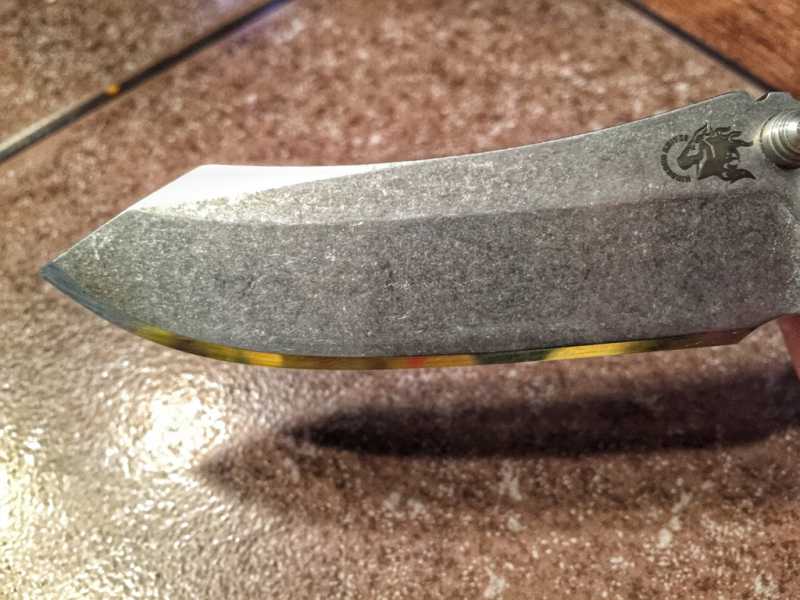
Was reprofiling my Hinderer today. I set both angles to 17° per side with the angle cube. I start sharpening and next thing I know the bevels are uneven. The left side bevel is a lot bigger than the right side even though I had both sides set at 17°. I put the angle cube on there again and the left side is 17 and the right side is 18 1/2°… What the hell? I double checked to see if the knife was perpendicular in the vice and it looked like it was, I had it clamped on the flats of the blade. I don’t know exactly what has gone wrong here.
Are you sure your arms were securely tightened down? If they moved during sharpening, the degree change could have occurred…that is the only way I can explain the change in degrees.
Are you sure your knife didn’t move at all during sharpening? If so, this could do it as well. Josh from REK on here has recommended, and I have had excellent success with this, that you tighten the top screw very good so that you shouldn’t need to tighten the lower screw but just a bit so the gap from the top to bottom of the vice is about the same. If you are tightening the bottom screw enough to create a much wider gap at the bottom than the top, you could bend the vice and you likely won’t have a good grip on the knife.
Assuming that the sharpening is even along the bevel on each side (not creating a thinner to wider bevel from heel to tip, or vice versa), then you can put your knife back in the vice at the same position (assuming you recorded your position), and ensure you tighten the arm screws really good with a pair of pliers or something (assuming you have the basic arms, if you have upgraded arms, I would use the allen wrench to tighten), then check the angles again, ensure they are the same, then when you are close to apexing the edge on both sides and if your bevels are uneven, then work the thinner bevel side until the bevel on the wider side is reduced. Clay has a great video showing him doing this. https://knife.wickededgeusa.com/forum/9-basic-techniques-and-sharpening-strategies/13230-asymmetrical-bevels-new-owner
I will say that if I am off a degree or more, I will adjust one side either in or out to bring the total difference between each side to less than a degree. With the upgraded arms, you can get even more exact, but I am good to being within a degree total variation.
Usually indicates the blade is unevenly ground from the factory and is quite common.
Also, if you’re not careful when clamping, even on perpendicular flats, the blade can tilt a degree or more. This seems to happen more when really torquing down.
I had uneven bevels from the factory on my Grayman SATU which I reprofiled and sharpened this past weekend. I had to work down the wider beveled side a bit to even up the bevels, but it works like a charm…just have to pay attention and ensure before you begin that your heel to toe bevel width on both sides is the same width…if it is not, then you have to readjust, resharpie, and make a few swipes to recheck until the sharpie is removed evenly on one side from heel to toe; unless you want it to be uneven of course.
I was about to say the same thing as uofaengr and wepsflana… I don’t think a 1.5 deg difference is really enough to produce an obvious bevel width difference. More than likely caused by the factory (or a previous sharpening attempt) setting the edge off-center. To correct, you have to stone the narrow-bevel side until the bevels are equal.
Now, what’s with the 17/18.5 angles? Are you saying that you re-checked your blocks with your angle cube and the one side seems to have moved from its original setting?
I had a freaky thing happen the other night. I use a long screwdriver-like tool for my micro-adjusts and I often leave them inserted into the screw. As I was sharpening, I noticed out of the corner of my eye that the handle of the screwdriver was moving. I looked down and realized that the locking screw had come loose and the vibration of sharpening was walking the micro-adjust screw inward. My angle had changed by more than one degree. I replaced the plastic insert under the locking screw, reset the angle and everything was wonderful again.
[quote quote=“wepsflana” post=21108]Couple things to consider:
Are you sure your arms were securely tightened down? If they moved during sharpening, the degree change could have occurred…that is the only way I can explain the change in degrees.
They were tight
Are you sure your knife didn’t move at all during sharpening? If so, this could do it as well. Josh from REK on here has recommended, and I have had excellent success with this, that you tighten the top screw very good so that you shouldn’t need to tighten the lower screw but just a bit so the gap from the top to bottom of the vice is about the same. If you are tightening the bottom screw enough to create a much wider gap at the bottom than the top, you could bend the vice and you likely won’t have a good grip on the knife.
That could be a possiblility…I usually tighten it up fairly tight but when Im reprofiling, Im pushing rather hard in the beginiing with the 100’s or 50/80’s. I’ll try that.
Assuming that the sharpening is even along the bevel on each side (not creating a thinner to wider bevel from heel to tip, or vice versa), then you can put your knife back in the vice at the same position (assuming you recorded your position), and ensure you tighten the arm screws really good with a pair of pliers or something (assuming you have the basic arms, if you have upgraded arms, I would use the allen wrench to tighten), then check the angles again, ensure they are the same, then when you are close to apexing the edge on both sides and if your bevels are uneven, then work the thinner bevel side until the bevel on the wider side is reduced. Clay has a great video showing him doing this. https://knife.wickededgeusa.com/forum/9-basic-techniques-and-sharpening-strategies/13230-asymmetrical-bevels-new-owner
I will say that if I am off a degree or more, I will adjust one side either in or out to bring the total difference between each side to less than a degree. With the upgraded arms, you can get even more exact, but I am good to being within a degree total variation.[/quote]
The problem here is I do that with every knife as I go along periodically I will put more Sharpie on and recheck. In this case…I did that and I am apexing both sides and somehow during sharpening…my angles are changing! I cannot figure out what is happening. Question??? If i set the bevel to a certain degree with the paddle sitting against the blade with the angle cube…as I sharpen away material…does the angle change because I am taking away material from the blade?
Not that much. You’d have to be taking off a lot of material for that to happen. There is some variance between stones too. My 400s and 600s seem to be the furthest off from the rest of my stones as they are usually about a half degree off compared to the others.
I personally measure my angles between each grit and micro adjust but it’s only a couple tenths usually that we’re talking about..not enough for you to notice without a loupe and a good eye or a microscope.
I think your issue is the factory grind. I have a Ritter mini grip that I have sharpened on both an edge pro and the WEPS. The first sharpening was on the edge pro, and one side had a bevel at least 3 times larger than the other side. Yes, you have to be careful to hold the knife on the flats using the edge pro but I was very careful and knew what I was doing. I’ve since sharpened that knife on the much more foolproof WEPS at the same angle, and the bevels came out the same. I personally did not care to grind the smaller bevel to match the other side, but I might give it a little more attention next time.
[quote quote=“razoredgeknives” post=21116]If you are sure your angle is changing during sharpening it could be one of two things:
your vise jaws are bent. unscrew the clamping screws and place them flat against one another… is there any gap at the top?
your pivot joints at the base of the rod arms are coming loose and moving.[/quote]
Lol mine has a small gap at the top that I’ve only recently noticed. Is it worth getting a replacement? I also thought the bending jaws was only an issue on earlier WEPS systems?
[quote quote=“razoredgeknives” post=21116]If you are sure your angle is changing during sharpening it could be one of two things:
your vise jaws are bent. unscrew the clamping screws and place them flat against one another… is there any gap at the top?
your pivot joints at the base of the rod arms are coming loose and moving.[/quote]
Not sure whats going on. I’m going to mess with it a little more tonight and see whats happening. I just got s new vise Monday because my previous one was bent. I never had this problem before.??? I’ll check everything a little closer tonight to see if I can find out whats happening. I’ve never had this problem until I got the new vise the other day.
No, unfortunately it still happens… it depends on how badly it’s bent. If it’s only like 1/32" then i would say to wait and see if it gets worse… but if it’s any more than this or if it’s causing issues call the WE team and they will get a new one right out to you. that is one thing i know for certain - that Wicked Edge backs up their products 110% and will take care of you.
This is true. I’ve never seen a company with as good customer service than Wicked Edge. I’ve had a couple small issues and they’ve been fast and courteous with each inquiry. Speaks volumes to me and I remember things like that when I’m deciding where I want to spend my money…
Ive had a few knives move around on me also…Since sharpie washes off with rubbing alcohol, I started marking the blade around the vice where it it clamped in so I see if it has moved during sharpening. Goodl luck!
Some knives (I had a Normark filet knife today) which have very polished surfaces and hard steel are difficult to clamp. Imagine trying to hold a piece of glass between the jaws of a pliers. Hard & polished equals slippery. Use a little masking tape on the knife and the problem goes poof.
That said, I don’t think knife movement would cause a 1.5 deg change without being obvious.
The amount of steel you remove by stoning won’t make an appreciable difference in angle.
It’s still not clear to me - when did the angle change occur?? After setup? After the first grit? At the end of your process?
[quote quote=“tcmeyer” post=21122]Some knives (I had a Normark filet knife today) which have very polished surfaces and hard steel are difficult to clamp. Imagine trying to hold a piece of glass between the jaws of a pliers. Hard & polished equals slippery. Use a little masking tape on the knife and the problem goes poof.
That said, I don’t think knife movement would cause a 1.5 deg change without being obvious.
The amount of steel you remove by stoning won’t make an appreciable difference in angle.
It’s still not clear to me - when did the angle change occur?? After setup? After the first grit? At the end of your process?
Are you using stones of varying thickness?[/quote]
These questions above need to be further understood. There is a lot that can go on during sharpening. Even with the vise not bent the arms not. Moving the blade not slipping you can easily have a stackup of sorts happen. I have a hinderer design. The blade shape going from the spine to the edge is off. It is not an equal angle from the center. If I just measure the same angle with the angle cube and start sharpening the bevels will look off. Hard to see 1 or 2 degree of offset in the blade shape compaired to where it is clamped. Then if you are making a lower angle reprofile the stones will be resting on the shoulder of the apex when you make your measurement to start with. Then you remove.the shoulder and when you make your final measurement after taking down the shoulder the angle will be different because you are now measuring the angle with respect to the true edge apex. A tiny bit of metal on the angle cube and or using a different paddle to make your measurements with can all add up easily. Do not get so hung up on the exact angle as measured by the angle cube. Get it set about where you want it and sharpen. If it is visually off adjust the side that looks smaller.in width in one degree and it.should match up better. 99 percent of people will not be able to tell one lick of difference in a 2 or 3 degree angle difference while cutting. More people would notice the visually unequal looking bevel.
Got it figured out guys. As I was reprofiling I just needed to work on the smaller Bevel a little more to match it up with the other side.You were right… As I was figuring out my angle with the angle cube I was sitting the paddle on the shoulder of the original angle, as I grind away… It took the shoulder off of the blade and my angle became more acute. I guess you could call this a brain fart… I got it last night! I love the acute bevel on this blade shape.
It’s funny you mention these little pieces of plastic. I’m not too sure if those with the PP2 even know they’re there!?
I dropped one of these pieces on my den floor last week and thought I had lost it for good. I began wondering what I could use to replace it, and I even played around with the idea of a hot glue gun. But, I lucked out and found it later that evening after getting down in my hands and knees with a flashlight for a good 10-15 minutes
My question is this: What did YOU use to replace it?
I sharpened by buddy’s Spyderco Techno last night and realized the left angle would change anywhere from .5 to 1 degree as I progressed through the stones…I think I might need to replace mine?
Tell you the truth, I have the PP2 with 3" extended arms (wish my actual arms were a bit longer at times :)), ok back to the point.
Anyways, I know of these little poly pieces between the micro adjust set screw and the adjustment/arm screws. Frankly, I don’t have to worry about them being loose or not because my arms are all the way screwed in…pretty tight (not tight enough to strip anything, but tight enough to not move while doing the biz on the WE. I am just not in the need to micro adjust at that level…like I have said, if I am less than a degree off total from side to side (say one side reads 17.5 degrees and the other is 18 degrees), I am good. If more than that, I will move one side a degree and go at it.
The key is recording both the angle cube measurement and the settings you actually put the arms at on the WE, so that you are not back redoing the effort next time.