I think it’s worth taking some time to discuss what people are pursuing when stropping their blades. Depending on the technique used, a variety of things can be accomplished. I’ll list a few and hope others will join in:
Refining the edge, improving the edge profile - I’ve had a lot of success and proven performance gain from even lightly stropping the blade after using the stones. Light strokes work for me and can be done in limited number after finishing with the stones. I’ve been able to quickly take a knife sharpened on the 100# diamond plates to shaving sharp with a few (10 per side) strokes on the 14um strops.
Making the bevel shine - I’ve had lots of glittering success taking the knife from a nice polish to a true mirror by using strops. In order to do so, you need to complete a lot of strokes which can negatively impact cutting performance if you don’t lower the angle by at least two degrees.
Making the edge more durable - If you strop at the same angle at which you sharpened, you will get some degree of rounding of the edge, making the final angle a little wider and a little less sharp. It will be a little more durable.
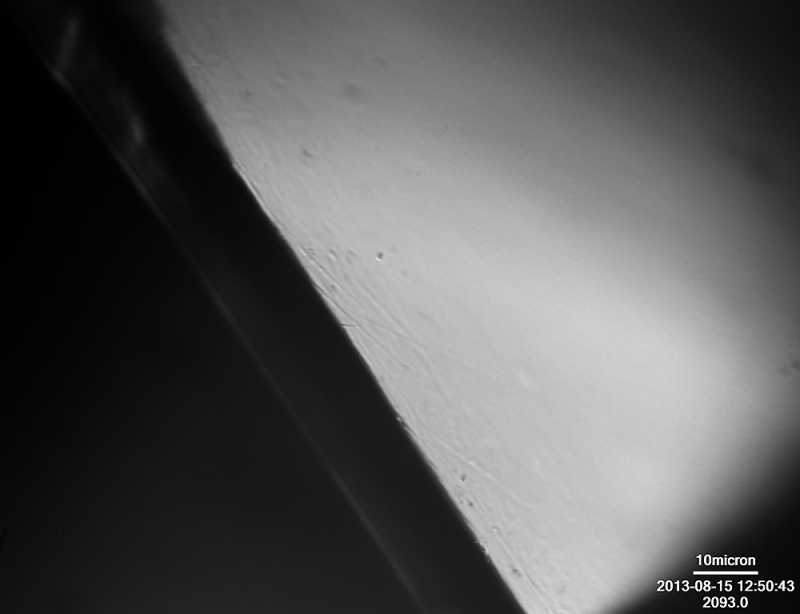
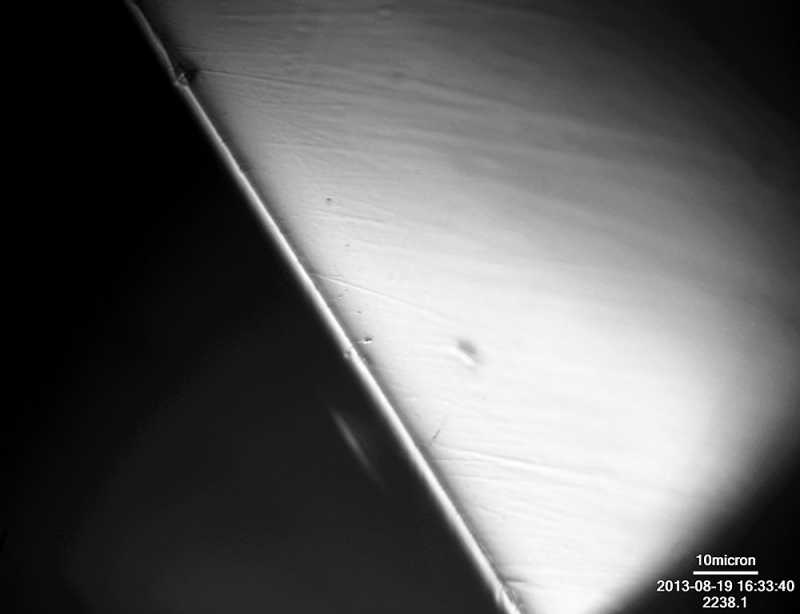
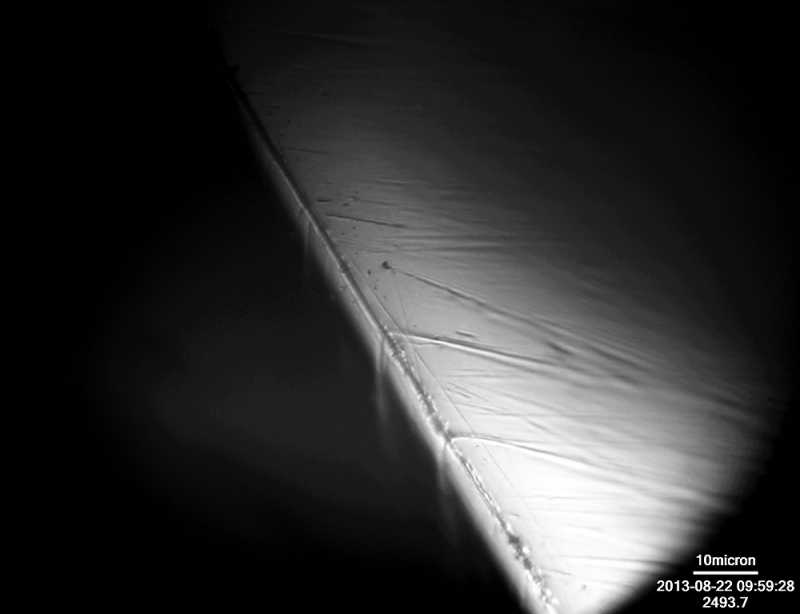
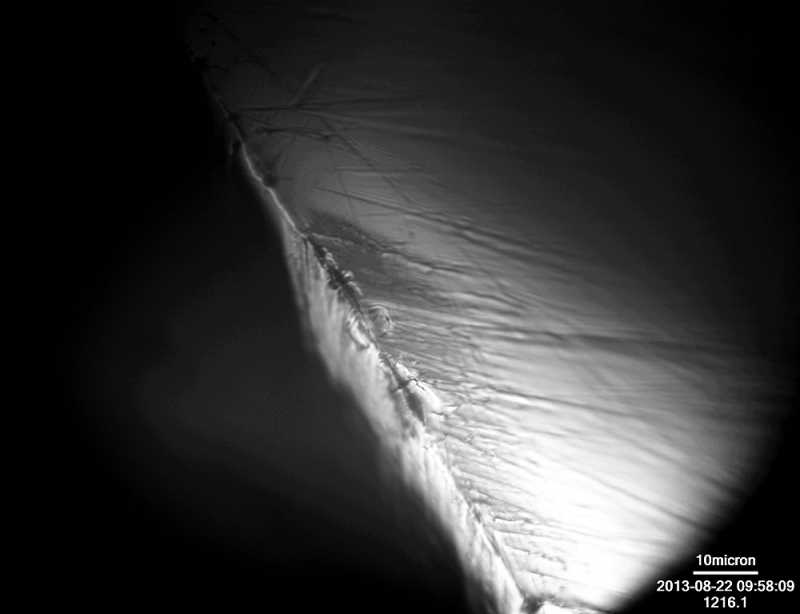
Here are a couple of pictures of blades stropped down to very fine abrasives. See if you can tell which technique was used:
I’m a bit slow and need further clarification. When you reference 100# diamond are you referring to your standard 80/100 coarse/medium coarse stones? What does the # sign represent. If you get a knife “shaving sharp” with 100 grit and strop then why would anyone take the time to use 200- 1000 grits?
Can you give an example of the specific angle for initial sharpening and the specific lower angle for strop?
Refining the edge, improving the edge profile - I’ve had a lot of success and proven performance gain from even lightly stropping the blade after using the stones. Light strokes work for me and can be done in limited number after finishing with the stones. I’ve been able to quickly take a knife sharpened on the 100# diamond plates to shaving sharp with a few (10 per side) strokes on the 14um strops.
Making the bevel shine - I’ve had lots of glittering success taking the knife from a nice polish to a true mirror by using strops. In order to do so, you need to complete a lot of strokes which can negatively impact cutting performance if you don’t lower the angle by at least two degrees.
[/quote]
I’m a bit slow and need further clarification. When you reference 100# diamond are you referring to your standard 80/100 coarse/medium coarse stones? What does the # sign represent. If you get a knife “shaving sharp” with 100 grit and strop then why would anyone take the time to use 200- 1000 grits?
Can you give an example of the specific angle for initial sharpening and the specific lower angle for strop?[/quote]
Good questions. The # sign refers to grit number and when I use 100# I am referring to our 100 grit diamond plates that are part of all the sharpening kits. How to finish a knife is the subject of endless conversation and the answer usually boils down to two things - your preference for the kind of edge you like and the specific cutting tasks you are planning. The 100#/stropped edge is great for some things, like ripping through tough, fibrous materials like rope or hard, smooth materials like zip ties. It’s not so great for carving, actual shaving or anything requiring a very refined edge. The 100#/stropped edge does not perform well with any kind of push cut and leaves very rough edges when slicing through paper. It will not pass the hanging hair test at any level. An example of sharpening at one angle and stropping at another might be that you sharpen the blade at 20 degrees and then strop it at 18 degrees.
I’m in this category I guess… stropping just enough to clean up the edge. I’ll do it at the same angle or higher… very light and maybe a dozen per side total. I don’t think I do enough to add any strength… just enough to clean it up and (hopefully) improve it.
Thanks for posting this Clay! I will take a guess. They are both stropped with many passes (not sure how many, but def. more than 5-10 at each grit) - I would guess you took them up to 10k choseras, then 100-125 total on the .25 diamond strop and about the same at .125 CBN strop (totally guessing here based off of recent posts =)).
As far as techniques, I would say the first has been lowered 2*/side whereas the second was not…?
…Here are a couple of pictures of blades stropped down to very fine abrasives. See if you can tell which technique was used:…
[/quote]
Thanks for posting this Clay! I will take a guess. They are both stropped with many passes (not sure how many, but def. more than 5-10 at each grit) - I would guess you took them up to 10k choseras, then 100-125 total on the .25 diamond strop and about the same at .125 CBN strop (totally guessing here based off of recent posts =)).
As far as techniques, I would say the first has been lowered 2*/side whereas the second was not…?[/quote]
…Here are a couple of pictures of blades stropped down to very fine abrasives. See if you can tell which technique was used:…
[/quote]
Thanks for posting this Clay! I will take a guess. They are both stropped with many passes (not sure how many, but def. more than 5-10 at each grit) - I would guess you took them up to 10k choseras, then 100-125 total on the .25 diamond strop and about the same at .125 CBN strop (totally guessing here based off of recent posts =)).
As far as techniques, I would say the first has been lowered 2*/side whereas the second was not…?[/quote]
Exactly![/quote]
WINNER WINNER WE HAVE A WINNER! give this man a prize! Lol Very good Josh! Okay I’m a little confused how does a rounded edge become more durable? Is it because the edge isn’t digging in as hard therefor it glides easier and last longer?
…Here are a couple of pictures of blades stropped down to very fine abrasives. See if you can tell which technique was used:…
[/quote]
Thanks for posting this Clay! I will take a guess. They are both stropped with many passes (not sure how many, but def. more than 5-10 at each grit) - I would guess you took them up to 10k choseras, then 100-125 total on the .25 diamond strop and about the same at .125 CBN strop (totally guessing here based off of recent posts =)).
As far as techniques, I would say the first has been lowered 2*/side whereas the second was not…?[/quote]
Exactly![/quote]
WINNER WINNER WE HAVE A WINNER! give this man a prize! Lol Very good Josh! Okay I’m a little confused how does a rounded edge become more durable? Is it because the edge isn’t digging in as hard therefor it glides easier and last longer?[/quote]
The little bit of rounding does two things - it makes the angle a little more obtuse and creates curved shoulders. The slightly more obtuse angle is less fragile and the rounded shoulders absorb a lot of the force created in cutting. With a v-bevel, the force is always concentrated on the edge. With a convex bevel, the initial force is concentrated on the edge but is quickly distributed to the shoulders as they push into the cut. The shoulders also spread the opening, reducing the load on the edge and stretching the material to be cut, making it easier to rupture.
…Here are a couple of pictures of blades stropped down to very fine abrasives. See if you can tell which technique was used:…
[/quote]
Thanks for posting this Clay! I will take a guess. They are both stropped with many passes (not sure how many, but def. more than 5-10 at each grit) - I would guess you took them up to 10k choseras, then 100-125 total on the .25 diamond strop and about the same at .125 CBN strop (totally guessing here based off of recent posts =)).
As far as techniques, I would say the first has been lowered 2*/side whereas the second was not…?[/quote]
Exactly![/quote]
WINNER WINNER WE HAVE A WINNER! give this man a prize! Lol Very good Josh! Okay I’m a little confused how does a rounded edge become more durable? Is it because the edge isn’t digging in as hard therefor it glides easier and last longer?[/quote]
The little bit of rounding does two things - it makes the angle a little more obtuse and creates curved shoulders. The slightly more obtuse angle is less fragile and the rounded shoulders absorb a lot of the force created in cutting. With a v-bevel, the force is always concentrated on the edge. With a convex bevel, the initial force is concentrated on the edge but is quickly distributed to the shoulders as they push into the cut. The shoulders also spread the opening, reducing the load on the edge and stretching the material to be cut, making it easier to rupture.[/quote]
Okay that makes perfect sense! I guess I should have been able to figure that out? Thanks for the help!
Could it be argued that the sharper V edge would become rounded with a little bit of use, and therefore the slightly rounded edge is basically just a V edge that’s been deliberately blunted a tiny amount, therefore you could go on to argue that the V edge would have the same long-term durability because it will achieve the same roundedness after a bit of usage?
It’s a good question, one that we might explore by extending the test and adding a large number of additional repetitions. If both blades are exposed to the same loads, any difference in durability should start to show up after enough repetitions.
I’ll also check the blades under the scope and see if there are any discernible differences in the edges of the blades. It seems logical that the keener, more narrow edge is being deformed but not necessarily in a way that will give it more strength.
I would think that would hold true if it was used to cut a suitable medium say a cork which is good for de-burring and I suspect would achieve just what you say. The wrong medium could cause micro chips which would not be helpful.
It would be interesting to look at an edge on Clay’s powerful microscope to see if cutting through cork does convex the edge.
[quote quote=“LeoBarr” post=13580]I would think that would hold true if it was used to cut a suitable medium say a cork which is good for de-burring and I suspect would achieve just what you say. The wrong medium could cause micro chips which would not be helpful.
It would be interesting to look at an edge on Clay’s powerful microscope to see if cutting through cork does convex the edge.[/quote]
I’d be interested just in seeing the effect it has on the burr.
Here are two nice shots at 2000x of the edge of the blade stropped at 13°. One is of the section of blade that was being tested, the other is of a section just a millimeter down that didn’t have any load:
[color color=#0000ff]Edge Baseline - No Testing - 2000x[/color]
[color color=#0000ff]Edge After Testing - 40 Repetitions - 2000x[/color]
The deformation is pretty easy to see. I’ll post pictures of the blade stropped at the sharpening angle of 15° later today. I’ll also complete a larger number of repetitions to see what happens to the blades.
[quote]Could it be argued that the sharper V edge would become rounded with a little bit of use, and therefore the slightly rounded edge is basically just a V edge that’s been deliberately blunted a tiny amount, therefore you could go on to argue that the V edge would have the same long-term durability because it will achieve the same roundedness after a bit of usage?
[/quote]
One might argue this way, if they could present some definitive studies that show highly regular convexing of the edge to be the primary results of using a knife. I have not seen such results. The photos I have seen of edge wear do not support this argument. Wear tends to be irregular and often the results are more to flatten, roll, or chip out the edge than to convex it slightly which appears to be the results of stropping.
I read Curtis’ goals for stropping, they match mine perfectly. It is all about edge refinement.
I can say this about stropping after a lot of repeated tests - you can take a nicely sharpened blade to a much higher level of sharpness with just a few strokes with the strops. Even a 10k Chosera finish barely passes a low score of 1 on the hanging hair test, do a quick 10 strokes per side with the .25um roo strops and you can suddenly score 4s and 5s with ease. I completed a couple dozen iterations of this test this past Friday and consistently had the same results.
I have seen the same sort of thing Clay.
That is why it is curious to see what appears to be rounding at the edge in your micrographs.
Of course, we have to remember that we are talking about rounding visible at 2500 X. Maybe a couple of microns of rounding. Regardless, the edge does cut better with proper stropping.
You know, the straight razor guys have been doing it for a very long time… there must be something to it. At least, when cutting hair!