[quote quote=“ToddSimpson” post=21634]FYI, have a look at this link:
Struers
Ted PellaPolishing is typically done with abrasive-loaded cloths. Ken’s Nanocloth is one example, but there are others
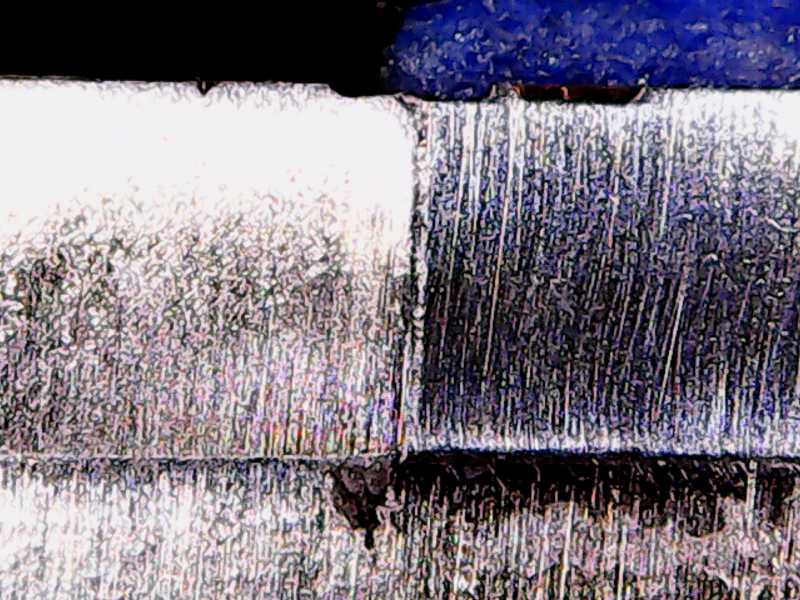
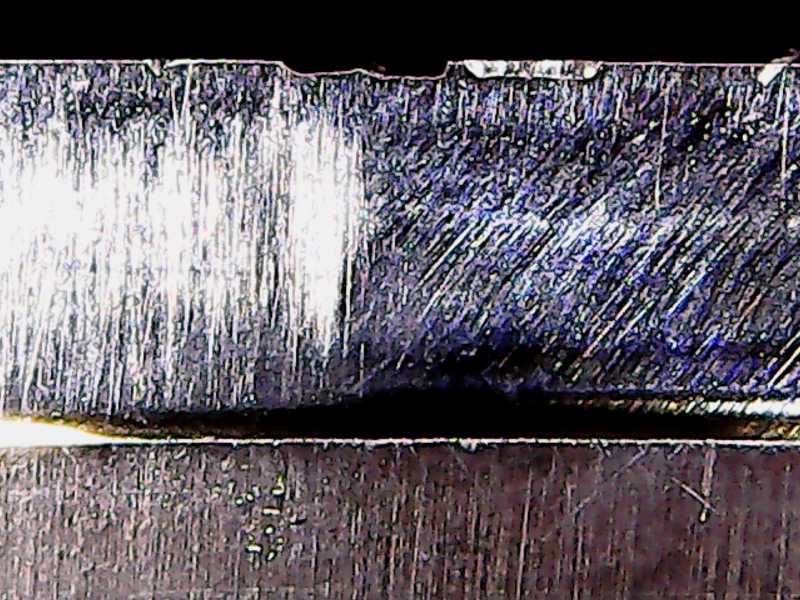
I find that finer grit hones will make narrower scratches, but not necessarily shallower scratches. The smaller the grit particle, the smaller the contact area and therefore the larger the pressure for a the same force. Have a look at the scratch depth in the Shapton 2k/4k/8k/16k images:
Blog
One advantage of polishing cloths is that the pressure exerted by the abrasive particles is moderated by the resilience of the cloth, so the scratches do get shallower with decreased abrasive size.
Lapping film has some of this resilience advantage and is also a great option for polishing.[/quote]
Agreed to an extent. I think where this conversation has detoured was what is the best next step from the 1K diamond stone before the strops. This is where the ceramics should fit in. AFter the ceramics then the strops would come into play. I do not think anyone is expecting a mirror finish from ceramics. Lapping films work great but do not last long. Water stones are great but are expensive and messy and need the reshaping. Ideally Ceramics would need the least amount of after care and transition nicely to the strops so you do not have to strop as long if you can knock the scratch pattern down from the 1K to something reasonable for the strops.
This lead into the ever confusing discussion about what grit is ceramics debate..and how does refinishing the ceramics effect the scratch pattern. It would make sense that if you took a hard ceramic that should be fully flat, and then roughed it up with a 100 grit stone, you would have less of the ceramic in contact with the blade edge due to the peaks and valleys you created with the 100 grit stone. Now, the smaller areas that are making contact with the metal would have an increased pressure for force on them against the metal thus possibly making the scratches deeper and more erratic. Why would you want that? The idea is to get a uniform lesser scratch pattern to transition to the strops. ON the softer ceramics the applied surface change with 100 grit would not last as long and go back to more or less flat. It would take longer on the harder ceramics. Although these are very interesting experiments, I would think a person would want to take the ceramic down to as even a surface you could without glazing it so the pressure would be the same throughout and contact area would be similar, and cutting ability would be matched to what it was intended for. I still hold hope that my super fine will work great as this in between stage from the 1K plate to the strops for a mirror.
Now when people talk abut a ceramic being the same material but a different finish… Which is where it feels some people were going here..you need to fully understand what is meant by different finish. Was the finish done by abrasion? Was the different finish caused by a different heating temperature? Was it finished different by adding an element such as some type of gas to the heating chamber during heating, or soaking or the cool down?
Think heat treating here. I would expect ceramic properties can be drastically changed by how they are heated and cooled and in what manner just like metal which would change the structure of how (even the same powder used) ends up being when all said and done. Then there is glazing that could occur or be added. So I think this is why defining a ceramic to a grit is so difficult. I am not sure what means you would use to “polish” ceramics..but I guess it is done. a quick search turned this up:
Ceramic processing is used to produce commercial products that are very diverse in size, shape, detail, complexity, and material composition, structure, and cost. The purpose of ceramics processing to an applied science is the natural result of an increasing ability to refine, develop, and characterize ceramic materials.
Ceramics are typically produced by the application of heat upon processed clays and other natural raw materials to form a rigid product. Ceramic products that use naturally occurring rocks and minerals as a starting material must undergo special processing in order to control purity, particle size, particle size distribution, and heterogeneity. These attributes play a big role in the final properties of the finished ceramic. Chemically prepared powders also are used as starting materials for some ceramic products. These synthetic materials can be controlled to produce powders with precise chemical compositions and particle size.
The next step is to form the ceramic particles into a desired shape. This is accomplished by the addition of water and/or additives such as binders, followed by a shape forming process. Some of the most common forming methods for ceramics include extrusion, slip casting, pressing, tape casting and injection molding. After the particles are formed, these “green” ceramics undergo a heat-treatment (called firing or sintering) to produce a rigid, finished product. Some ceramic products such as electrical insulators, dinnerware and tile may then undergo a glazing process. Some ceramics for advanced applications may undergo a machining and/or polishing step in order meet specific engineering design criteria.