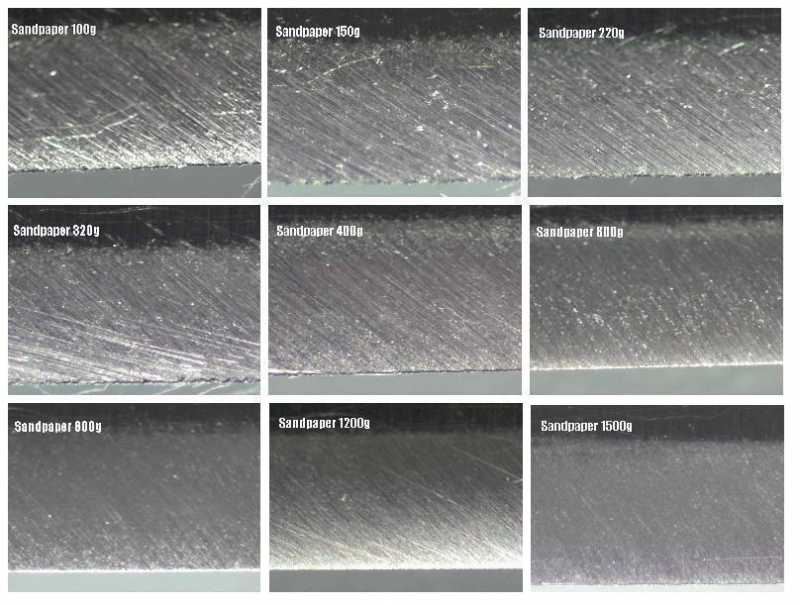
[quote quote=“PhilipPasteur” post=5079]If you look close you will see that all stones/plates rated at, say, 800 grit (as in your original question) do not have abrasives that are the same size. This is partially the result of several different stnadards that are in use to define grit sizes (Japanese, European, American) and the different methods used to measure the grits. If you check the hedings on the grand unified grit chart and you will see the names of the different standards. You will also see the various items rated at 800 grit can run from 22 down to 12 microns in real abrasive size. On the WEPS grit chart you will notice that the 800 dimond plates use 12 micron grit while the 800 Chosera stone have 14 micron grit size. Look at the 3000 Shapton with a 5 micron grit compared to the Chosera with a 4 micorn grit size. At this level the difference equates to 20%.
Of course this is just the beginning. Besides the grit size you have the material that the grit is made from. Then there is the shape and hardness of the grit material, how does it abrade. Typically the diamonds are sharper and harder the the AL Oxide in many synthetic stones. They will cause a very different scratch pattern in use even if the actual grit size is the same.
Then you get into the thing that would take a book to cover, the binder and brasive concentration of any given synthetic stone. We have already talked about the differences between Shaptons which release abrasives very slowly and the SS or Chosera stones that shed more and make a nice mud. This reflects the philophy behind the stones deigners. As Tom points out, the Choseras aim to polish as well as abrade. The Shaptons to make a perfect scratch pattern with polishing being much less important.
So what does this mean? Well, just because the grit of a plate or stone is listed as, say 800 grit (from your original question) you can’t make any assumptins about what it does at the edge. You need to know the actual grit size and type, the binder and design philosphy befor making any decisions about equivalency in your progression. Beyond that, try the stones, use magnification to see what is going on, then test the edge. Just keep in mind, 800 is not always 800 when rating abrasives…  [/quote]
You probably hit upon one of the reasons many say just stick with one set or type of stones… it’s easier than trying to figure out what works with what. :S I actually started a comparison chart a few years ago that tried to address this… I found that nobody compared different stones or “systems” to each other. The comparisons being made now though, are more detailed. That’s what I like about the WE and the studies that Clay is doing, as well as the information you’re sharing… it presents a better understanding of how things work… and can work together.
Edit: Here’s one old picture I did… a kid’s microscope (literally) compared to what’s being done now… :ohmy:
This is a good point. I read a comment once… stropping is done to refine the edge you already have… not to create the one that you want.
A bit of a side note… I found the book “The Art of Japanese Sword Polishing” a very interesting read… it goes into a lot of detail about the different types of stones used, how they’re used, and the type of finish and results you get. (Just thought I’d mention it, since the subject came up).