Trying to get my head around how I mount and setup tapered knives to achieve a bevel of the same width on each side.
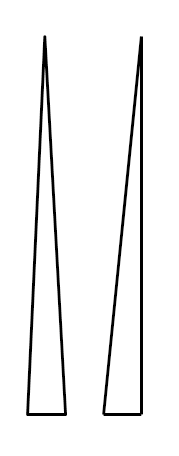
By tapered, I mean a knife that doesn’t have sides parallel to each other where the WEPS clamps.
A wide spine with flat sides evenly tapering to a thin edge, then a bevel.
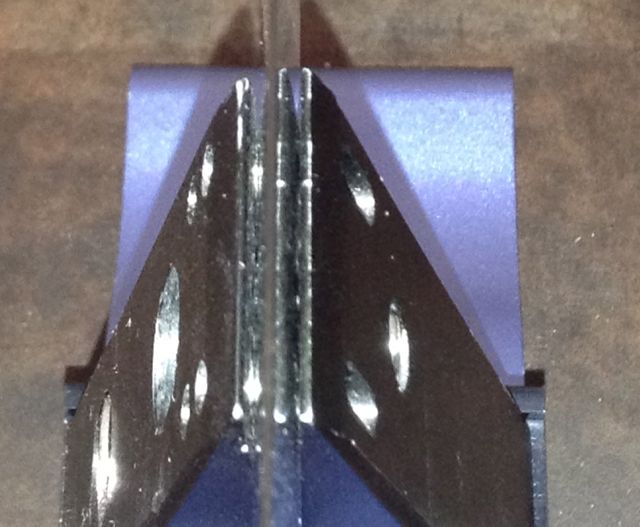
This picture (although not taken for this purpose) shows a correct illustration of angles being the same on each side.
But it uses a rectangular blade.
Of course it would still be the same if you were able to clamp a tapered blade in a perfect vertical plane, but the WEPS has trouble doing this.
As the left side of the clamp always remains fixed and perpendicular to the angle bar, it pulls the left face of the knife against it when clamped, while the right side of the clamp adjusts outward to achieve a tight grip on the knife face.
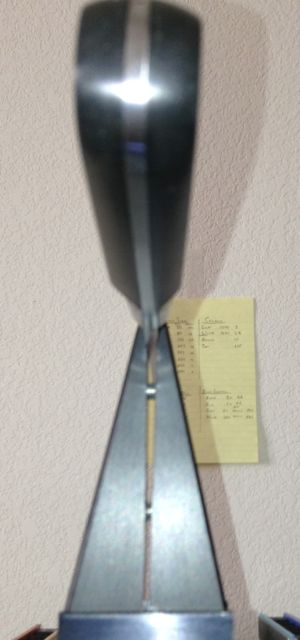
If you look under the clamped knife (between the left and right clamps) you will see a gap that tapers from narrow at the top to wider on the bottom.
Fine, you say, it’s a tapered blade?
You should also notice the right clamp is protruding out some distance at the bottom, no surprises once again?
But this also means the knife is angled to the left, if you look along the blade from the handle you can see this.
Now, if I set my angles to 20Ëš on each side with my angle guage, (like every one does) I will get a narrower bevel on the left side.
Even though I will achieve a correctly angled edge.
The only way I can see to obtain my goal is to somehow make the knife perfectly vertical in the clamp or deliberately have different angles on each side.
To get 20Ëš with even bevel, then perhaps I need 19.5Ëš on the left (less) and 20.5Ëš on the right (more)?
I’m guessing smaller changes would apply.
How to I calculate this while a knife is clamped?
Has this already been discussed somewhere before?
Should I just go outside and smell the roses instead?
I don’t quite understand the problem you describe. If the problem is that the knife isn’t perfectly vertical in the vise, try to clamp it using a piece of chamois. (Chamois? According to my dictionary this is an animal :-). I mean the soft leathery stuff.)
If the problem is that the knife is quite wide and that the right clamp protrudes to the right so much that the angle bar doesn’t indicate the correct angles anymore, use an angle cube.
If it’s yet another problem, please explain :-). Smelling roses is always a good idea. (Man, it’s getting winter where I live, almost freezing outside. Lucky you.)
I still don’t quite get it. The idea of chamois is that it is quite flexible and that it compresses at points where needed and not at other points. So it helps in getting a fully flat ground blade vertical. Foam tape might help, too. I use that myself. See here.
Why would you need to put chamois on the left side only? Or is the problem that your knife tapers only on one side?
Not sure if you did it just to emphasize the problem, but your bottom screw is definitely cranked in too far.
I try to start with the knife sitting in the vice and the inside surfaces of the vice being parralell. I do put blue painters tape on the blade and use a piece of Chamois or the soft kind of medical gauze wrapped all of the way around the spine of the knife and extending towards the edge of each side well past the tips of the jaws on both sides, this gives a layer that can be compressed at the spine but still gives support to the tapered sides of the knife. I then tighten the top screw down hard while making sure the blade is centered. Then I tighten the bottom screw, but no more that I have to to keep the knife from movingj, just snug. I try to keep the gap between the fixed and movable vice jaws equal top and bottom. The only time I ever saw my vice look like your pictures (pushed out that far at the bottom) was when I had bent the tip on one side of my vise.
Anyway, after I do things as described above, I get virtually identical bevels. Using the proper technique, you too can get that blade pretty close to dead on centered!!
Hmmmm. I looked at the info that was linked. It was pretty specifically about how to properly clamp a FFG (triangular) blade in the WEPS properly. Isn’t that what you want to be able to do?
That’s a good point. First tighten the top screw, only then the bottom one.[/quote]
I always do, is there another way?
The top screw sets the clamp angle and the bottom tightens the grip.
I pinch the clamp from above to match the blade angle on both sides, then bring the top screw in to gently hold that grip.
Then tightly secure it all with the bottom screw, which spreads the clamp out at the bottom and therefore in at the top.
Is this wrong?
edit - Can I suggest you kind people try this, you will see the knife leans to the left?
It’s no surprise, I’m just trying to work out the best way to counter this so I get an even bevel.
Not angle, bevel width the same on both sides.
[quote quote=“Billabong” post=7011]I pinch the clamp from above to match the blade angle on both sides, then bring the top screw in to gently hold that grip.
Then tightly secure it all with the bottom screw, which spreads the clamp out at the bottom and therefore in at the top.
Is this wrong?
edit - Can I suggest you kind people try this, you will see the knife leans to the left?
It’s no surprise, I’m just trying to work out the best way to counter this so I get an even bevel.
Not angle, bevel width the same on both sides.[/quote]
On FFG blades, don’t pinch the clamp to match the sides. Hold the blade vertical, and tighten the top screw. If you don’t pinch it, the clamp will grab at the base on both sides. Then tighten the bottom screw to secure the blade.
If you use a thin piece of leather (I like), or some foam tape (I didn’t like as much, I could get it to slip, but others have had success), it will help hold it. But, you can actually clamp it without anything.
I took a couple of pics… the first one shows the blade clamped with equal spacing on both sides (you have to look at it for a sec… maybe a little too close)… the 2nd one shows the position of the clamp sides on the same blade. No leather or foam, and the blade is tight.
Mark, if you pull your clamp off its mount.
So you have a left and a right side.
Then clamp any tapered knife so the sides touch the clamp “flush” top and bottom, no gaps.
Now sit the clamped knife on a bench, with the left side (base) of the clamp flat.
Your knife will have a lean to the left.
But, if you were able to attach this clamped knife back onto the mount with the knife at a perfect vertical, then life would be good!
That’s a good point. First tighten the top screw, only then the bottom one.[/quote]
I always do, is there another way?
The top screw sets the clamp angle and the bottom tightens the grip.
I pinch the clamp from above to match the blade angle on both sides, then bring the top screw in to gently hold that grip.
Then tightly secure it all with the bottom screw, which spreads the clamp out at the bottom and therefore in at the top.
Is this wrong?
edit - Can I suggest you kind people try this, you will see the knife leans to the left?
It’s no surprise, I’m just trying to work out the best way to counter this so I get an even bevel.
Not angle, bevel width the same on both sides.[/quote]
I tighten the top screw down hard and use some kind of material to help center the blade (as mentioned). The less you have to tighten the bottom screw the less potential you have of moving the blade off center. This has been discussed at length and techniques to mitigate the problem discovered. One approach is to do what I do, it works (did you even read my previous post).
Clay has discussed several design changes that might take some of the currently required attention to detail out of the process. These have ranged from mounting some kind of rubber tips to the vise to making a vice where both jaws are moveable and self centering. I guess my point is that you can position the knife so that you get equal bevels with the current system if you develop the proper technique. Some of those techniques are illustrated in Clay’s video, I offered one that works. If you check the forum, you will likely find others that have worked for other members. Point is it can be done.