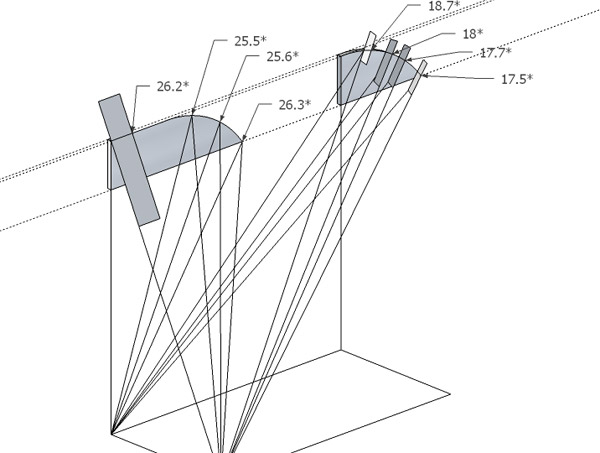
Thanks for your comments! It’s a fascinating subject, these angle changes. Ever since Clay brought it up for the first time, people have been learning new things about it. (And new misconceptions have arisen :-).)
Curtis made a good point:
You’re completely right. The angle not changing along the straight portion of the blade has nothing to do with the stone rotating around the guide rod.
Phil also made a good remark in the blog comments:
Well, yes and no. The angle changes I calculated are indeed only valid for the shape and clamp position of the blade in this case. However, I chose this case for a reason: I wanted to know what the maximum angle change along the tip curve could be.
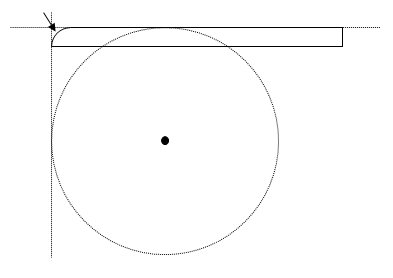
I therefore chose a blade shaped in such a way that the end of its tip points straight down. (The curve of the tip makes a 90 degree angle.) And the only way to clamp this blade in such a way that the sharpening angle at the end of the tip would be the same as along the straight portion of the blade, is the position I used in my blog:

The following statement by Curtis is not correct for the blade shape of the case under discussion, although it may be correct for other blade shapes:
Phil made a similar remark in the blog comments.
It is not possible to postion this blade in the clamp so that the end of the tip (or even any part of the tip curve other than its exact beginning) coincides with the circle. If you would position the blade so that the end of the tip touches the circle, you would be basically not be sharpening the end of this tip at all:

sweet spotHowever, please recall that I chose this blade shape for a reason. In many cases it is possible to position the knife in such a way that at least part of the tip curve “almost†coincides with the circle. In that case there is (as) little (as possible) angle change at that part of the curve. This is basically what you do when you try to find the .
And in special cases (when the tip curve follows the exact circle) it may be possible to position the blade in such a way that the entire tip curve coincides with the circle:

In that case there is no angle change at all along the entire tip curve.
So the following summarizes what I did and why.
[ul]
[li]We all know that the angle of a blade remains constant along the straight portion of the edge. We also know that the angle usually varies along the tip curve. The way in which this angle varies along the tip curve depends on the exact blade shape, the position of the blade in the clamp and the sharpening angle along the straight portion.[/li]
[li]In some special cases it it possible to position a blade in such a way that there is no angle change along the entire tip curve. Thus, the minimum angle change is 0 degrees.[/li]
[li]I wanted to know what the maximum angle change was.[/li]
[li]I therefore picked a blade with the most extreme tip shape: a tip with a 90 degree curve. I positioned this knife in the clamp so that the angle change on one spot of the tip curve (the end) would be 0 degrees.[/li]
[li]I then calculated what the maximum angle change would be on this tip curve. It is x – arctan(tan(x)/sqrt(2)), where x is the sharpening angle along the straight portion of the blade.[/li]
[/ul]
Thus we can conclude that the angle change on the tip curve is somewhere between 0 and x – arctan(tan(x)/sqrt(2)). The exact angle change at each spot on the tip curve differs per shape and clamp position of the blade.