The sweet spot discussion from a few days ago rattled this loose that I had early on attempted to make and had left partially complete.
Now with the help of a belt sander and more experience it doesnt quite look like a failed 8th grade shop project anymore(kinda):
Its adjustable up and down and has independent clamping vise jaws for FFG and kitchen knives.
The rods are aftermarket 11" long and the lock collars under the paddles become VERY important. Without them the stones will slide down the face of the knife and wreck your day!
I can see something like this having very mainstream applications. I know that for my system this setup will see use especially on many larger kitchen knives.
Dude that looks great!! I have wondered if Clay can, for the 4th gen vise, create one that will have a center knob that will allow you to spread the jaws or move them in with a simple twist of a knob! I love what you did here, you have a very creative mind my friend!
And I have GOT to get some of those stop collars! Where do you get them from? I would need the .375" size though…
Josh you know me, Im the bargain basement Baron. I took a 50 cent nylon sleeve from the hardware and tapped the threads for a nylon screw to be inserted. Works!
The 2 things I like about this vise concept is first it can be raised to change to increase the arc of the sweet spot…and the independantly adjustable vise jaws allow for different tapered blade profiles to be locked in.
A side bonus is you can adjust the vertical plumb of the blade while its clamped by loosening one side and tightening the other.
The only design flaw Id change if doing again would be to stack the adjustment screws vertically down the middle instead of staggering them side to side(on their respective sides), it tends to twist the vise jaws a bit wonky.
My brother made a mock-up of the WEPS using some hardware he bought at a local Habitat Restore. His vise sat at about chest level and the pivot point was down on the floor. About a 54" radius. Worked really nice, but wouldn’t follow a short radius belly.
Ok, I thought Clay brought his up in another thread, (can’t find it right now), but doesn’t the fact that the stone pivots or rotates around the rod allow it to “follow the curve”? I know you still have to set it for the angle… but didn’t think it was necessary for the curve???
The paddles will follow the curve and can rotate to adjust to blade contours if Im understanding your question right…the vertical adjustment is just to allow for different blade profiles(curves) better.
The closer the blades curve is to the exact curve of the sweeping arc of the paddle as it travels will mean that the bevel angle your sharpening at will remain constant throughout the length of the bevel.
The only really point or advantage I am aware of to having the vise higher up is widening the sweet spot for shallow curves like on the apex bevel of longer kitchen knives. At least that was its only intended purpose.
With a giant rig at Tom described I can easily visualize how it would sharpen a samurai sword(not that you would) by following the sweep closely along the same arc of the giant blade.
Sorry I can’t post a diagram, but for a stone to follow a specific angle as the edge sweeps down towards the pivot point, it needs to stay more or less perpendicular to the edge. Where the rod end pivot point is way off to the south - “no can do.” If the tip sweeps to a vertical orientatation, the stone can rotate about the rod and therefor about the tip, Thereby losing any reference to the plane of the knife’s edge.
Cool. Didn’t want a diagram… more interested in actually what happened with your brother’s setup.
I can understand that the stone can’t follow a curve if the radius doesn’t match, IF the stone didn’t also rotate. But since it does, I’m back to the original question, how necessary is adjusting the height?
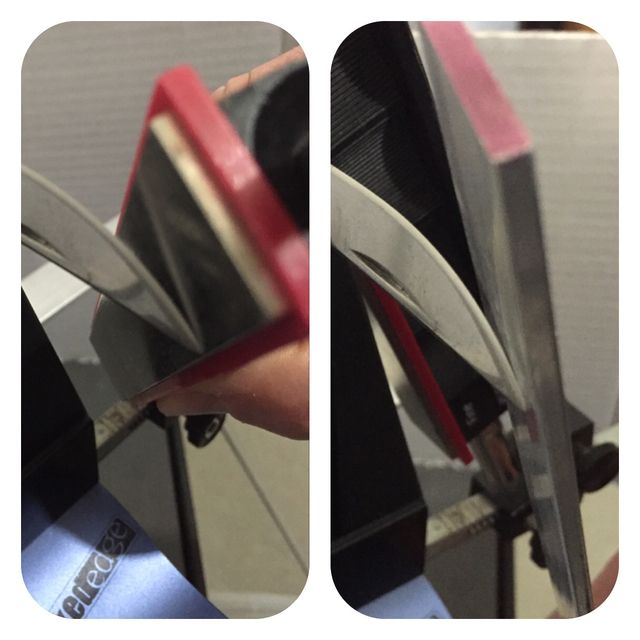
Here’s the best I could do this a.m. …
Took a flat aluminum bar 3ft. long, and tried to duplicate the pivot location and 20° angle of a standard setup. Then tried to take a picture of the “stone” at the tip. Because the stone rotates, it appears that it could still cover the tip (since I can’t actually sharpen, maybe not).
My guess is that at some point it would matter, for example when the blade curve reaches 90° perpendicular. (Which also leads me to wonder that when we pivot the blade, are we really approximating the arc, or just keeping the curve in a position where the change doesn’t significantly matter?)
Mostly I wonder simply because a lot of knives of various shapes have been sharpened without the use of any vertical change, not just on the WE, but many guided devices of various sizes. Not saying it doesn’t make setup any easier, my guess is it does, just… does it ultimately affect the outcome?
My brother’s rig does beautifully on the knives he sharpens, which are all kitchen knives with very little curve to them. Imagine sharpening the tip of a Tanto though. (Yes, I know to move the blade so as to put the forward edge in a horizontal plane - this is just for demonstration purposes) The stone would stay almost vertical at the tip and be free to rotate around the edge. The pivot point on the WEPS is chosen to best match a broad variety of knives - most of which have some degree of belly to them. The closer the blade conforms to the radial sweep of the rods, the more uniform the bevel angle will be. For relatively straight blades, the more the constant-angle horizontal plane rule applies.
On a related point, consider that you have a blade like the CRKT Razel, where the forward edge is at a right angle to the main edge. If you were to mount the blade with the tip immediately forward of the vise, the bevel angle there would be closer to 90 degrees than 20. So you move the knife forward, (if it will reach that far) so as to put the angle close to your desired angle. This is the same principle as “finding the sweet spot,” but in an extreme case.
The only reason I can see for increasing the height of the vise is to more closely match up to much larger, deep belly blades.
Thanks. Your reply certainly makes sense… the Razel is a good example of what I said… as you approach 90° the pivot distance matters (which now makes me think a real benefit would be in being able to lower a knife).
I guess at some point, if anyone who is doing this could come up with a table of… this pivot distance works on this knife… that would be interesting to see.
And I have GOT to get some of those stop collars! Where do you get them from? I would need the .375″ size though…
Josh you know me, Im the bargain basement Baron. I took a 50 cent nylon sleeve from the hardware and tapped the threads for a nylon screw to be inserted. Works! The 2 things I like about this vise concept is first it can be raised to change to increase the arc of the sweet spot….and the independantly adjustable vise jaws allow for different tapered blade profiles to be locked in. A side bonus is you can adjust the vertical plumb of the blade while its clamped by loosening one side and tightening the other. The only design flaw Id change if doing again would be to stack the adjustment screws vertically down the middle instead of staggering them side to side(on their respective sides), it tends to twist the vise jaws a bit wonky. [/quote]
You are resourceful as usual, my friend!
If the two bottom jacking screws are done inline, certainly as you already realized, will eliminate the unpleasant twist.
If I may suggest, if it is not already done, radius the end of the jacking screws will also eliminate marring the opposite jacking flat!?


 The 2 things I like about this vise concept is first it can be raised to change to increase the arc of the sweet spot….and the independantly adjustable vise jaws allow for different tapered blade profiles to be locked in. A side bonus is you can adjust the vertical plumb of the blade while its clamped by loosening one side and tightening the other. The only design flaw Id change if doing again would be to stack the adjustment screws vertically down the middle instead of staggering them side to side(on their respective sides), it tends to twist the vise jaws a bit wonky. [/quote]