White Steel and Super Blue Steel

I have some knives coming from Bladesmith Murray Carter. They are made from either white steel with one of them made from “Blue Super” steel.

Are these sharpened in any special way or still in normal progression? I’m assuming these are blended steel formulations. His work making custom knives is amazing and I don’t want to “experiment” on these as one new to knife sharpening.

I’ll post some pics as soon as they arrive.

[quote quote=“ElPasoTom” post=2653]I have some knives coming from Bladesmith Murray Carter. They are made from either white steel with one of them made from “Blue Super” steel.

Are these sharpened in any special way or still in normal progression? I’m assuming these are blended steel formulations. His work making custom knives is amazing and I don’t want to “experiment” on these as one new to knife sharpening.

I’ll post some pics as soon as they arrive.[/quote]

That’s super exciting! He’s an phenomenal knife maker and they should be a treat to work with. I can make some recommendations once you get them in and post some pictures.

I’m very interested in this too, Clay. I have several Murray Carter knives, shown here:
http://www.youtube.com/watch?v=GgqjnjF0_Fg

If that provides you enough for any recommendations, I’d love to hear them. Also happy to take some close-up pictures.

Thanks,
Dan

Hey Dan,

Can you send me the specs on each of those beautiful knives along w/ a close up photo?

-Clay

Hey Clay,

Started taking a few this evening and quickly realized I suck at taking pictures of blades! Going to have to work on that. The photos you take of yours are beauties and really show of the qualities of the blade.

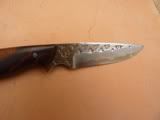
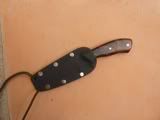
Here are a few I took of Murray’s Original pattern neck knife, the right, uppermost knife in the overall collection photo. Hoping that will help size the other blades. I’m happy to take other close-ups of the other blades, but it might take a few days to happen. Other than length, let me know what other blade specs you might need.

(Click to access WebShots where full size can be downloaded)

~Dan

Dan, nice collection i’m suprised you took the neck knife off long enough to photograph it:P

Thanks, ElPasoTom! If you have one in your order, you’re going to love it! I have to keep myself from ordering another, though he just came out with what he calls is Perfect profile and I might just give in for that one.

Just realized I sort of hijacked your thread here and I apologize for that. Definitely interested in any opinions on sharpening these steels.

~Dan

Dan,

No problem… I’m new here myself. Glad to see another fan of Carter Cutlery. I’ll only have two of his pieces though.

5.7 sun Stainless Fukugozai Wabocho in Blue Super steel

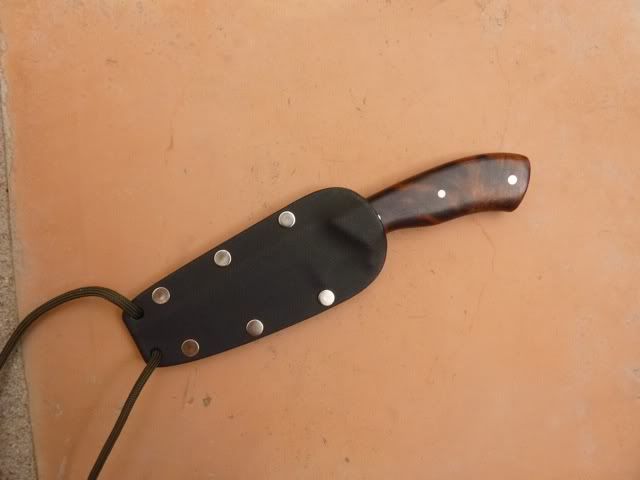
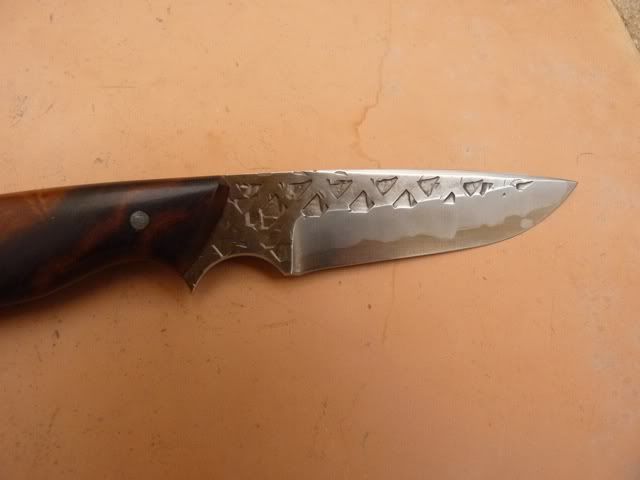
Neck knife 182 Oyako hammer finish white steel, ironwood handle

So lets figure out how to keep em sharp

Thomas

I need to acquire one of his knives too!

OK,

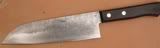
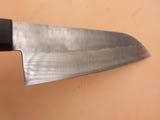
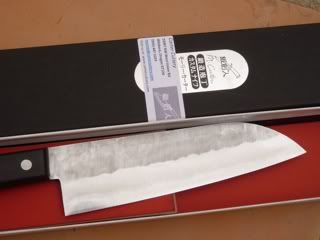
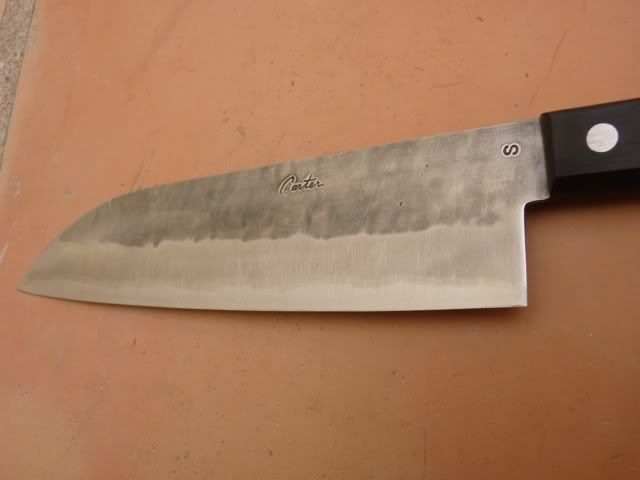
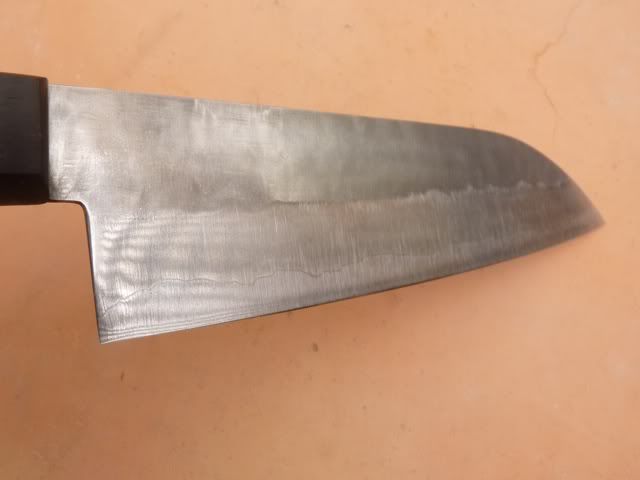
Got a nice surprise in the mail today. Two new Murray Carter Knives.

Kitchen knife is in Blue Super steel


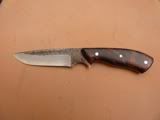
Neck knife in white steel with hammer finish


Sharp as hell too!

Trying with larger pics… sorry still getting used to the forum and photobucket.


These would look even more beautiful with a natural stone finish on them. Thiis provides contrast between the soft cladding or jigane and the harder core of white or blue carbon steel or hagane.

And yes I do have some natural stones available for the WEPs for just such a knife.


Ken

Ken,

First i have to get a WEPS, currently not scheduled to ship until end of April. I also ordered the ceramic stones, and a full set of Choseras. Where would these “natural stones” fit into the progression, or how would i make use of them?

Thanks

Thomas

Wooh! Those are beautiful! I just realize our kitchen is in desperate need of a Murray Carter knife… :mrgreen:

Thomas, you can increase the picture size by uploading larger sized pictures to Photobucket. The ones you uploaded are 320x240 pixels. Photobucket is quite generous with space. I usually upload 1024x768 photos.

Natural stones, among other things, provide a ‘natural stone finish’.m This finish treats the core steel differently than the softer cladding steel, providing contrast between the two and revealing structural characteristics of the knife. Rather than giving the same shiny finish to both steels, the softer steel produces a matte finish because it more easily is scratched by the natural stone and the core steel gets a shiny finish but with a slight black haze to it or kurobikari finish. This reveals the structure of the steel, giving the knife a most interesting finish. Some rare synthetic stones also produce a similar effect such as the Nubatama 2000 grit stone as seen in this video

[video]http://www.youtube.com/watch?v=cFt7mdKP4PU[/video]

Where I 'convert a typical synthetic stone finish to a finish closely resembling a natural stone finish. Note the change in contrast on this blue steel knife (specifically aogami super).

So in a sense these stones represent a parallel series of stones with some fascinating characteristics of their own. You can transition from synthetic stones to naturals at any point along the sequence of refining an edge and you can follow the natural stones with compounds as well and even use compounds on naturals as a component of the slurry.

The edges produced are quite different especially under a scope, and have different characteristics particularly as regards edge longevity. You will also find that for instance for some tasks the particular toothiness of an aoto (medium grit range natural) will provide an edge very well suited for a butcher - not overly refined but very pleasant to use for meat cutting. This is a very long topic and one that would completely take this thread way off topic.

Natural stones ‘react’ in an individual manner to different steels and different methods of using steel by individual knifemakers, so in my opinion a knife made using traditional Japanese steels by a traditional Japanese style knife maker like Murray would react very favorably to sharpening with natural stones.


Ken

[quote quote=“ElPasoTom” post=2727]Ken,

First i have to get a WEPS, currently not scheduled to ship until end of April. I also ordered the ceramic stones, and a full set of Choseras. Where would these “natural stones” fit into the progression, or how would i make use of them?

Thanks

Thomas[/quote]

Ken, this is beautiful! I didn’t know that some natural stones leave such a finish. Is that because the abrasive stuff in the natural stones is softer than in most synthetic stones? It gives a great finish. (And now I know it, I suddenly see this finish on many other Japanese knives.)

But what is absolutely amazing are your sharpening skills.

:woohoo: :woohoo: :woohoo: :woohoo:

And then: three degrees! And then just go to five degrees and know that it is five as if you do nothing else all day :woohoo: .

And then such a beautiful beautiful knife :cheer:.

I am going to drop dead in just a minute… :silly:

[quote quote=“mark76” post=2732]Ken, this is beautiful! I didn’t know that some natural stones leave such a finish. Is that because the abrasive stuff in the natural stones is softer than in most synthetic stones? It gives a beautiful finish. (And now I know it, I suddenly see this finish on many other Japanese knives.)

But what is absolutely amazing are your sharpening skills.

:woohoo: :woohoo: :woohoo: :woohoo:

And then: three degrees! And then just go to five degrees and know that it is five as if you do nothing else all day :woohoo: .

And then such a beautiful beautiful knife :cheer:.

I am going to drop dead in just a minute… :silly:[/quote]

“I didn’t know that some natural stones leave such a finish. Is that because the abrasive stuff in the natural stones is softer than in most synthetic stones? It gives a beautiful finish. (And now I know it, I suddenly see this finish on many other Japanese knives.)”

Your reasoning is exactly correct. Aluminum oxide and silicon carbide, two of the more common abrasives in synthetic stones are FAR harder than the natural abrasives found in Japanese Natural stones so there is very little differentiation between how they react or treat the softer and harder steels. The natural abrasives are both softer and more varied in particle size distribution and individual particle makeup. The shapes of the individual particles themselves are not the precise spheres and other regular geometric shapes we see in synthetics and compounds, but sometimes are more flakelike or have other shapes that are more mine specific. The binding mechanism is different too than the binding sysytems employed in synthetic stones.

Mark, my sharpening skills are not as amazing as you are saying at all. Let me clarify. When I got this knife used some time ago I resharpened it using a device I made for controlling angles and at that time I made a symmetric triple bevel with the device at 3.0 degrees, followed by a microbevel at 5.0 degrees followed by a third bevel at 7.0 degrees - three distinct bevels, per side with all three bevels per side (six total ALL polished up to a fine grit level (I believe it was a 16k Shapton GlassStone finish if I correctly remember it.). I did this as a technique demonstration at the time because I knew of no other device capable of doing this (still don’t).

I could not do this freehand and don’t think anyone else can do it either because doing it (especially for 311 mm at the same three angles) is, IMHO beyond the mechanical abilities of the human hand to do freehand at this level of precision.

What I am doing in this video is much more humble a goal. I am blending these three distinct angles into a convex bevel - much like smoothing out the corners of a stop sign into a circle. This convex grind is often referred to as a hamaguri grind. This is within the limits of human precision. I am also doing more of a zero grind - in other words there is NO bevel on the edge at all - just the two sides of the knife meeting. This is accomplished by pressing very close to the edge of the edge. So this edge is somewhere between a zero grind and a very acute thinned hamaguri grind.

Here this stone is somewhat softer than a Shapton and the mud acts to give a less precise grind, allowing the rounding or convexing to occur - favoring the conversion to a hamaguri grind.

What is most interesting about this particular stone is the way it differentiates the soft cladding from the harder core steel and gives as close to a natural stone finish as any synthetic stone I have seen. Furthermore, even among natural stones, the kasumi finish or hazy finish is often less consistent than this stone. When I shot the video and first turned the edge over to see what I had done, I was about to squeal some ‘expletives of joy’ but fortunately caught myself from ruining the video. That a synthetic stone is capable of doing this is most remarkable and reflects a very deep understanding to have even created such a stone. Seeing this stone in action gives me a great deal of humility to stand before it seeing this being accomplished - far beyond my level of understanding as to how this stone was formulated.

So going back to the original topic, bringing out this level of contrast on a knife like Murray’s would be a particularly nice way to enhance or more accurately bring out the quality of his work using a natural stone finish. His steels are very traditional Japanese steels so doing this would be a very nice matchup.

Doing this on the Wicked Edge would allow producing this effect to be done with precision. I have natural stones mounted on the WE platform specifically for this task - going from coarser natural stones like the Amakusa and natural Kyushu Ohmura to natural Aoto, Binsui, Igarashi and Yaginoshima Asagi to name a few. I had planned to introduce these a bit later to the Wicked Edge, but given an interest, I can certainly move this along more quickly.


Ken

Ken,

So excuse a novice sharpener, but all this discussion about natural stones… is this sharpening just the edge of the knife, or more of the surface of the knife as well? Do you have any photos you can put up that show this end result. A before and after would be wonderful if you have it too.

Thanks

Thomas

Thanks Ken, for the explanation. Where I live we have a saying “modesty is a virtue”. I think you have at least one virtue :mrgreen:.

But I won’t drag this threat off-topic any further. These natural stones give a great finish to beautiful knives!

[quote quote=“ElPasoTom” post=2734]Ken,

So excuse a novice sharpener, but all this discussion about natural stones… is this sharpening just the edge of the knife, or more of the surface of the knife as well? Do you have any photos you can put up that show this end result. A before and after would be wonderful if you have it too.

Thanks

Thomas
[/quote]

Thomas if you are up for it I would like to put a natural stone finish on the knife you just posted. A perfect opportunity to show a before and after.

Please send me a PM. This would be an interesting project (at no cost).


Ken