As discussed above, I experimented with my VSTA’s using a series of my blocks, all of which have been modified to add bronze bushings to tighten their angular variability.
After my intial testing and comfortable that ten readings would be valid, I then took ten readings of eight blocks, after using the VSTA adapter to set each block to the reference angle.
Sorry, but the spreadsheet doesn’t copy very well, but you get the drift…
The results show that properly used, the VSTA (SWAT for you old-timers) should produce angles within about 0.23 degrees of each other, or plus/minus 0.115 degrees. If I toss out the last two sets of samples, the range is much better at +/- 0.07 degrees. As for you statistics guys, come on. Lighten up.
Note that each stone was reset to the reference angle with the VSTA, so the variability listed included all the possible contributing factors - The variability in the stone, the execution of the VSTA procedure and the actual taking of readings.
Wow, interesting experiment! It seems that you can get very accurate results using the VTSA. Particularly since the your measurement results include not only the actual angle differences, but also measurement errors . (I know how difficult it is to measure a 0.1 degree angle difference with an angle gauge. And these things are accurate up to x only, too.)
Did you include stones in your test set that are much thicker than the stock stones? Like the Chosera’s?
I don’t have any stones that are more than 0.020 or 0.030 different, so I can’t say for sure.
But I did a little checking of the geometry in a simple CAD program. It occurred to me soon after the VSTA came out that the micro adjusts set the offset at about 10 degrees, but the actual difference in thickness showed up at about 20 degrees for most of my sharpenings. In other words, the VSTA was designed to correct for thicknesses in stones used at about 10 degrees. However: large differences in stone thickness could fall outside of the micro-adjust’s range, and require movement in the base at the degree bar, which is not at 10 degrees, but at zero degrees.
Stone thicknesses which were adjusted for within the range of the micro-adjusts - say 1/4", would result in angular errors of only about 0.10 degrees. Changes in the degree bar setting are done horizontally and don’t account for the angle of the rod. If my method is right, a 1/2" offset taken in the horizontal axis could produce an error of 0.65 degree for the resultant rod angle. Pretty awful.
A lesson from this? Set-up your VSTA’s with the thinnest of your stones and the micro-adjust’s set near their inboard limit. This would allow you to make whatever adjustments you needed for thicker stones with the micro-adjusts and reduce any geometric errors. You don’t want to use the degree bar as the offset method. So how thick are the Choseras?
So far as I know, this is the first time anybody’s pointed to this problem. Has anybody else noticed this? Am I full of sh__?
I’ve got the original arms, but I don’t have any original blocks. The idea is interesting, but the original arms are only adjustable in the horizontal axis. I’ll have to at least try it to see how well it works with stones of roughly the same thickness. Maybe later this week.
I don’t know if you picked up on it, but the first three columns of data were using the same stone - just repeating the setting procedure.
Clay: Do you know what the thickness of a Chosera block is? Didja get my gift package yet?
[quote quote=“tcmeyer” post=18570]I’ve got the original arms, but I don’t have any original blocks. The idea is interesting, but the original arms are only adjustable in the horizontal axis. I’ll have to at least try it to see how well it works with stones of roughly the same thickness. Maybe later this week.
I don’t know if you picked up on it, but the first three columns of data were using the same stone - just repeating the setting procedure.
Clay: Do you know what the thickness of a Chosera block is? Didja get my gift package yet?[/quote]
I think it would be interesting to study the differences of using the VSTA with the original and upgraded arms.
First, thanks for your original post. I think it’s very clear and useful.
Would you be able to describe any more precisely how you converted your paddles? What tools you used. etc.? Anything you’re willing to share. I see that you say a little more in reply to another response which is already useful.
It’s very important for me to find a way to add bearings to all of my paddles, but I’m not sure if I will be able to do it myself or whether I will need to find help doing it. I use my tools for work everyday for a micro precision task and if my knives are not “just right” it’s as if they aren’t sharp at all. Other posts about technique have helped me to work around this problem to some degree, but not entirely. So I can’t thank you enough in advance for any help on this issue.
Thanks again for all the info on this link! I sent you a private message a while ago. I wonder if perhaps you didn’t receive it and therefore am cluttering up this thread with a public/private message asking if you did. Sorry if I’m not using the forum correctly by doing this. If I am, anyone reading this: please feel free to tell me to: DESIST
Thanks again for all the info on this link! I sent you a private message a while ago. I wonder if perhaps you didn’t receive it and therefore am cluttering up this thread with a public/private message asking if you did. Sorry if I’m not using the forum correctly by doing this. If I am, anyone reading this: please feel free to tell me to: DESIST :)[/quote]
Gus,
Welcome to the forum! How are you going to figure this thing out if ya don’t ask questions?? I would say your safe to ask away around here. Everyone is always real eager to help the next guy coming along.
It looks like things may have got confused with your PM? TCMEYER is always willing to help. I would wait as he should be along soon and will see this.
Good luck with your WE and remember to always have fun!
I’ve PM’d Gus and must apologize for the error of my ways. When I invited Gus to send me his e-mail address, someone else jumped in ahead of him. Since the name was completely different, I thought it was Gus, and having sent him the requested info, I stopped checking my PM’s.
Tom-
Thanks for the last message. Since for mysterious reasons even my emails don’t go through, I send you another personal message. Sorry to clutter up this link!
Thanks for understanding!
Gus
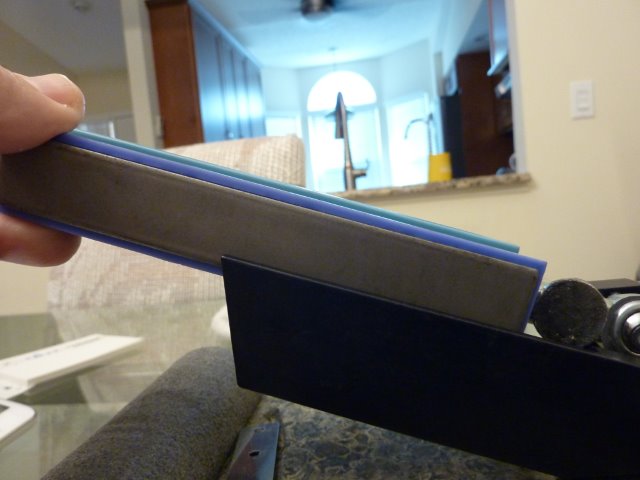
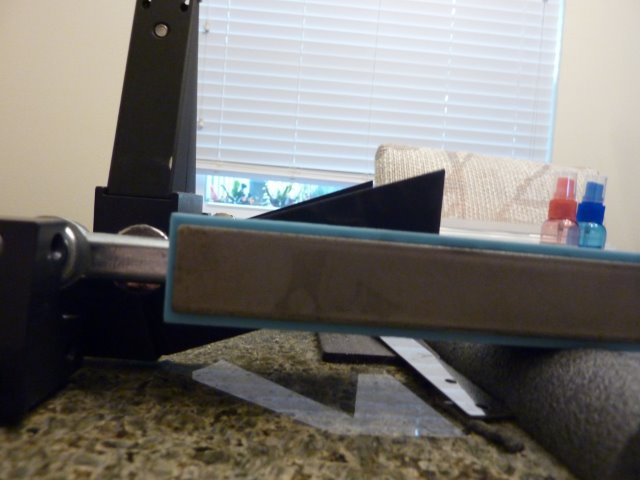
Back to the original post: Is there more then one shape or Model VTSA made? I have the PPII and my VTSA is at a different height than my plates. When I pivot the Diamond plate so to get maximum overlap of Diamond plate surface held flat against the VTSA the Diamond plate’s long top edge is between 0 degrees and 4 degrees relative to the mounting base but the VTSA’s long top edge is fixed at approximately 20 degrees.
When I pivot the mounted Diamond plate to make the long top edge parallel to the long top edge of the VTSA and at the same roughly 20 degree angle they only overlap by approximately 3/8".
The Diamond plate is above the VTSA and barley overlapping when pivoted and held long bottom edge parallel to long top edge of the VTSA and at the same angle relative to the mounting base. Are the plates or stones and the VTSA supposed to overlap, superimposed, and lay flat against one another while the top long edges are parallel?
From the pictures in the original post it appears they are but it’s hard to tell.
I had wondered the same thing. Maybe they were designed for the older arms? OR..there is a method or reason to have them shaped this way and angled this way that I do not understand just yet. Regardless, they work for the PP2, but it seems they could work even better if they aligned up more? Or maybe they were designed for a happy medium so they work on both style of arms. Having a small business myself, I understand how important it is to minimize “options” and variations. If you can get one to work for both it is much better from a business standpoint.
In your second picture it looks like the height difference is about the same as the riser block that gets added to the vise for the PP2 arms eh?
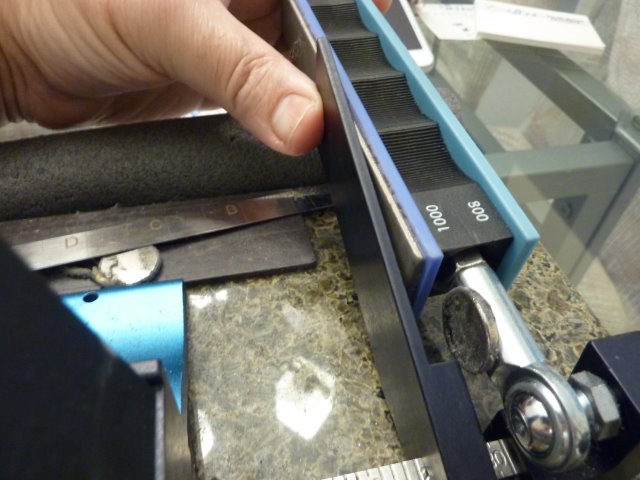
Somehow I missed this post the other day. The VSTAs are designed to work with either set of pivots, basic or pro. They don’t need to align perfectly, all you need is a couple of inches of stone against the plate to get them flat. Looking at HoodMa1’s top picture, the right technique would be to loosen the collar, slide the stone over to mate with the plate and then pinch the stone to the plate with thumb and fingers right around the first finger groove after the grit numbers on the paddles. If you do that, you’ll have plenty of contact from stone to plate and then you can tighten the collar once you have it flush.
Since this thread was started, I’ve added one little step to my method.
I noticed early on that if you carefully set the angle of the VSTA as described, the resulting angle you get with subsequent stones seemed to be about 0.1 degree different. I couldn’t feel anything in the stones or the rods, so I tried adding pressure against the ball joint. In other words, I pinch the stone against the VSTA, but then I push both of them against the rod-end ball joint while I tighten the VSTA collar into place. Seem to help. I think there’s some degree of error that occurs as you tighten the collar screw. This pushes it to one side.
[quote quote=“tcmeyer” post=20631]Since this thread was started, I’ve added one little step to my method.
I noticed early on that if you carefully set the angle of the VSTA as described, the resulting angle you get with subsequent stones seemed to be about 0.1 degree different. I couldn’t feel anything in the stones or the rods, so I tried adding pressure against the ball joint. In other words, I pinch the stone against the VSTA, but then I push both of them against the rod-end ball joint while I tighten the VSTA collar into place. Seem to help. I think there’s some degree of error that occurs as you tighten the collar screw. This pushes it to one side.[/quote]
Agreed! The Vista has to move and the Vista will also self level itself as you tighten it. As long as you are holding the stone tight against the vista and then push like you said while you tighten that sets the Vistas right to start with.
Where I was having problems is when I moved on to another set of stones I did not have a method to (and I did not think about) the ball joint movement.
What I love about your method is you first angle it and put pressure on the stone at the top and then adjust with the pressure so it is very repeatable. Looking forward to trying that method on my next mirror job and having the usb microscope handy.
 . (I know how difficult it is to measure a 0.1 degree angle difference with an angle gauge. And these things are accurate up to