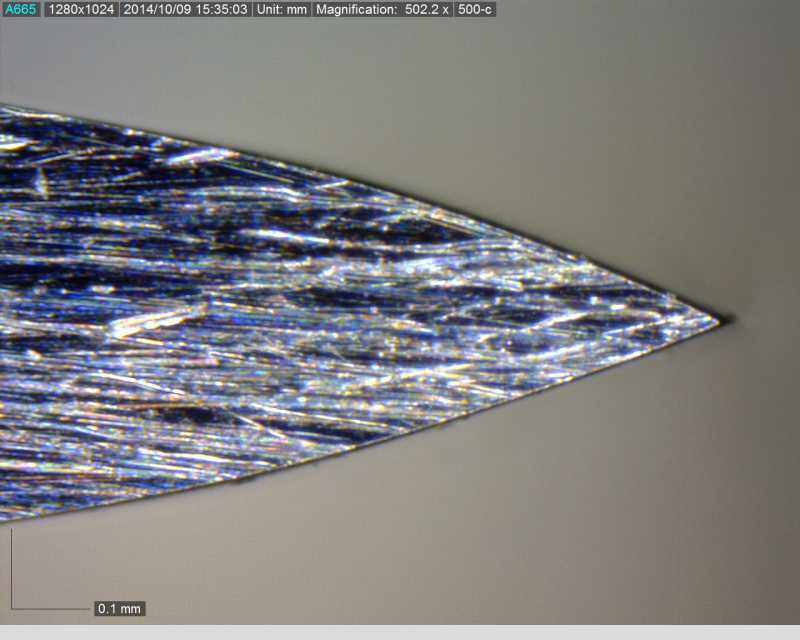
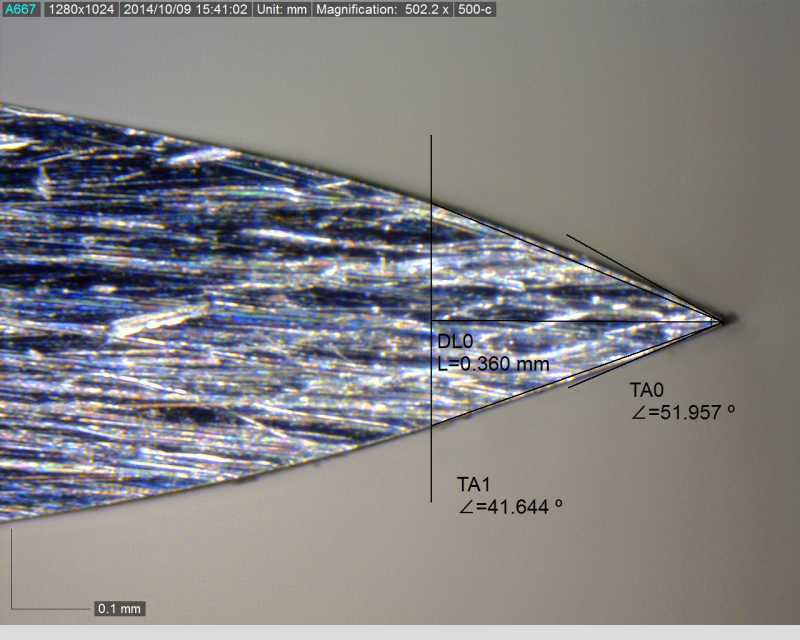
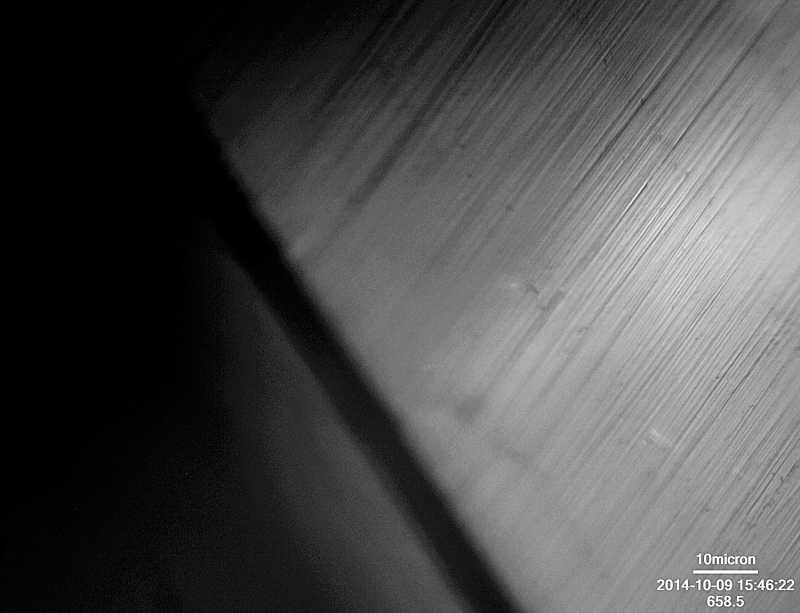
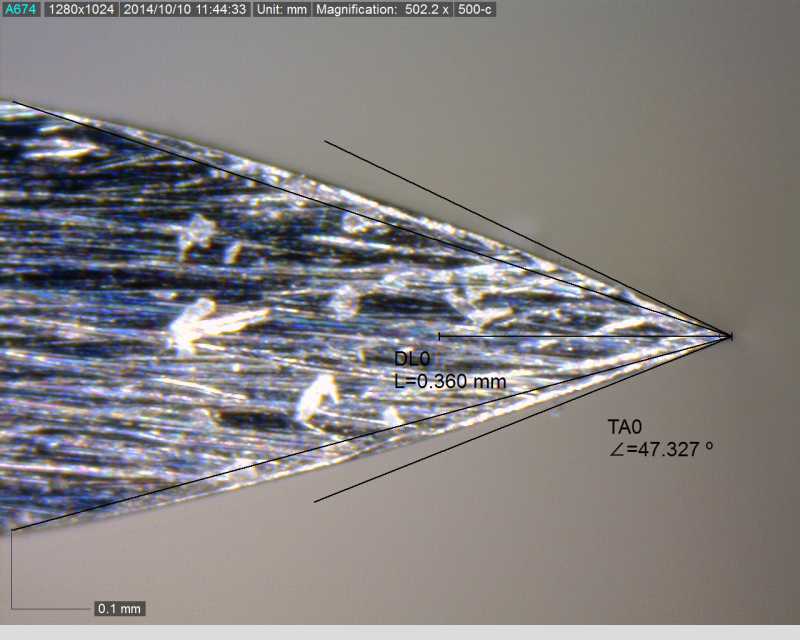
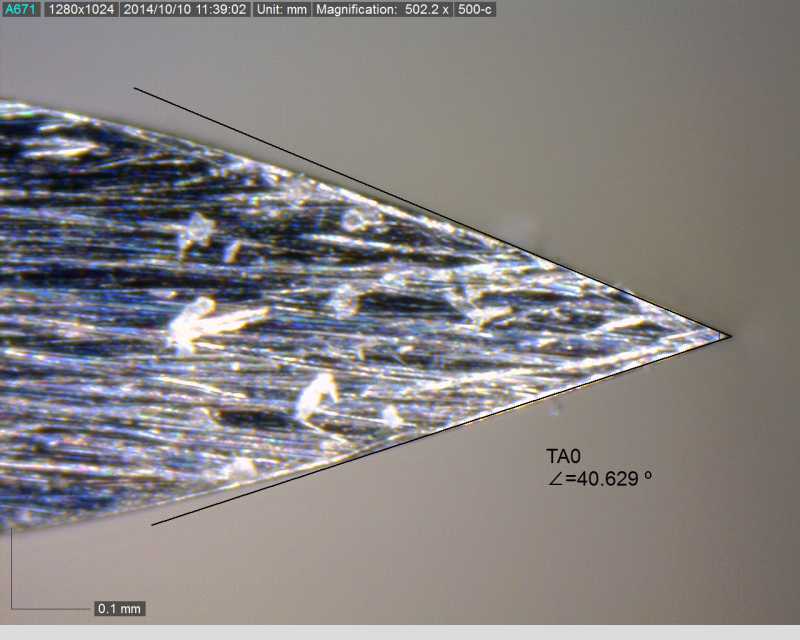
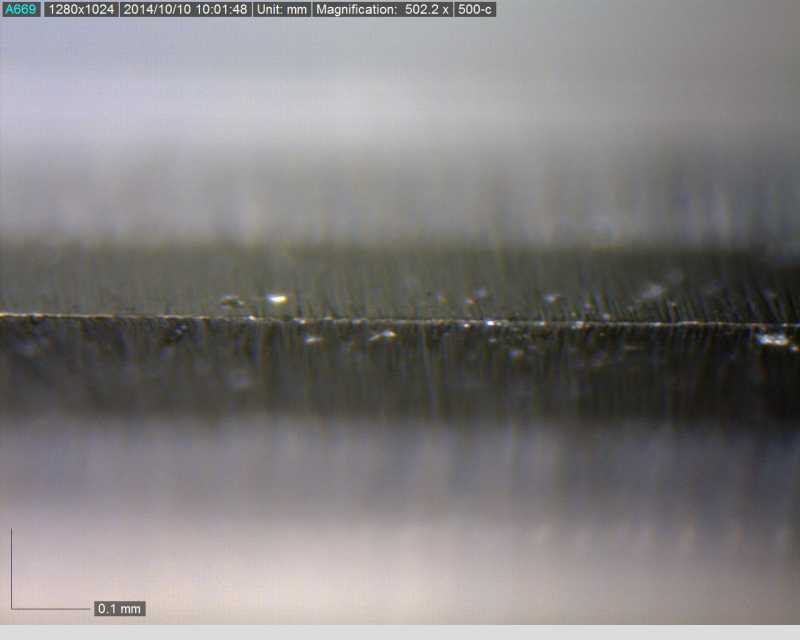
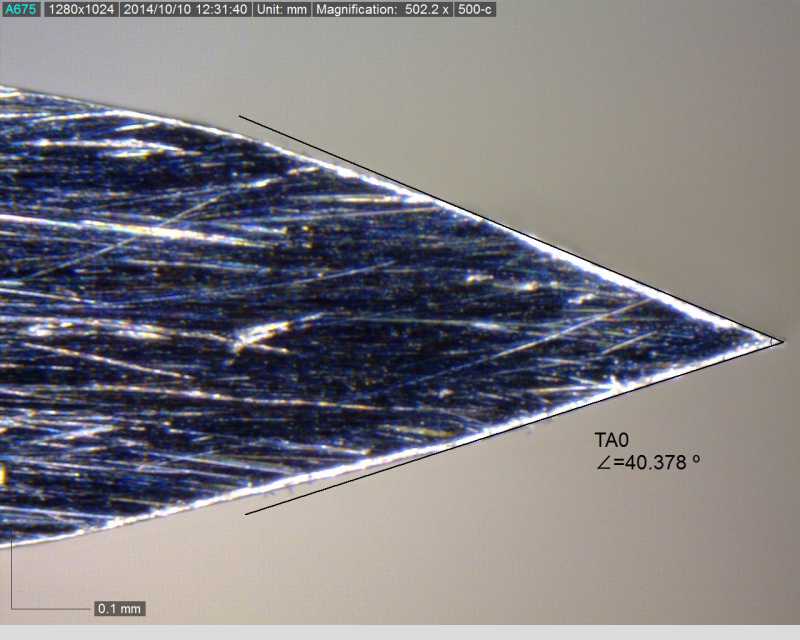
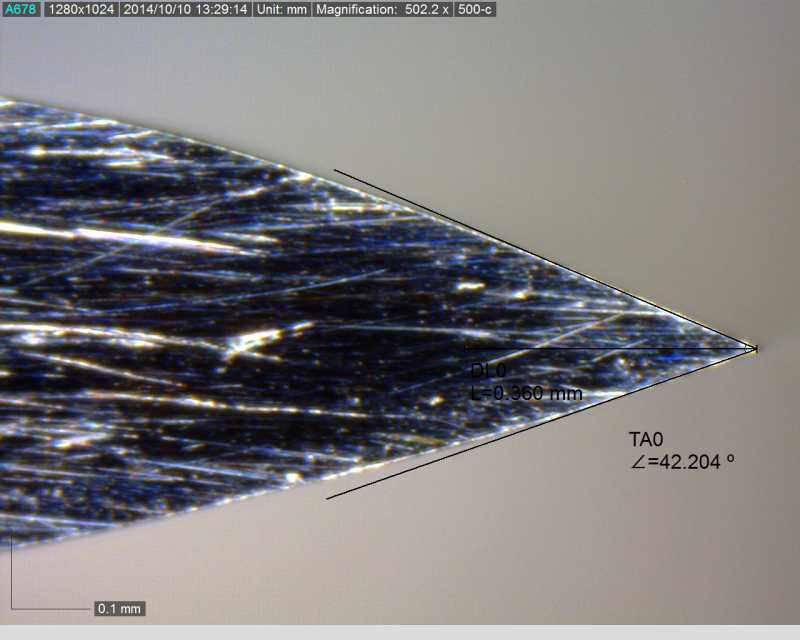
I stropped it again at 20 dps, fairly hard pressure, around 75 strokes per side:
Attachments:
I stropped it again at 20 dps, fairly hard pressure, around 75 strokes per side:
Clay, can you explain the TA1 and TA0?
Those are just the two angles I measured. The software assigned the letters to the sides TA automatically and one measurement is labeled 0 and the other is labeled 1. The letters are arbitrary, the could easily be AB or any other designation you’d want to give each of the sides of the angle.
but which is which? or am i missing something
edit: oh i see, TA0 is the vinal edge angle, TA1 is the overall bevel angle… right?
Got it!
[ol]
[li]TA1 is closest to the original bevel of 20 dps with the 1000# diamonds. A little widening occurred with stropping that affected even this angle, probably because the tip is now a tiny bit closer to the shoulder of the 20 dps bevel.[/li]
[li]TA0 is the angle closest to the tip that shows the widening edge after stropping with the 14um strops.[/li]
[/ol]
This gives me a nice thought. Maybe I can make a little mark in the blade some distance from the very edge and then periodically measure the distance from edge to mark to see how much steel is being lost.
ohhhhh neat! So will you do another one of them side pictures again like you did for the 1000 grit plate? It would be interesting to compare.
Also, what paste are you using? And is it the normal leather or kangaroo or balsa? Just one strop and grit or multiple? This cross section side view is a great way to see exactly what is going on there!
I measured the sharpness after stropping at the same angle. The blade scored 363 vs. 236 with the 1000# diamonds at the same angle e.g. after stropping at the same angle, the blade required 53% more force to cut through the media.
Next, I’ll flatten out the bevels and restore the blade to 20 dps with the 1000# diamonds. Then I’ll lower the angle by 1 dps and strop it.
[quote quote=“Zamfir” post=19189]ohhhhh neat! So will you do another one of them side pictures again like you did for the 1000 grit plate? It would be interesting to compare.
Also, what paste are you using? And is it the normal leather or kangaroo or balsa? Just one strop and grit or multiple? This cross section side view is a great way to see exactly what is going on there![/quote]
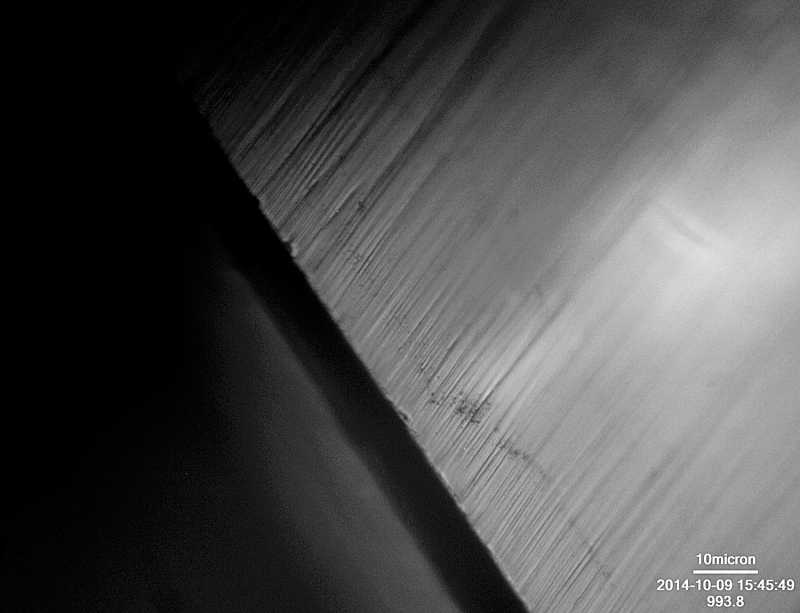
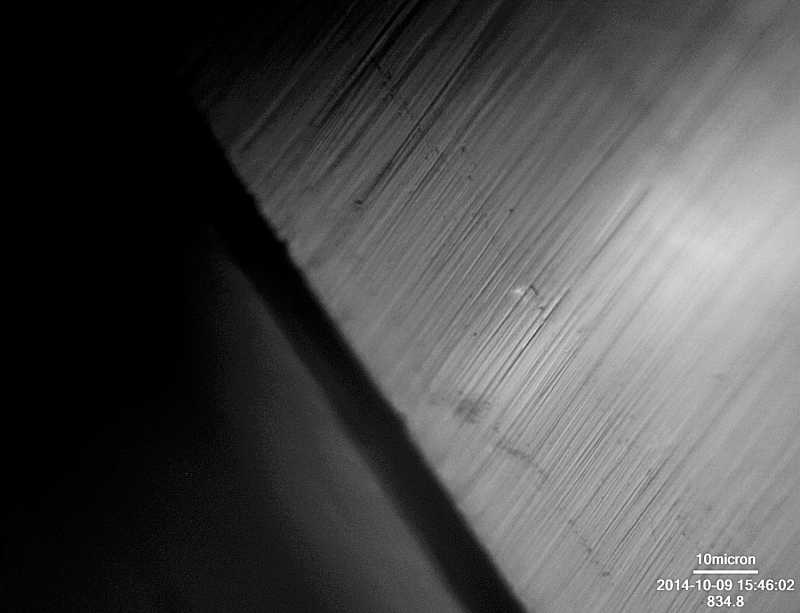
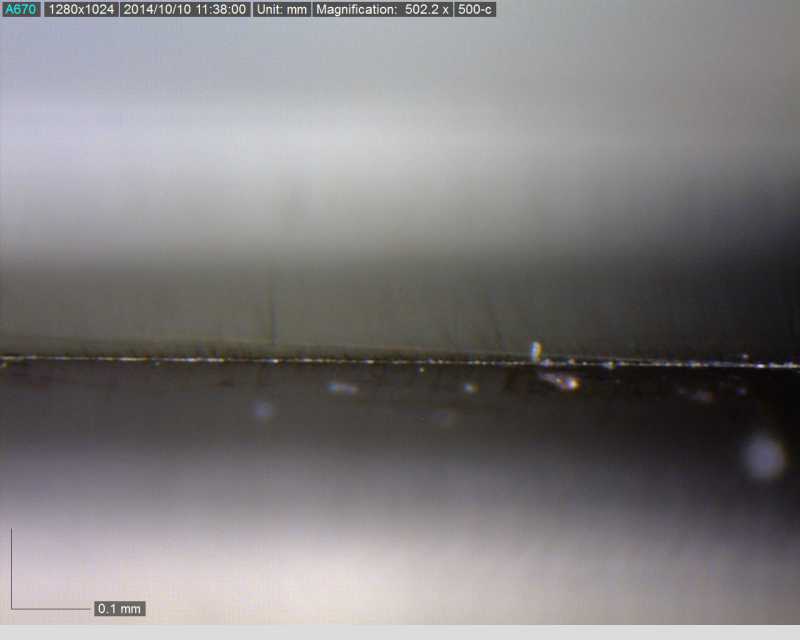
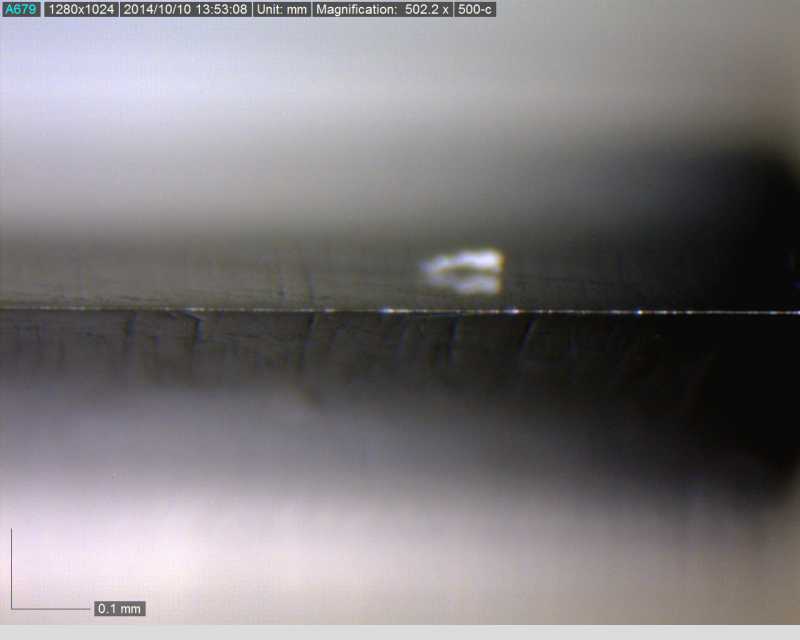
I did put it back under the scope to show the side of the bevel. There is enough curvature that it’s hard to get a clear picture. I had to take three images at different distances, one showing the edge, one showing the middle of the bevel and the last showing the shoulder of the bevel. Here they are:
[quote quote=“wickededge” post=19174]A note on the angles in the photos:
The primary grind is somewhere around 11 degrees though you can’t see it in the photos. Then there is a 15 dps bevel that drops to a 20 dps bevel. Once the stropping was completed, the final edge bevel is around 24.175 dps.[/quote]
Very interesting. I had first missed you had put a 20 degree microbevel on the 15 degree edge. But what is interesting is that the convexing seems to take place on the entire bevel, not just on the place where originally the transition from 15 to 20 degrees was.
Is that the sharpness measured with Dan’s jig?
Hahah! You did it again! :lol: A nice convex edge and down from 20 to 25 degrees without blunting the edge. I’d really like to know how much pressure you used. And I assume you used plain cow leather?
[quote quote=“razoredgeknives” post=19176][quote quote=“CliffStamp” post=19170]When bodies are in sliding motion across each other and they are of similar hardness, there will be adhesive based wear which will include things such as fracture, welding, burnishing, etc. . If they are of very similar materials then this can be very high due to localized bonding. This is why you don’t want to use D2 to try to stamp 420J1 for example as there is too much chromium to chromium bonding and it produces high adhesive based wear.
A leather strop loaded with paste which is used on a knife will develop almost immediately metal particles on the surface, this when used again generates metal on metal contact and you get all the large mish-mash of non-abrasive interactions as you just have two pieces of the same metal grating against each other. Now it isn’t the only effect. This is complicated by the fact that you have at the same time the abrasion from the paste still happening as well.[/quote]
Wow… I think you hit the nail on the head. From what I remember reading this theory has not been proposed as of yet and it makes a LOT of sense (more than any of the others I’ve seen).
[/quote]
I agree. This sounds like the first plausible theory of what is actually happening when stropping, next to abrasion! :cheer: :cheer:
Many thanks, Cliff!
A nice thing about this theory is that it is actually falsifiable. By stropping the same edge (first cleaned) with a clean unloaded leather strop we should not (or hardly) see any of the results of adhesive based wear.
Mark,
You’re right - I used plain cow leather with 14um diamond paste. I will try to rig up a scale under the sharpener to measure the force I’m using. I was pushing fairly hard, not hard enough to lift up the base.
Oh well, once you’re used to the WE pastes, the phrase “almost enough to lift up the base” gives a good indication of the force. I never realized it could have such an effect… :cheer:
Enough pressure to almost lift the base? I had not come anywhere close to that kind of pressure. Had no idea that much was needed. I am starting to get the suction feel and I just press enough to feel that and drag the strop.
It will be interesting to see the difference when you play with different pressures. And Balsa vs cow. This is super helpful Clay! Thank you much for doing it.
I don’t normally use that kind of pressure, just when I want to get a super polish. I normally use very light pressure stropping. Even so, there is definitely edge rounding that occurs unless you lower the angle.
Here’s the latest round, stropping at 19 dps. First I reset the bevel to 15 dps with the 1000# stones, then added back the 20 dps micro-bevel. Then I stropped with the 14um diamond on cow leather strops with moderate to heavy pressure at 19 dps.
20 dps with 1000# diamonds
19 dps with 14um diamond on cow leather strops
I didn’t do quite as good a job sharpening with the 1000# stones on this round, averaging a score of 268 (I must have used a little too much pressure with my final strokes.) Even so, there was a sharpness decline after using the strops at 19 dps with an average score of 308.
I also photographed the bevels straight down onto the edge:
20 dps with 1000# diamonds
19 dps with 14um diamond and cow leather strops
I redid the study, again restoring the 20 dps bevel with the 1000# diamonds:
20 dps with 1000# diamond plates
and then stropped the edge with moderate to heavy pressure at 18 dps:
18 dps with diamond and cow leather strops
It seems to have added about 1 degree per side.
I tested the sharpness after restoring the 20 dps bevel: 294
and then again after stropping at 18 dps: 250
So, it looks like I could even drop the angle by one more degree to minimize rounding but I did get a pretty nice bump in edge sharpness stropping at -2 degrees.
Is the sharpness on a draw being affected either way? That machine does a push cut correct?
Here are a couple of shots of the 18 dps stropped blade shown edge on:
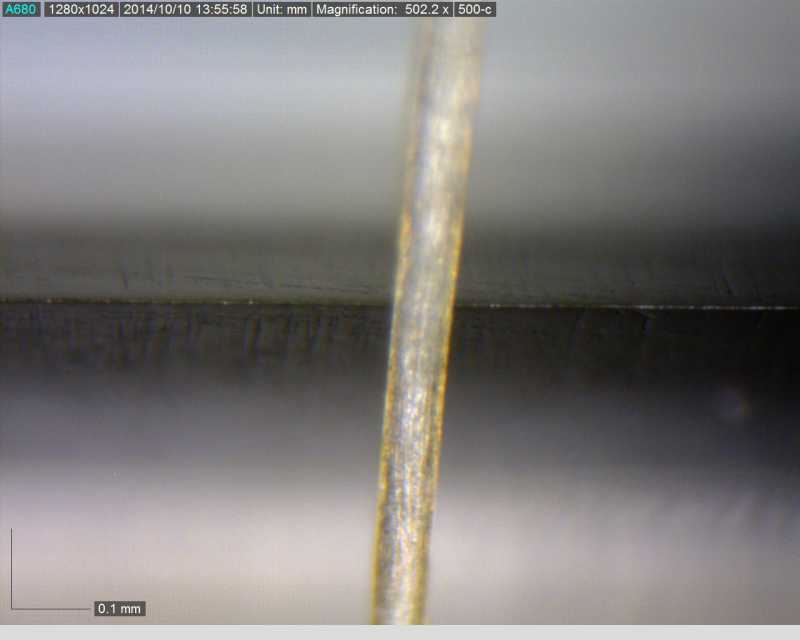
The bottom one is shown with a human hair for reference.