If I sharpen a knife at 20 degrees should I strop at the same angle or should I strop at a lessor angle, say 19 degrees? The only strops I currently have are leather.
Or is this practice only used when you are trying to convex the bevel. Say you sharpen at 17 degrees, micro bevel at 20 degrees then should you strop at 19 degrees?
This knife sharpening sure can get involve but I am having a blast! :woohoo:
All of that is valid. The real key is to strop lightly. It’s ok to strop at the same angle lightly. By increasing to 19 your attempting to effect the angle only and not touch the edge. For touch ups it’s ok to strop at the same angle.as the final bevel.only by trial and error to you figure out what’s right for you. If this is your personal knife and it becomes maintenance it’s one thing. If your doing some else’s knife to hand off you might be using a different technique based on what you negotiate with the other person.
I think the short answer is, find what works for you. I’ve come to the conclusion that good stropping results depends on a lot of factors that “intertwine”, so what works for one person, may not work for another. For example, one person can strop at the same angle with light pressure, another might lower the angle and increase the pressure. I actually get good results with light stropping at a higher angle, (which is why I was bummed that Clay’s microscope pic doing this showed a lot of rounding… my results seem to differ). :blink: Add to that the variety in leather, compounds, etc., and it’s easier to just experiment with a few variables, like the ones you mentioned, and “dial in” what works for you.
I’ll add, in addition to angle, pressure, etc., another factor to work with is the amount you do. Try a few strokes, like 1/2 dozen, vs. doing a bunch (which is what a lot of sharpeners do to polish the bevel). Another factor to play with. B)
After writing all the above… Wayne had it in his answer. :silly: :lol:
I keep bouncing back and forth between -1 degree and keeping the same angle. Both work very well, but for some reason with my technique (which is very light pressure, after some practice) I seem to get a much sharper “feel” when keeping the same angle. I’m not sure why that is, because both cut equally well in my basic tests and normal use.
So I guess I can just add +1 to the trial and error advice!
The strops work mostly by drawing or smearing the metal across the surface of the bevel, burnishing it. If you’re stropping on the same angle, it’s conceivable that you’re drawing the metal right to the edge and actually pulling it out to a finer apex. This is a topic I’m really curious about but will probably need access to a SEM to study it. Even at 2000x I can’t get a good clear measurement of the edge thickness.
[quote quote=“ApexGS” post=5686]I keep bouncing back and forth between -1 degree and keeping the same angle. Both work very well, but for some reason with my technique (which is very light pressure, after some practice) I seem to get a much sharper “feel” when keeping the same angle. I’m not sure why that is, because both cut equally well in my basic tests and normal use.
So I guess I can just add +1 to the trial and error advice![/quote]
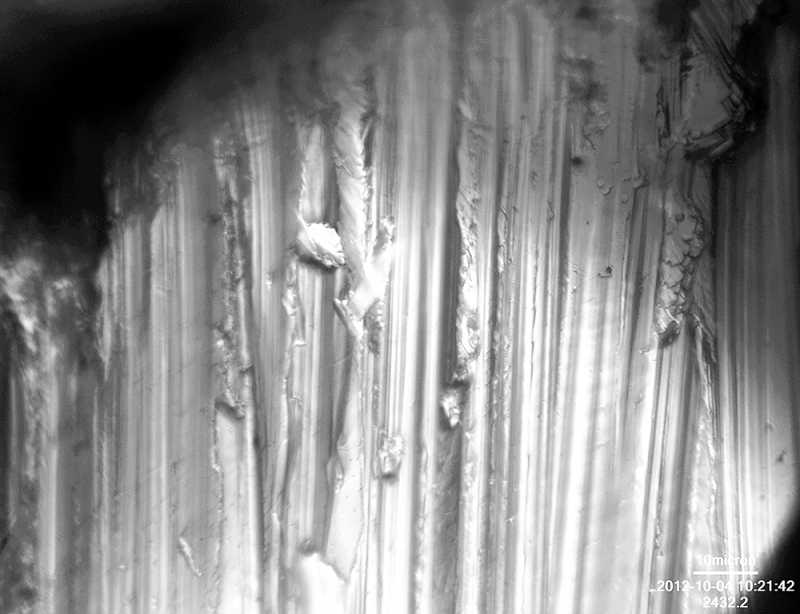
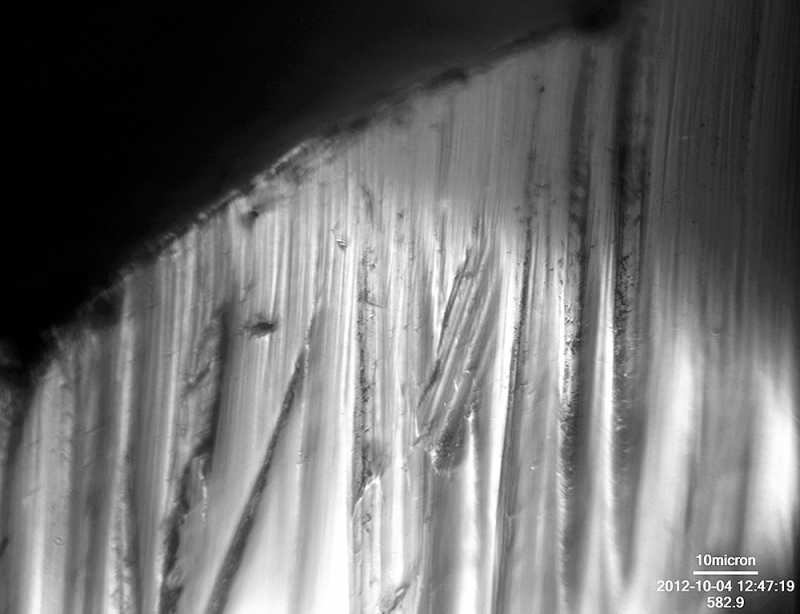
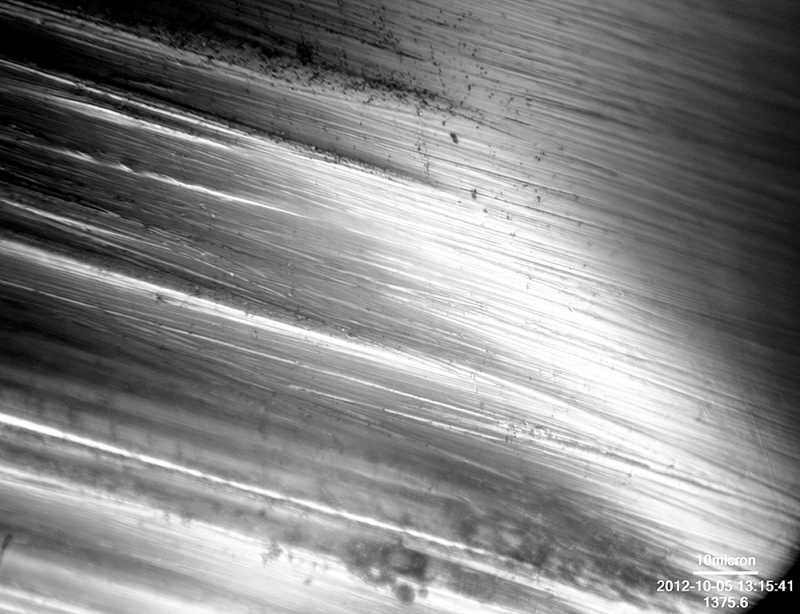
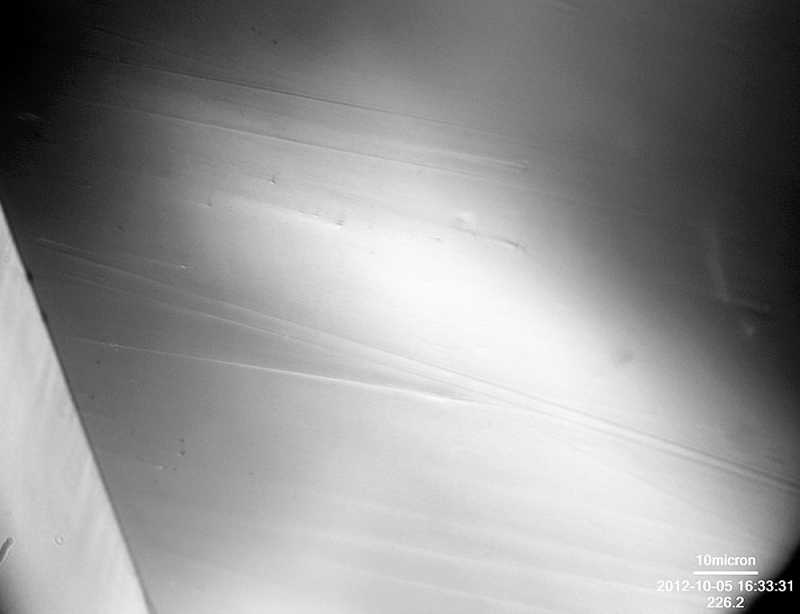
The image above is of the edge after being sharpened with relatively new 200# diamond plates.
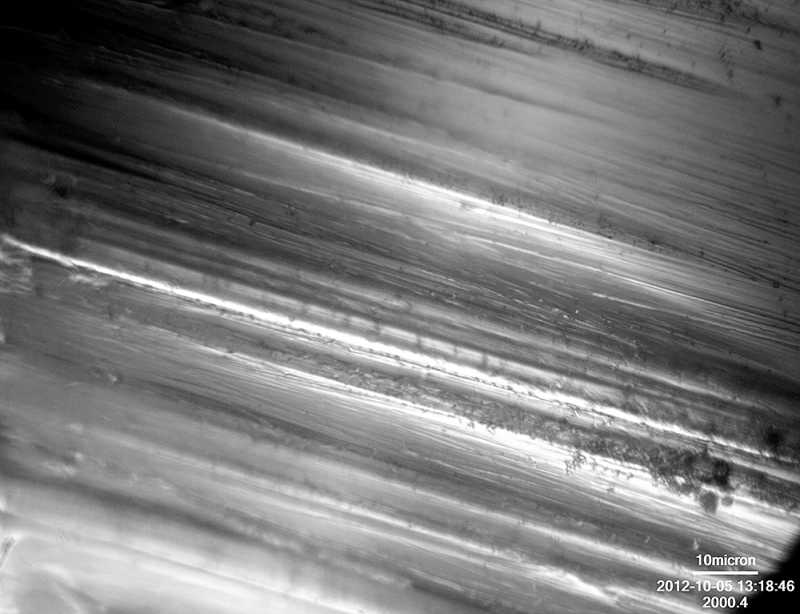
The image above is of the edge after I completed 40 strokes with the 14 micron diamond and leather strops immediately after the 200# diamond plates. It’s easy to see how the metal was both abraded by the stropping paste and moved around by the ‘stiction’ of the leather, pushing the peaks of the ridges into the valleys and rounding them out.
Thanks for all the input! I keep reading about stiction. Could someone give me a working definition? Conceptually I understand the Wiki definition. When stropping a knife what level, quantity or quality (not sure how do ask) of stiction works best?
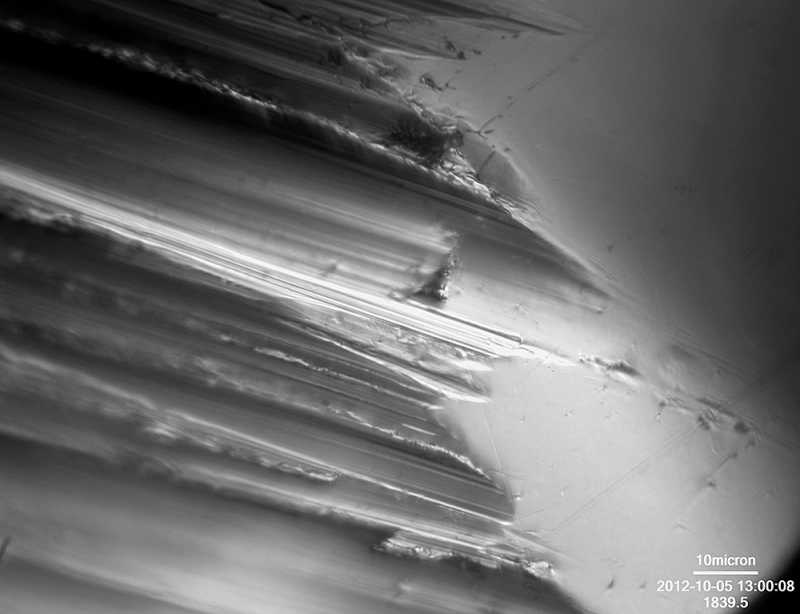
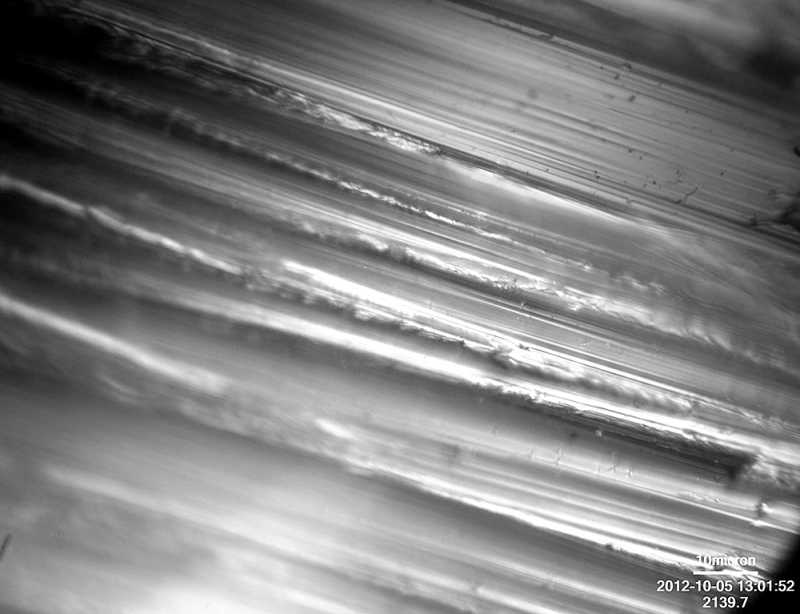
This next little study was fun to do though also time consuming since prepping the samples takes a long time for the 2000x images. There is a long process of cleaning the samples and lens, then applying clean immersion oil for each iteration. In order for the 2000x lens to gather enough light and present a clean image, it needs a continuous bond of the oil between the end of the lens and the sample. Every time I take the sample out, I have to add more oil and re-form the bond. Still, all the work aside, it’s a blast So without further ado, here are some images of an edge that started as nearly perfectly smooth and to which I applied a micro-bevel 30um wide with the 400# diamond plates:
The above image shows the smooth shoulder at the start of the micro-bevel where the diamonds started digging in and cutting little troughs out to the edge.
The above image is showing the middle of the bevel.
Next I lowered the angle three degrees and completed 40 strokes with the 14um diamond and leather strops. I was surprised by some parts of the results. The first image shows the transition at the shoulder between the formerly smooth section and the micro-bevel:
The 14um strops clearly created their own very distinct scratch pattern and wiped out the smooth section. The also had an impressive affect on the scratches from the 400# diamond plates:
It’s exciting to see the combination of burnishing and abrading going on with the strops.
As a footnote, these are the same 14/10 strops I’ve had for a long time and the paste hasn’t been refreshed in months. I did apply some rubbing alcohol to increase the ‘stiction’.
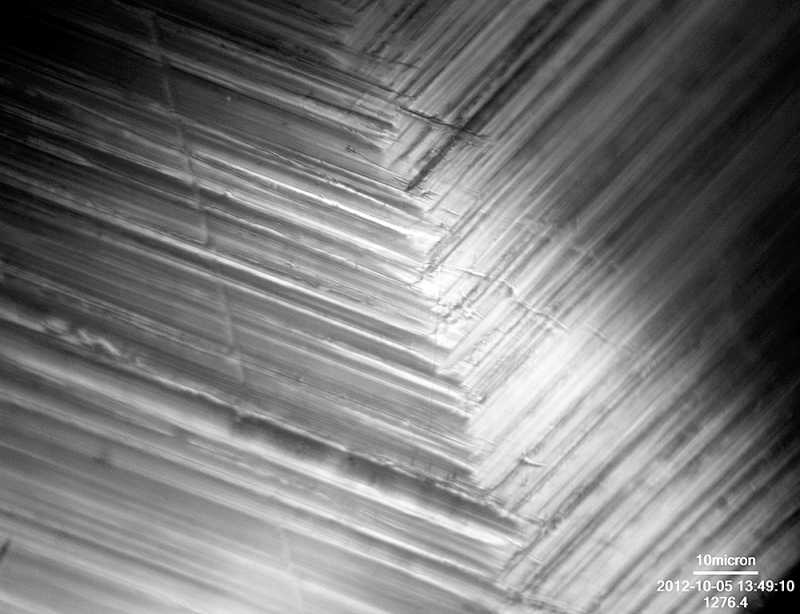
In the first image of the post above we see the clear junction of the 400# micro-bevel where it cuts into a very polished primary bevel. In the third image I’ve lowered the angle by three degrees and completed 40 strokes with the 14um diamond and leather strops. The effect is dramatic and illustrates why it’s so easy to create a convex edge with a couple of facets and the strops. The strops easily smooth over any peaks. In the next little study I’ll try to image the vertex of a pair of facets and then smooth it over with the strops.
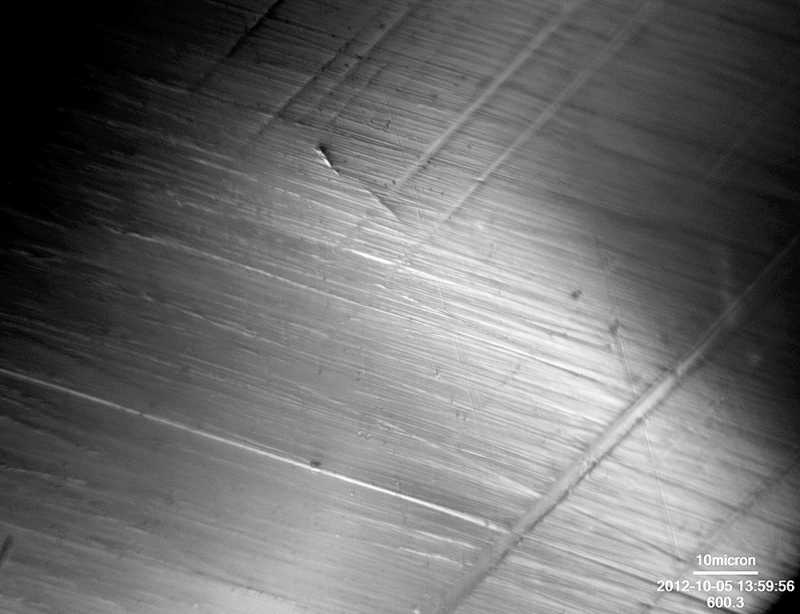
I admit that I’m shocked by the image below. I changed the angle to 22° and completed 40 strokes with the 14um strops. There is almost no evidence of the junction between the facets - it’s been almost entirely erased by the strops:
The only way I can even find where on the bevel to image is by the direction of the scratches. I’m now extremely thankful I used alternate directions with the 1600# stones when making the facets.
I wanted to highlight this… I find this almost as interesting as the pictures themselves… had no idea it was this involved. :woohoo: That’s dedication!
Agreed! It really moves around quite easily.[/quote]
Sliding Metals Show Fluid-Like BehaviorThe first time I saw this sort of thing was a still shot from a high speed video on a gun blog, which showed some metal bar stock being cut by a lathe and how it “bunched up” in front of the cutter as it turned. Here’s the link to the article about it:
Metallurgy is some fascinating stuff! And keep up the good work Clay, from what we’ve seen so far it looks like that microscope is worth the work and the wait!
Oh yeah, this is a great video! I saw it a while back and it sort of transformed the way I look at metal. Thanks for the feedback. It’s really fun to do these studies and share them with you guys.
Here is a shot of the same blade after I’ve restored it to basically super polished:
There are a few little marks that I haven’t bothered to remove; enough of the surface is smooth that we can easily isolate whichever grit we’re trying to study. The process to restore the edge was as follows:
Set the angle to 20 degrees> Sharpen with the 1200# ceramic stones until I almost reached the edge (verified by 60x handheld, lighted loupe), flattening out the bevel again> Sharpen with the 1600# ceramic stones until I do reach the edge> Strop with cow and diamond at 14um> 10um> 5um> 3.5um> 1.0um> 0.5um> I then used kangaroo leather and diamond at 1.0um> 0.5um> 0.25um and then 0.125um CBN on nano-cloth and then back to 0.25um diamond on kangaroo.
I’m guessing about 1/2 hour give or take. I was doing about 50 strokes per side with each grit but my cycle rate is very fast, usually 100+ per minute. Cleaning between grits and switching grits takes the longest.
 but I am having a blast! :woohoo:
 So without further ado, here are some images of an edge that started as nearly perfectly smooth and to which I applied a micro-bevel 30um wide with the 400# diamond plates: