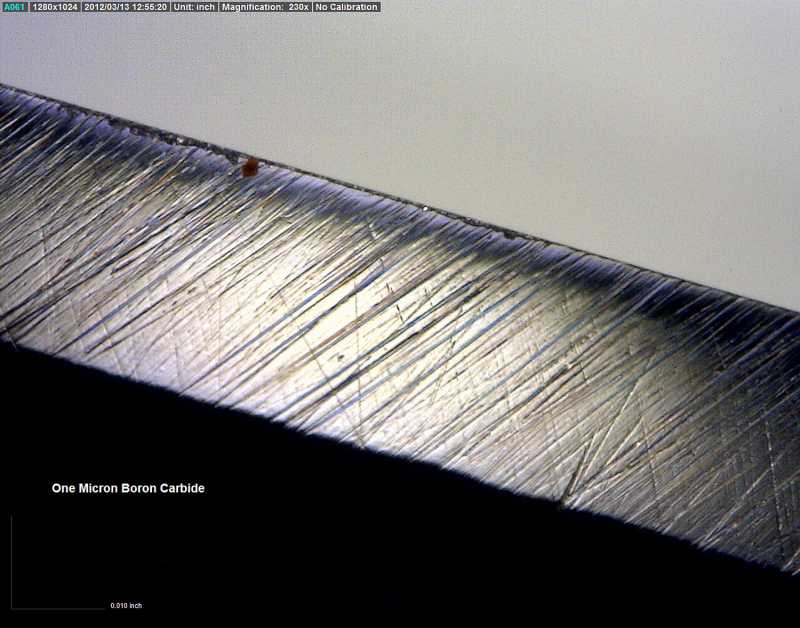
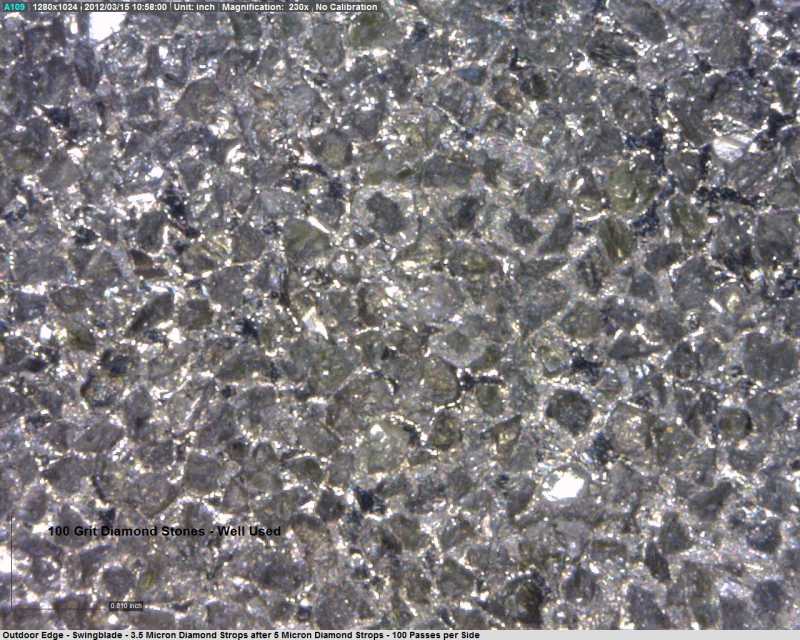
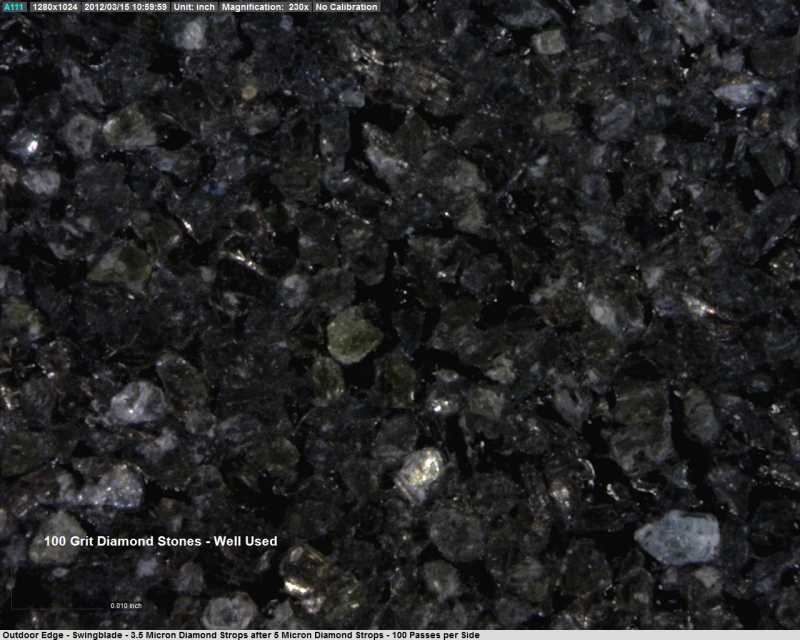
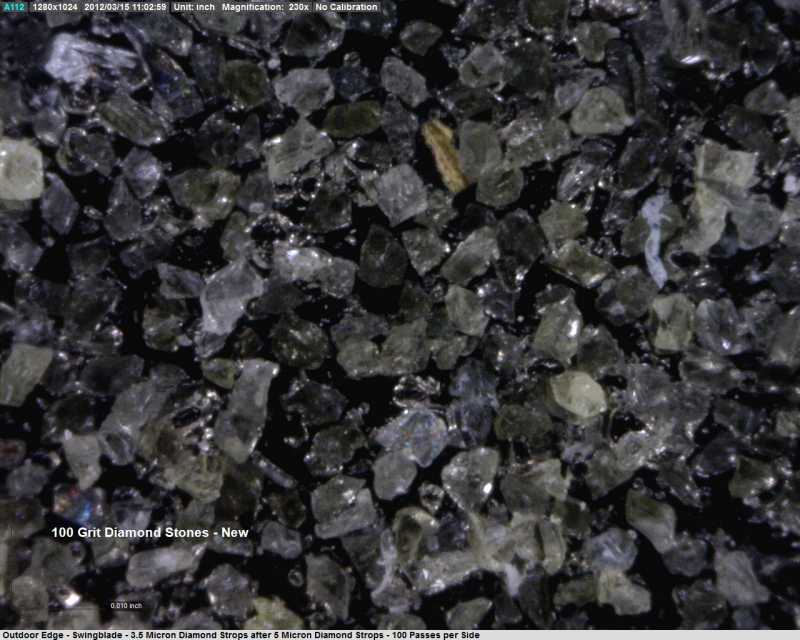
What a fascinating thread! I should have joined in much sooner. The quality of the micrographs are stunningly clear.
So a couple of points.
There is a relationship between the edge of the edge and the scratch patterns on the bevels so it is useful to evaluate these scratches, but ultimately it is how these scratches intersect with the edge of the edge. And as Tom has pointed out in previous work, these scratches intersecting the edge of the edge are often points of failure, either chipping during sharpening or during blade usage.
I feel like we are seeing two primary effects - a sort of contmination AND a revealing of underlying scratch patterns from coarser grits.
The latter is more straightforward, so I’ll discuss it first. When a finer compound / stone/ plate is used, the predominant effect is the elimination of the more superficial scratches first, leaving the larger ones remaining, with enhanced contrast from it’s surroundings which have become ‘shinier’ due to a higher finish.
Now this is a critical point. The deeper scratches from the previus grit should be eliminated at this time, not allowed to remain as artifacts for yet the next fioner grit, which will have a more difficult time eliminating these deeper scratches. This is the ideal approach. It does have it’s drawbacks, however in that this usually will require that you keep on sharpening even past the point of getting a sharp edge. More labor and time, but for these levels of study, pretty mandatory.
In some of the photographs, scratches appear but it becomes more challenging to discern scratches being revealed vs new scratches being created. You can see some deeper scratches remaining through a couple of grits. ALL scratches should be removed so that the only scratches present are all in one direction and of the same depth - that of the stone / abrasive being used. This is a lot more work.
Then any new scratches can more clearly be attributed to the new abrasive surface and the chances of hidden scratches significantly reduced or eliminated. With finer jumps in grit size this further eliminates these ‘rogue wave’ scratches.
So next is grit contamination. There are several sources possible and more than one may be present. There is the compound itself. It may be poorly formulated with contaminants or poor quality control or contaminated from ‘user error’. Then it may become contaminated from airborne contaminants. For cosarse grits this is pretty unimportant, but it isn’t at all unusual to have airborne particles several microns or tens of microns in size floating around. For this reason, stropping surfaces should be in their own individual baggies and ideally even cross contamination between two abrasive surfaces on a paddle minimized. Then there is metal contamination. Burrs from a previous sharpening can easily cause hugh scratches, either embedding themselves in leather or other strop or be floating around in stone slurries.
Then there is the substrate itself. Balsa does have some abrasive properties. So do papers, both of which can have particles embedded in it, typically clay particles from the water used in the manufacturing process of paper for instance or from particulates the tree is exposed to in its life as a tree.
Leather naturally has abrasive content itself. These silicates aren’t particularly hard but are hard enough to scratch metal. And random in size over a range as it is a natiural product. This is why leather is an abrasive surface and along with it’s draw is used to refine edges. One of the finest leathers that still has a good deal of draw to it is Kangaroo leather. For coarser compounds, you won’t notice the extra refinement, but as one decends into the submicron particles, these errant scratches and so forth become more apparent as a problem and show up as random scratches, which I believe is some of what I am seeing. I am quite comfortable in firmly stating that both my products (eg the 0.125 micron CBN, etc) and the Hand American products are some of the cleanest stuff you can buy, so I strongly suspect other sources of contamination.
In addition to the Kangaroo leather which provides an extremely smooth substrate, I also carry another product which is available for the WEPS platform - Nanocloth.
What does Nanocloth do? NOTHING. Why would you want something that does nothing? To precisely address this problem.
If you strop an edge on nanocloth, NOTHING happens. No metal swarf appears at all. It has NO effect on your edge or as close to no effect as anything I’ve seen. BUT, if you spray, in the extreme, some 25 nanometer (0.025 micron) polycrystalline diamond on it - a very light coating, what you get when you use it as a strop is deposits of fine metal swarf.
The effect of using this nanocloth is a ‘pure’ compound effect. NOT a mixture of compound plus substrate effect.
So for instance, in the picture when the 0.125 micron CBN was being used and a number of errant deep scratches were produced, if nanocloth was used instead of leather, I would be quite surprised to see the introduction of all those errant scratches. Similarly so for some of the coarser compounds preceding it.
When you critically evaluate edges, it is so helpful to have a repeatable pure substrate to separate the effects of compounds from the underlying substrate.
And then there are scratch patterns from natural stones, which are a whole different ballgame, but that’s something for another thread.
It is a real treat to see such serious discussion of sharpening techniques and strategies among such knowledgable members. I hope that I can conribute to this on the forum in some small way.
In addition to Tom’s work, I really have to give a big thumbs up to Clay for designing a device that allows so many variables of sharpening to be eliminated that confuse and confound many ‘freehand sharpeners’, giving, in addition to being an excellent sharpening device, a device that allows the serious sharpener to explore the limits of techniques in such a profoundly clear manner. Combined with these micrograph, this platform represents an exciting level of sharpening research that I am quite proud to be able to be a part of.
Ken