Yeah, I’ve thought about this quite a bit (way before I ever started with my WE  )
)
The problem with a “solution” for serrated is almost all serrated knives have something unique that must be applied to them but causes failure for other serrated patterns. A few examples:
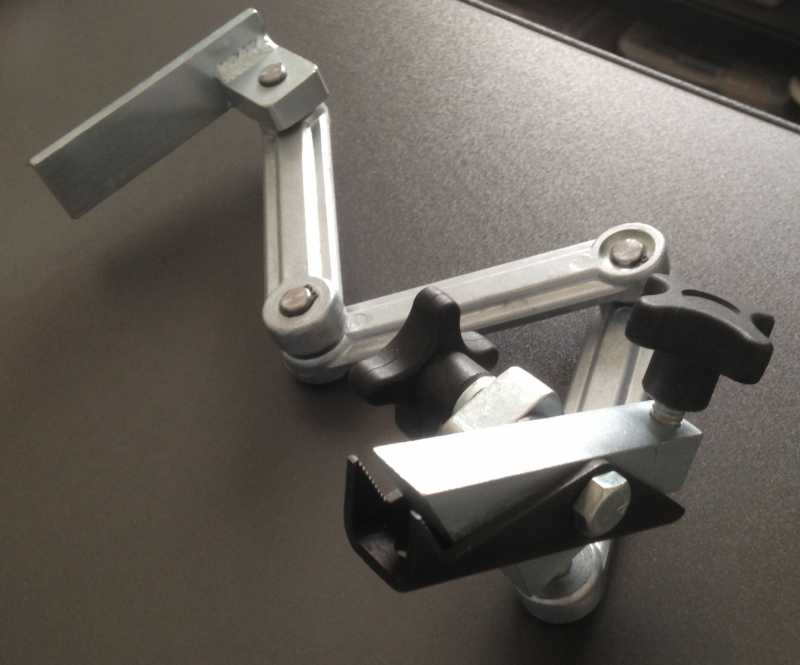
Some serrations are ground perpendicular to the edge. Others are ground perpendicular to the “cut line” or spine. Some fall somewhere in between. A fixed arm/clamped system will only work on the first, and that only with absolutely precisely mounted blades. For the others, the blade would need to travel along the arm mounting point or visa versa.
Serrations are different sizes and shapes. From wide shallow "U"s to deep "U"s to narrow "U"s to all the same variations of "V"s. then you have rounded “points” and apexed “points”. You can find any combination of those intermixed together.
There have been several attempts from other companies to address this but none are perfect. DMT has a system of cylindrical and variablely tapered rods. Yes, there is usually a spot on each variable rod that fits most U shaped serrations but any travel on the rod (the sharpening motion) takes you from too narrow to too wide. It fails totally on V shaped serrations. Fixed radius rods work fine on "U"s IF you find a properly sized rod(s) for your serration pattern. Spyderco attempted to solve this by using triangles to create a single point of contact (the apex of the triangle) You work this single point in and out of the various serration shapes. It works (IMO) better than most of the cylindrical solutions but requires a very steady progression to maintain the original pattern. The best solution to date (IMO) is the Spyderco Profile set. Two different variably radiused curves (eg Spirals ) opposing two different V notch angles. I can usually find a place to set these very close to the original serration pattern but the angles have to be held unguided and each serration has to be sharpened individually, ugh
Add to this the wide variety of blade shapes you’ll find and the combination quickly becomes overwhelming, especially in the context of a fixed arm system.
This may be the one area I find the floating blade design of the EP actually has an advantage. Yeah, you’d have to constantly adjust the blade against the stone path but it would remove a few of the variables, simplifying the process.
For WE to do this would require a complete redesign, allowing either the blade or the arms to slide relative to one another. No simple solution.
I know Clay is working on this, but just the 5 minutes I took to write down the basic issues gave me a headache I’d hate to be actually working on a solution Of course, if he finds one, I’m interested, but I’m not holding out a huge degree of hope.
Saying “offer a serrated option” sounds simple until you look at what that solution entails. It gets overwhelming very quickly, at least to my mind.
Ken