The one on the bottom is your knife! :lol: I put it in that picture for reference. :woohoo: :silly: :evil: :whistle:
Haha. Sneaky, sneaky! Guess I should’ve looked closer. I can definitely see the pixels now that you mention it… I knew it was too good to be true.
now THAT was funny… :whistle:
The one thing you may find is that if this is a a clad knife which makes thinning easy isince the cladding will be of a softer material than the core .
Even if it is not clad it is not that huge a job by hand when you consider how long people spend on attaining a perfect mirror finish . It depends if you have any bench stones .
The gyutou does not have as much belly as a western chefs knife. In your picture the top three knives are santukous the lower is a gyutou although normally they have a little more belly towards the tip this one is flat which is not right.
If you have a course bench stone or diamond plate like an Aotoma 140 bench sized plate it would be a good exercise for you to do you could still do the final edge with the WE I would suggest looking at some videos say by Japanese knife imports and possible Murray Carter although their styles differ it would be a good learning curve for you. Essentially when lightly pinching the profile there should be a smooth transition down to the edge more like a skandi grind.
I reckon that if you have some bench stones to thin with it would take a maximum of four hours to do that’s if it is not clad and is blue or white steel.
Good luck with it . It could even be worth buying anAotoma 140 bench sized plate to do this it is unlikely to be the only time that you are going to need to thin a knife.
[quote quote=“LeoBarr” post=21730]The one thing you may find is that if this is a a clad knife which makes thinning easy isince the cladding will be of a softer material than the core .
Even if it is not clad it is not that huge a job by hand when you consider how long people spend on attaining a perfect mirror finish . It depends if you have any bench stones .
The gyutou does not have as much belly as a western chefs knife. In your picture the top three knives are santukous the lower is a gyutou although normally they have a little more belly towards the tip this one is flat which is not right.
If you have a course bench stone or diamond plate like an Aotoma 140 bench sized plate it would be a good exercise for you to do you could still do the final edge with the WE I would suggest looking at some videos say by Japanese knife imports and possible Murray Carter although their styles differ it would be a good learning curve for you. Essentially when lightly pinching the profile there should be a smooth transition down to the edge more like a skandi grind.
I reckon that if you have some bench stones to thin with it would take a maximum of four hours to do that’s if it is not clad and is blue or white steel.
Good luck with it . It could even be worth buying anAotoma 140 bench sized plate to do this it is unlikely to be the only time that you are going to need to thin a knife.[/quote]
You are the master when it comes to japanese knives Leo!.. I know if I ever have any questions about them you got the answer! Great points all around!
[quote quote=“LeoBarr” post=21730]The one thing you may find is that if this is a a clad knife which makes thinning easy isince the cladding will be of a softer material than the core .
Even if it is not clad it is not that huge a job by hand when you consider how long people spend on attaining a perfect mirror finish . It depends if you have any bench stones .
The gyutou does not have as much belly as a western chefs knife. In your picture the top three knives are santukous the lower is a gyutou although normally they have a little more belly towards the tip this one is flat which is not right.
If you have a course bench stone or diamond plate like an Aotoma 140 bench sized plate it would be a good exercise for you to do you could still do the final edge with the WE I would suggest looking at some videos say by Japanese knife imports and possible Murray Carter although their styles differ it would be a good learning curve for you. Essentially when lightly pinching the profile there should be a smooth transition down to the edge more like a skandi grind.
I reckon that if you have some bench stones to thin with it would take a maximum of four hours to do that’s if it is not clad and is blue or white steel.
Good luck with it . It could even be worth buying anAotoma 140 bench sized plate to do this it is unlikely to be the only time that you are going to need to thin a knife.[/quote]
As I have stated before. I have owned similar knives. A gift from my wife, she picked them up off ebay. She bought me 10 or so at about 50 bucks a piece back in the late 90’s or 2000’s.
They are a stamped steel or knife blank. Not bad steel persay, just not super expensive knives.
The one thing you may find is that if this is a a clad knife which makes thinning easy isince the cladding will be of a softer material than the core .
Even if it is not clad it is not that huge a job by hand when you consider how long people spend on attaining a perfect mirror finish . It depends if you have any bench stones .
The gyutou does not have as much belly as a western chefs knife. In your picture the top three knives are santukous the lower is a gyutou although normally they have a little more belly towards the tip this one is flat which is not right.
If you have a course bench stone or diamond plate like an Aotoma 140 bench sized plate it would be a good exercise for you to do you could still do the final edge with the WE I would suggest looking at some videos say by Japanese knife imports and possible Murray Carter although their styles differ it would be a good learning curve for you. Essentially when lightly pinching the profile there should be a smooth transition down to the edge more like a skandi grind.
I reckon that if you have some bench stones to thin with it would take a maximum of four hours to do that’s if it is not clad and is blue or white steel.
Good luck with it . It could even be worth buying anAotoma 140 bench sized plate to do this it is unlikely to be the only time that you are going to need to thin a knife.
The knife could be a sujihiki which is more of a slicer than a gyutou but it still should have a little belly towards the tip.
I do not believe that you are correct. According to the person who posted the image the three knives are:
[ul]
[li]Konosuke HD 210 Funayuki[/li]
[li]Kohetsu AS 210 Gyuto[/li]
[li]Kanehiro AS 210 Gyuto[/li]
[/ul]
To bottom knife is of course an inset of the one KnifeKnerdAtX sharpened. It looks like the top two thirds of a gyuto. 
I have not seen a santoku with the profile of the 210 gyutos in the photo. The santoku profiles nearly always drop the point and round the nose to a greater degree. I can find plenty of other examples of gyutos with similar profiles if you don’t like the ones chosen for some reason.
[quote quote=“DSGROUSE” post=21732]As I have stated before. I have owned similar knives. A gift from my wife, she picked them up off ebay. She bought me 10 or so at about 50 bucks a piece back in the late 90’s or 2000’s.
They are a stamped steel or knife blank. Not bad steel persay, just not super expensive knives.[/quote]
Not worth the $40 for Josh to regrind it then, just as I thought. I can’t imagine that regrinding this (new belly included) on bench stones would be practical. I hope the time and stone consumed is measured if someone does it.
Yes Mr Wizzard I was wrong about the description of the knives.
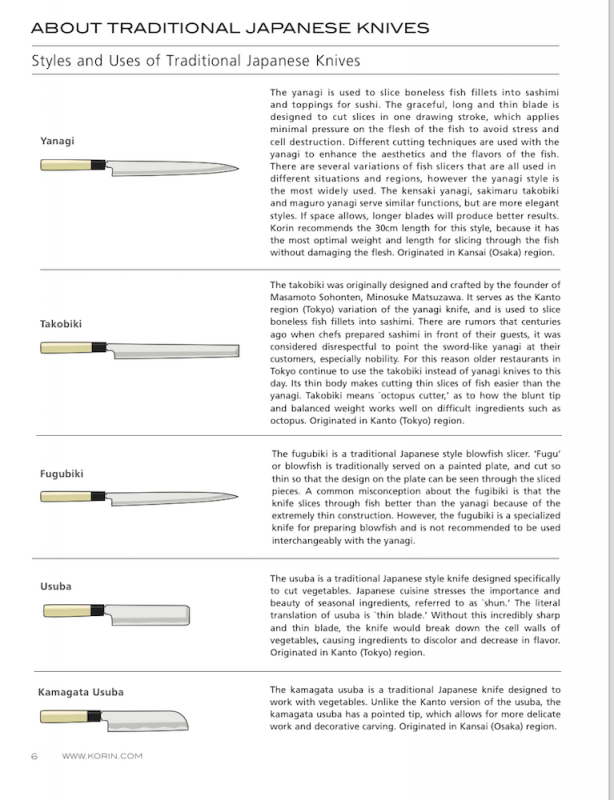
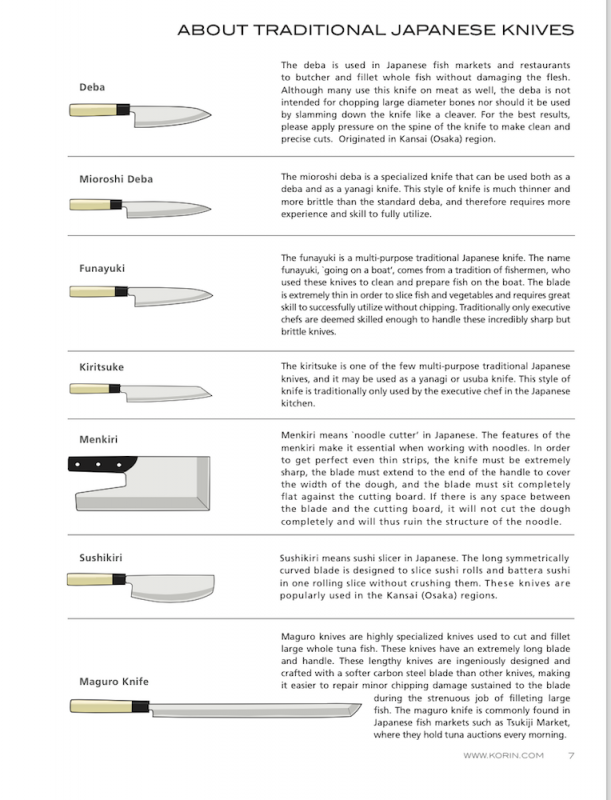
Here is some clarification from Korin.
If I were to thin the knife I would do it on the Aotoma 140 plate so minimal loss of material with the added benefit of a further appreciation of knife form.
Attachments:
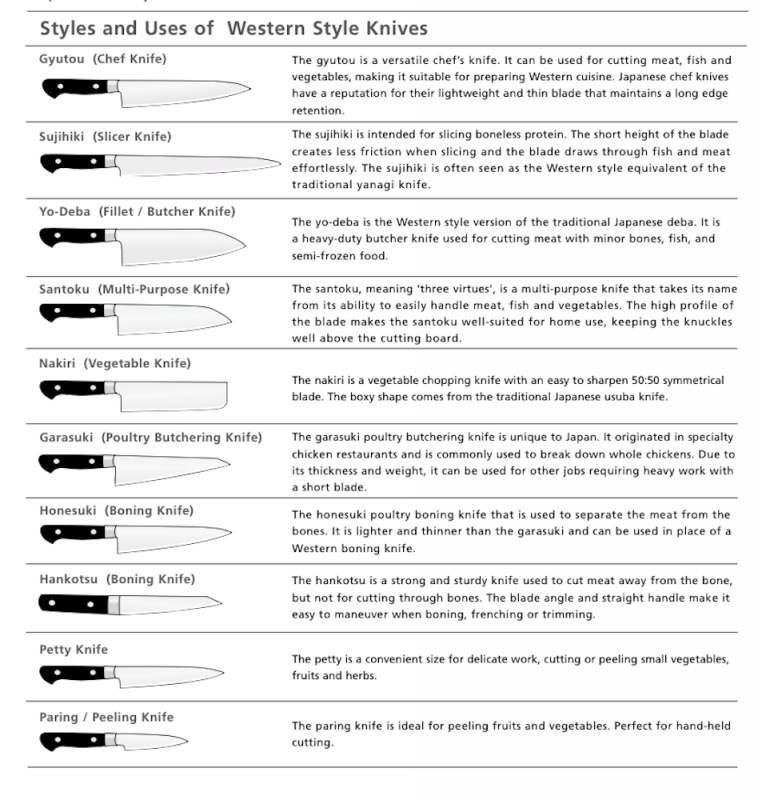
More from Korin traditional Japanese knives
I’m wondering how much time over how many years it would take a gyuto to have its belly worn down to the point where the edge is almost perfectly flat/parallel to the surface it’s cutting on?

~Steven
[quote quote=“KnifeKnerdAtX” post=21755]I’m wondering how much time over how many years it would take a gyuto to have its belly worn down to the point where the edge is almost perfectly flat/parallel to the surface it’s cutting on?
~Steven[/quote]
Like I said. I had a knife just like this. It came this way.
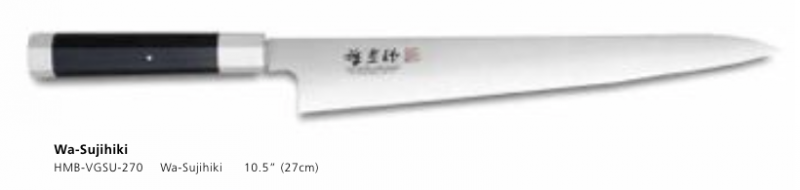
I think it looks more like a Sujihiki the Wa refers to the handle it looks like it has not had so much wear this sort of knife is used like a Yanagi draw cutting the Yanagi is a single bevel but I would expect it to be thicker up towards the spine .
It would not take much work to make it into a Sujihiki enen if it was not one it just needs a little belly put into the third nearest the tip.
Attachments:
[quote quote=“LeoBarr” post=21757]
I think it looks more like a Sujihiki the Wa refers to the handle it looks like it has not had so much wear this sort of knife is used like a Yanagi draw cutting the Yanagi is a single bevel but I would expect it to be thicker up towards the spine .
It would not take much work to make it into a Sujihiki enen if it was not one it just needs a little belly put into the third nearest the tip.[/quote]
That is my thought as well
Ok, unless I’m mistaken, so far I’m seeing 2 theories:
- Gyuto - Well worn, belly almost non existent.
- Sujihiki - As is.
Theory #2 makes more sense in my opinion. Mainly because it seems odd to me that the geometry would be changed so drastically on a Gyuto. Also, it seems closer to Sujihiki length which is typically 240-300mm.
Hmmmm…

~Steven
Its a much less destructive (2) option to reshape about how thick is it on the spine?
From what I remember it’s about 1/8" thick at the spine.
I did not realize that you meant the profile was like this, only the original make. Mystery solved I guess.
[quote quote=“KnifeKnerdAtX” post=21759]Ok, unless I’m mistaken, so far I’m seeing 2 theories:
- Gyuto - Well worn, belly almost non existent.
- Sujihiki - As is.
Theory #2 makes more sense in my opinion. Mainly because it seems odd to me that the geometry would be changed so drastically on a Gyuto. Also, it seems closer to Sujihiki length which is typically 240-300mm.[/quote]
My first comment in this thread was “Is that a honesuki?” because it looked strange to me. DSGROUSE confirms #2 is correct. Certainly that is good news as the knife is not nearly as worn as if it were a gyuto.
How thick is the blade directly above the polished bevel, and how tall (wide) is that bevel?