http://www.amazon.com/gp/aw/d/B00FW6YNE6/ref=mp_s_a_1_1?qid=1397446410&sr=8-1&pi=SX200_QL40
The ones i got weren’t self adhesive and cheaper but i cant find those. These are the .5m . The 1, 3, and 6 are all linked together
With apologies to Clay…
I got the bushings from McMaster-Carr: item # 6338K412 for $0.79 each. They have a 1/4" ID and a 3/8" OD.
I went this way because it’s really, really hard to drill a straight hole 6" long, maintaining a precise distance from the surface of the platens at both ends. So what I did was make my blocks in 2 pieces and routed an oversized 3/8" half-round channel in each piece. Then, with a bushing placed in each end and with a length of 1/4" rod holding the bushings straight, I glued the two halves together, but didn’t glue the bushings into place. It was just too many pieces to manage at once. After the glue for the wood had set, I re-set the bushings into position with JB Weld (epoxy), again using a length of rod to ensure alignment.
Before assembling, I had hand counter-sunk the inside of the bushings so a rod entering from one end would have no trouble finding the hole in the opposite bushing. After the epoxy had set, I counter-sank the outside ends as well.
Obviously, before any of this, I ran the stock thru my planer to hold the correct total thickness.
Unlike the standard blocks, which have a continuous bore, this method leaves a long stretch of unguided rod, so you have to make longer rods - about 12", and this can be a problem, as the ends are threaded to an uncommon 1/4"-28. If you have a die handle, a round die is a $10 investment. If you can find one with a hex die, a little more. For me, more toys in my estate.
Did I answer all your questions? Oh, yeah… Yes, I think they definitely have less play than standard blocks, but this is dependent on the rod stock you buy. There is a couple of thou difference in the various stocks. The stainless I bought (McMaster #89535K85) is too tight and needs to be sanded and polished down. The crummy carbon steel rod I bought at the local hardware store after polishing is outstanding.
Of course, there is the possibility that I might help you out, but I would prefer that Clay and the guys from WE get the business and I’m sure they’d accommodate you.
I tried your small circular technique and it worked wonderfully for me. I also tried lapping film and had no success. I did use a flexible substrates though. I was thinking I would try a solid substrate but after using the circular method I do not see a point. I made the clearest mirror polish I have ever made and I made the sharpest edge I have ever made.
This might have something to do with my diamond stones finally breaking into the point where they are not scratching where scratches are not wanted. I am on knife number 57 and I can finally call the edge a wicked edge.
Thank you very much
[quote quote=“stephenleesharkey” post=17239]
I tried your small circular technique and it worked wonderfully for me. I also tried lapping film and had no success. I did use a flexible substrates though. I was thinking I would try a solid substrate but after using the circular method I do not see a point. I made the clearest mirror polish I have ever made and I made the sharpest edge I have ever made.[/quote]
I couldn’t quite grasp it from the descriptions; are you guys using the circular motion with all the stones or just the ceramics?
~Dan
I did 100 small circles every 3/4" up along the blade twice on each side starting with the 1200 and ending with the micro fine. The course side of my micro fine I’d coarser than my 1200 so I never use it. With the 1200 and even the 1600 I noticed a burr developer after my circles so I just did a few alternating stropping strokes after every 100 circles along each side was complete. I then did 500 strokes total per grout with leather starting with 5 micron and ending with .5 micron.
You have to have your previous scratches with you diamond stones totally erased though. I used a cross hatch method to achieve this.
Good luck

Attachments:
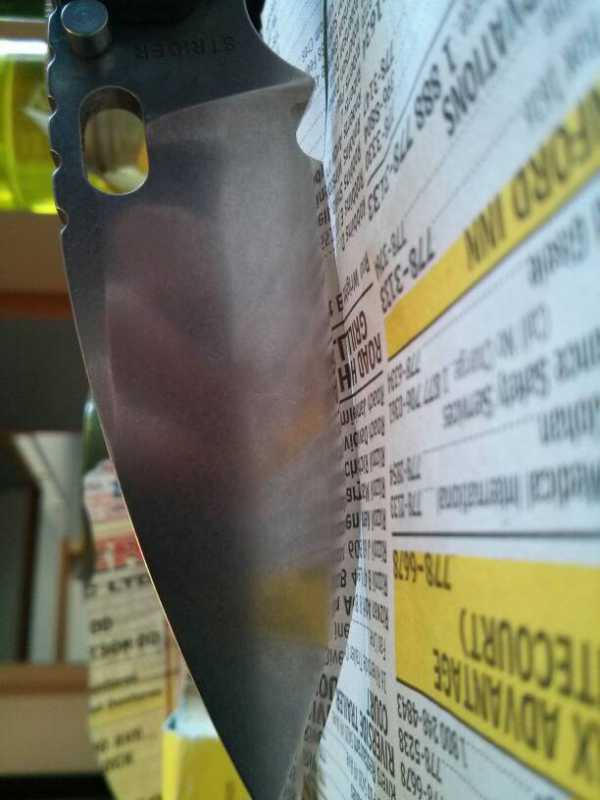
This is a sharpness test of the same knife.
Well, that’s a convincing a demonstration of sharpness as I’ve seen. Especially so with a wide bevel.
BTW, I’ve been using film on glass platen blocks, and you can’t use a down-stroke once the edge is pretty sharp. It will find enough softness in the film to cut into, just as you would with leather strops, but on a much more limited scale. Kind of like shaving off the high spots with your straight razor, but once it bites, it lifts the film and digs in. With a soft platen, it would be no different than with leather strops.
I found that with an Edge Pro and drill stop collar which maintains the angle setting between stones that it is possible to use films without cutting them although it is worthwhile doing a couple of trailing strokes first . I think if you get the SWATS or whatever they are called now you will be able to uses the films with no worry of cutting into them . Before I had the drill stop collar on the Edge Pro this was a problem since if the angle is out by probable a 10th of a degree the blade will cut through the film.
Leo Nav
I know the OP said he didn’t want water stones.
I have to give a shout out for the chosera’s anyway. With just a “set” , 400/1k or 600/1k you can get a mirror edge. No need to have the entire set. This is mirror edge to the naked eye anyway.
But the chosera’s are much more than just a 1 trick pony. I like the end result so much I use them for my EDC pocket knives, where I don’t care about mirror edges, but care about a nice sharp edge.
I just broke down and ordered the entire set. Yikes. $708 to get them up here in Canada. Oh well they sound like they’ll be worth it. They must be partially made of PANDA.
Will one of you more experience guys slap a progression chart on here showing what stones you would use starting from 50grit on a complete reprofiling. Would you still use diamond stones and ceramics in the mix? Thanks a lot guys. This info will be much appreciated. I suppose it may differ depending on the desired finish. Im talking about clear mirror. I guess what would achieve the best working finish would interest me too.
Thanks guys and gals
Steve
Like some of the guys, I’ve drifted away from using the 1200/1600 ceramic stones, just because they don’t feel right. I’ve compared the scratches they produce with abrasive films of comparable grits and they look pretty close to identical. It’s more of a “fingernails on the blackboard” thing. I’ve managed to accumulate a set of glass platens so I can run film instead of the ceramics.
That said, I’m not one of the experienced guys but I have a little something to offer. I did a bunch of Googling, looking for grits vs microns and finally came to the conclusion that grits are pretty arbitrary. There’s a relationship between grit size and micron size, but every outfit comes up with their own results. What we call grit is what others call “mesh,” the size of the screen through which the bits of abrasive fall. The higher the mesh, the smaller the size of the abrasive particles. Generally, if you divide the number 20,000 by the micron size, it’ll give you a number representative of grit size, plus or minus maybe 50%.
If you’d like a copy of my spreadsheet, send me a personal message with your e-mail address.
If a vendor comes up with their grit sizes by comparing the scratch patterns with another media, their numbers will vary by the degree of subjectivity. Hold up your thumb, eyeball it and say “Yup, that’s about right.”
Tom
I defer to my betters. Working finish tends to be form600 to 1000. Mirror, diamonds to 1000, then drop to 400 Choseras and progress.