The Perfect Edge: The Ultimate Guide to Sharpening for WoodworkersI just noticed the link to the book page from Google Books I posted before was not working. So here is a retry: . The folder on the Nagura stone contains some information regarding your question.
Obviously I’m not the expert here. Just pointing to some interesting material.
Tom, have you got a clue why stones that require water seem to wear faster? (Or is it a wrong observation?) My el cheapo stones that require almost constant soaking/keeping wet wear down very fast, whereas the Wicked Edge ceramic stones don’t seem to abrade at all. Does the water cause the wearing down (e.g., due to dissolving the resin bond), or is the wearing down the reason you want to add water (to create the slurry and remove the swarf)? Or do we need Ken to answer this question?
Ken, where are you? Come back! (You have got an unread PM, by the way. The notification is rather obfuscated, but you can access it by clicking on the link in the top right corner.)
I’d say it is a correct generalization when you throw in the sheer number of “el cheapo” stones on the market
But Shaptons and Choseras are in a class of their own on the high end, and are designed to hold up longer while cutting faster, so I think you’d be wrong in this specific case.
Overall, I think wear rates are more dependent on the binding agent/matrix hardness. Ceramic stones like the WEPS ceramic and the Shaptons use a ceramic binder which holds the abrasives in place better and longer. Choseras use a Magnesia bond, which is a little softer and more “cushy” (hence the wonderful feedback).
In theory, by using water the wear rate is increased overall because the abrasion rate is increased as you are flushing the system of swarf, which is in contrast to stones used dry, which “loads up” the surface, slowing abrasion, thus slowing the wear rate down.
Hey Tom, the picture is getting clearer and clearer!
What occurs to me is that the WEPS ceramic stones and the Shapton stones seem very similar. Both use aluminium oxide with a ceramic bond, both are hardly porous and very slow wearing.
Are there any major differences between them? Why is it that the Shaptons require some water (but only a little bit) and the WEPS ceramics stones don’t (although a little bit of water might help)?
And now I am going to use my Chosera stones for the first time :mrgreen: .
I feel the WEPS ceramics have a softer matrix than the Shaptons, overall. This makes sense because you want the ceramic to be able to come loose on the WEPS ceramics, but the Shapton mentality is to keep on abrading at every level.
my Youtube channelIn other news, I will be making some lapping videos with my WEPS Shaptons and Choseras this weekend. Keep an eye on ! B)
That is interesting, Tom! After three months of use I am not able to observe any wear on my WEPS ceramic stones. So the Shaptons will show even less wear? (Though I am not quite sure what you mean by “you want the ceramic to be able to come loose on the WEPS ceramics”. The abrasive ceramic stays right where it is on my WEPS ceramic stones.)
And have you got any clue why the recommendation for the Shaptons is to use a some water and for the WEPS ceramics is to use them dry? Is that something about the way the stones are constructed or is it more like the “cleaning philosophy” behind the stones? (The WEPS stones can be used dry, but they do collect steel dust and require frequent cleaning.)
[quote]Keep an eye on my Youtube channel![/quote] Subscribed! It’s like Youporn, but your social environment won’t complain B).
I did an interesting discovery during the last few days. When you add a little bit of water to the WEPS ceramic stones, the edge seems to come out much clearer than when you use no water! :cheer: You don’t need to soak the stones: just a few drops of water to keep the stones wet are enough.
The edge even approaches the mirror you normally only get after the 5K/10K Choseras or after stropping with the WEPS stropping pastes.
I was wondering whether anyone has any ideas on why the is the case.
It might seem an obvious case of “facts fit theory”. The theory here is that by keeping the stones wet, you prevent clogging the stones with metal filings. This prevents the filings to scratch the edge and makes the stones more effective.
However, I doubt whether this theory holds. The reason is that the stones get just as black when you use them with water as when you use them without water. So apparently steel filings are still accumulating in/on the stone. Or am I misinterpreting this?
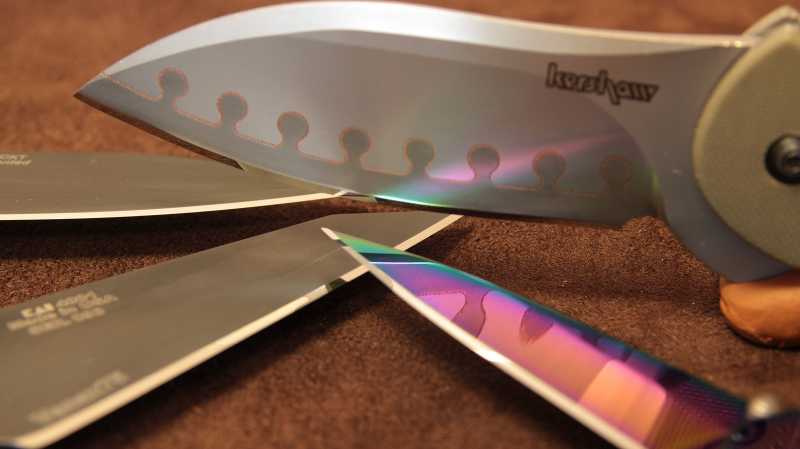
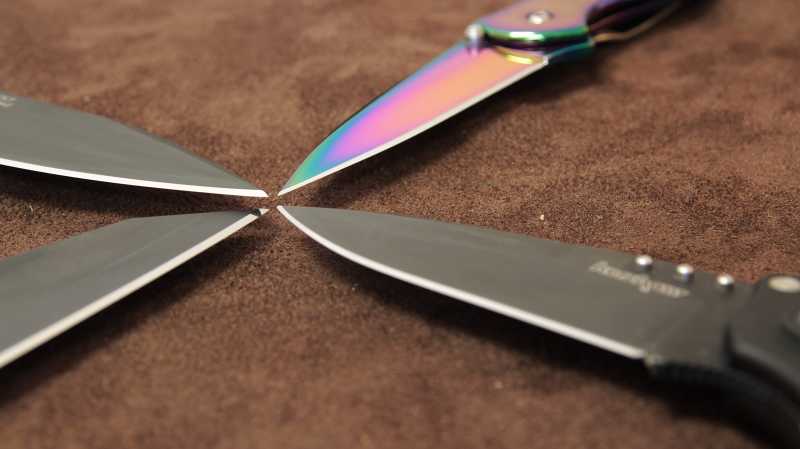
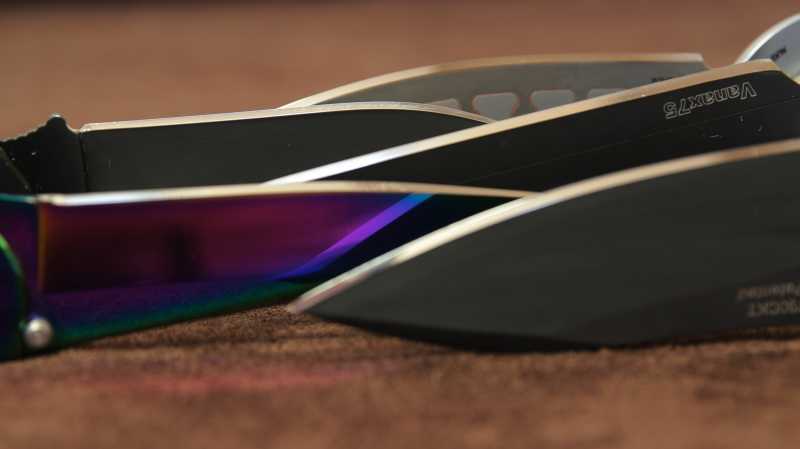
I can’t speak yet to why it works so well to use water with the ceramics, but I can attest to Mark’s results; I get tremendous results by keeping the ceramic stones wet. I use a spray bottle with water and a few drops of dish soap and get great results - essentially a mirror polish. After the ceramics, a few strokes with the strops and the edges gleam beautifully. Here are the Kershaw blades I just completed with that exact method:
[quote quote=“mark76” post=2989]I did an interesting discovery during the last few days. When you add a little bit of water to the WEPS ceramic stones, the edge seems to come out much clearer than when you use no water! :cheer: You don’t need to soak the stones: just a few drops of water to keep the stones wet are enough.
The edge even approaches the mirror you normally only get after the 5K/10K Choseras or after stropping with the WEPS stropping pastes.
I was wondering whether anyone has any ideas on why the is the case.
It might seem an obvious case of “facts fit theory”. The theory here is that by keeping the stones wet, you prevent clogging the stones with metal filings. This prevents the filings to scratch the edge and makes the stones more effective.
However, I doubt whether this theory holds. The reason is that the stones get just as black when you use them with water as when you use them without water. So apparently steel filings are still accumulating in/on the stone. Or am I misinterpreting this?
Is there anyone who can shed more light on this?[/quote]
Ytreich from the Knife Forums hits the nail on the head, IMO:
I’ve also witnessed this in person. Basically, the ceramic loads up with metal flakes, and those flakes stick out like cactus needles, adding stray divots to the surface of the edge. This is somewhat similar to metal burnishing, but its overall coarseness makes it less desirable at the WEPS 1200/1600 level of refinement. We’ve seen that than on higher grits, metal burnishing can be more beneficial.
Don’t forget the flip side - if you let the ceramics load up, they do leave a more refined edge, even if it is less perfect.
[quote quote=“jendeindustries” post=3043]Ytreich from the Knife Forums hits the nail on the head, IMO:
I’ve also witnessed this in person. Basically, the ceramic loads up with metal flakes, and those flakes stick out like cactus needles, adding stray divots to the surface of the edge. [/quote]
How do you recognize that the ceramic loads up with the metal?
The point is, when I use the WEPS ceramics with water, the stones do not come out cleaner than when I use them without water. In both cases, there is a little bit of black stuff (metal, I assume) that remains on the stones.
There will always be some residual “black” metal swarf on the ceramic stones/steel That’s part of abrading. I think the water helps keep it from accumulating to the point where it begins to burnish the metal instead of abrading into it.
Kind of a hilarious request for you…
We all love your microscope pictures of knife edges, especially your grit progression photos.
But how about some microscope images of the ceramic stones before and after use? And then with and without water? I suppose it may look like a mess with all the swarf, and nothing beautiful like a refined edge. But I’m just curious to see what the swarf looks like on the stone, and maybe (maybe?) it would be interesting.
If using something such as a DMT Dia-Flat lapping plate, which is XXcoarse, when flattening waterstones . . . Does one need to progress serially thru less coarse plates before using the waterstone for sharpening? I couldn’t find my answer after reading thru the posts. Perhaps my question is texturing related?
Would appreciate advise on flattening plate coarseness relative to waterstone coarseness when flattening my Chosera stones.
Hi Phil
From the video, I get the idea that it does not matter what the coarseness of the flattening plate is . . . I guess I’d kinda like for him to come out and say so . . .
My Choseras are for a different system (though I might try a mod to use them on the WEPS), and I only have one of each grit . . . I may have some doubles by mixing my brand X Choseras and my WEPS stones though.
“So you have your diamond surface. What grit is ideal? Well coarser grits leave a rougher surface texture and get the work done quicker. But they leave deeper scratches and wear the stone faster sometimes unnecessarily so. So, for a badly dished stone, use a very coarse plate (eg, 140 Atoma). For coarser stones - also a coarse plate. A finer plate on a coarse stone wears the diamond plate faster. And a very coarse plate leaves a more aggressive coarse stone surface, which is desirable. For finer stones - 1k and above, I use a 400 Atoma, since this leaves a smoother surface or a DMT coarse, however the DMT coarse has very strong Stiction issues so you need to move fast and use lots of water. This also produces a minimum of wasted stone to create flatness.”
I use the DMT wxtra coarse up to my 800 Chosera (400, 600, 800). I use The coarse DMT from 1000 to 10K. I usually run the 2000/3000 and 5000/10K lightly on the WEPS 1000 diamond for texturing. I have done the same sort of thing with my 5K Shaptons. 10k Naniwa, 12 K Superstone and the 15K shapton.
I think the imperative it the flattening process. I tend to “feel” that the texturing is more of a technique for stone feedback. I don’t think that it will actually make that much difference in the edge. You are still using the same abrasive, though the abrasive release may be greater at first, possibly resulting in faster abrasion of the edge.
I also use two stones of the same girt to rub together for a few seconds before each blade. This may lead to a flase sense of security, but it also begins to release some abrasive which makes the stones initially more agressive.
Thanks Phil
I was looking for it to be more spelled out which is what you provided.
Stones are not inexpensive and I don’t want to be wasting them by aggressive flattening, on the
other hand, I don’t want to spend a life time flattening a stone.
You do not need to progress through the coarsest to the finest lapping plate when lapping a stone. However, you will notice a definite difference when you lap a fine stone with a fine diamond plate vs. lapping it with the coarsest.
For general use, I don’t think the surface texture of the stone will influence too greatly the final edge, however, when you are looking for perfection, it will. If you lap the 30K Shapton pro with an extra coarse diamond plate, the rather deep grooves left in the surface of the stone can and will influence the final edge. With regular knife sharpening, though, this surface texture will wear down as it gets used.
I still don’t recommend lapping the higher grits with the coarsest diamonds, though - a coarse DMT if you must, but the 400, 600 or the 1200 Atomas will do just fine.
In general, I will do one of the following:
Coarse stones (#120 - 1K):
Shapton Lapping plate with coarse (~80 grit) powder.
Atoma #140
DMT XXC
WEPS 100 diamond
Medium Stones (1K - 4K)
Atoma 400 or 600
DMT XXC or XC
Shapton DGLP (#350 grit)
Shapton lapping plate with medium (~800 grit) powder
 (You have got an unread PM, by the way. The notification is rather obfuscated, but you can access it by clicking on the link in the top right corner.)