[quote quote=“Geocyclist” post=7844]Bumping this up. Have some questions here (actually searched the forum rather than starting a new thread).
1.) Does anyone have feedback on best performance (sharpness, edge quality) of leading vs. trailing.
2.) Does anyone do both leading and trailing? I was trying 5 each, then finishing 1 each way. After looking at Clay’s photos, would alternating leading/trailing stokes clean up the burr on the bevel and the edge?
3.) Feedback on direction - tip to heel or vice versa? Do you roll the tip less by going tip to heel? (or do I just need more practice?) I did find the mixing tip => heel and heel => tip seems very rough, like going against the grain. Or is this good? Does switching directions get the scratches out or just make more/worse?[/quote]
Here’s my .02
On some knives I can’t tell. On knives that I have an issue with… primarily a burr that won’t go away, edge leading works best for me at cleaning it up. If I’m trying to get a knife as sharp as I can, I find edge leading, especially with the ceramics, gives me a better edge.
On the WE I primarily do edge trailing. I never do edge leading with the coarse stones.
With the coarse stones I do heel to tip, seems to be the quickest way to set up the edge. From 600g on, I’ll do heel to tip, then I’ll do 10-20 strokes tip to heel before moving to the next stone. With the finest stone or strop I plan to finish with, the majority are tip to heel. Switching cleans up the bevel better, and finishing tip to heel sets the “teeth” for better slicing. Even with a polished finish, I see a difference. (All this is edge trailing).
Not set in stone “rules”, just a general pattern I tend to follow on the WE.
I tried your technique with my CRKT Ripple and I have to say, it’s probably the sharpest blade I’ve done so far. I also now have the upgraded ball arms and paid special attention to keeping pressure very light. Still, it was able to shave facial hair in relative comfort, and other hair was no issue whatsoever! I shouldn’t have changed so many variables at once to get a better idea of what is making the greatest difference, but it has to be the combination of all. Light touch is key. I’m now a believer.
cbwx34, why do you not do edge leading with coarse stones?
I noticed an improvement on my last knife by doing both heel to tip and tip to heel, finishing each stone with tip to heel. I can feel/tell I am working the scratches out. The sharpness was better also.
For a re-profile I do scrubbing strokes to get a burr with 100# stones. Then from there its alternating strokes.
cbwx34, why do you not do edge leading with coarse stones?
I noticed an improvement on my last knife by doing both heel to tip and tip to heel, finishing each stone with tip to heel. I can feel/tell I am working the scratches out. The sharpness was better also.
For a re-profile I do scrubbing strokes to get a burr with 100# stones. Then from there its alternating strokes.
I know you were asking Curtis. I can just throw in how I do things and why I do not alternate at lower grit levels.
I run through all of the stones until about the 3K Choseras.. including (today anyway) the WEPS ceramics edge trailing. In the past I have done everything edge trailing. Not sure I can get anything any sharper…
Lately with the real fine stones I have been doing … depending on OCD level, about 100 strokes edge trailing, 30 or so edge leading and a few edge trailing. The dge leading strokes at the higher grits can get rid of the very fine scratches a bit faster… but not so much that I worry about it… nor can I see it without lots of magnification. So… why? Because it is easier for me to do with the level of coordination that I possess. I can control the paddles consistently better… I think, being consistent is as important as anything that I do while sharpening. Muscle memory is very important in getting there.
Some folks have said that they can cut some things better by angling the scratch pattern toward the heel,
I think they are talking about lower grits. I have a knife prepped up to the 5K choseras… I will go to 10K and a bit of stropping. Then, as Clay suggested increase the angle by a degree and go down to the 1200 cermaics. Usually I would just do this edge trailing… because that is what I do. Maybe I can do that.. do some tests, and go back and try edge leading for a few strokes. See if I find any improvement. If I do, maybe I work a new wrinkle into my progression.
I think,if you feel you are getting blades sharper with one direction over the other, it could be the direction that you leave the “tooth” pattern. For a couple of years and lots of knives …hair whittling, hair tree topping, rope parting from 2 inches away (not really :)) I am not sure that I can improve sharpness results from the primarily edge trailing method… though cosmetically I have seen faster scratch removal by alternating..
Bottom line, why do I do it that way… because I am comfortable with it and it works for me… I get great results.
Of course, as always, do what works for you.. It is always great ot hear what others do to get good results!
I understand the coordination thing myself. I started out thinking I should go with edge trailing since I have to use it for stropping it would improve my coordination for stropping and help eliminate nicking the strops. But then I started wondering if there was any advantage or disadvantage to either direction.
I was wondering if there was any negative result with edge leading that caused people to avoid it, such as leaving a burr or wire edge.
[quote quote=“Geocyclist” post=7932]cbwx34, why do you not do edge leading with coarse stones?
I noticed an improvement on my last knife by doing both heel to tip and tip to heel, finishing each stone with tip to heel. I can feel/tell I am working the scratches out. The sharpness was better also.
For a re-profile I do scrubbing strokes to get a burr with 100# stones. Then from there its alternating strokes.[/quote]
I don’t think it matters alot, but I feel it leaves a better edge for the finer stones, not having really coarse particles running into the edge. On the finer stones, it doesn’t seem to make as much difference. I probably should have said “rarely” not “never” and added a bit more… for example if trying to do a re-profile, some major work or repair, scrubbing up and down is a good method.
I’ve recently been reading some stuff on the Spyderco forum where Cliff Stamp was really speaking against any kind of trailing edge strokes and also stropping in general. He was saying something about stropping and edge trailing strokes just push the metal back and forth and fatigue the edge causing a loss in edge retention. This confused me because from my own limited experience, I seem to have better edge retention since getting my WEPS and adding stropping to the finishing step in my sharpening routine.
It’s sometimes hard to sift out the truth when so many seemingly experienced knife people can have directly opposing viewpoints on how to achieve the best edge…
Ain’t that the truth! Most of the knowledge base in the field is based on anecdote, which doesn’t mean it’s necessarily incorrect, but a lot of it has not been tested rigorously with controlled variables.
I read the entire post here. Sound like edge trailing creates a better edge (as in smoother), by using very light pressure the “burr” or slop on the bevel is minimized. Using strops this is cleaned up. Is it accurate to say the better edge comes from edge trailing?
Ain’t that the truth! Most of the knowledge base in the field is based on anecdote, which doesn’t mean it’s necessarily incorrect, but a lot of it has not been tested rigorously with controlled variables.[/quote]
I like how you experiment and post pictures like this Clay. It really helps sift things out.
I read the entire post here. Sound like edge trailing creates a better edge (as in smoother), by using very light pressure the “burr” or slop on the bevel is minimized. Using strops this is cleaned up. Is it accurate to say the better edge comes from edge trailing?[/quote]
I think more testing is in order! I’ve got a pair of identical Shun knives that I’ll use for the test. I’ll sharpening them with the exact same progression with the same number of strokes, one edge leading, the other trailing. Of course I won’t be able to strop the edge leading knife. Then I’ll need some series of tests to perform on each, so I’m open for suggestions on that Maybe a few for sharpness and a few for durability.
I would like to see some tests before/without stropping. Like you say stropping is only 1 direction. Plus it may erase the difference found between leading and trailing. I am more surprised that you didn’t have a preference after hundreds of knives.
I would suggest some “initial” sharpness test, such as phone book paper slicing, push cuts, cutting the side that’s hard to cut.
Then some durability tests, such as 100 cuts of rope then back to phone book paper.
I am curious about both initial and long term edge characteristics. Is one way more toothy and/or more durable?
Also neat to see the microscope shots too.
Finally, if there is a disadvantage to one direction, does stropping correct it?
Thanks for the feedback. I actually do have a preference, edge trailing, but it too is based on anecdote. Our collective experience is really valuable, but I am always hesitant to make a solid statement about the superiority of one technique over another without really testing it as rigorously as possible. I think your plan sounds good and I’ll get started on it soon.
[quote quote=“Geocyclist” post=7948]Clay,
I would like to see some tests before/without stropping. Like you say stropping is only 1 direction. Plus it may erase the difference found between leading and trailing. I am more surprised that you didn’t have a preference after hundreds of knives.
I would suggest some “initial” sharpness test, such as phone book paper slicing, push cuts, cutting the side that’s hard to cut.
Then some durability tests, such as 100 cuts of rope then back to phone book paper.
I am curious about both initial and long term edge characteristics. Is one way more toothy and/or more durable?
Also neat to see the microscope shots too.
Finally, if there is a disadvantage to one direction, does stropping correct it?[/quote]
Geo - for the first test, what would you like to see for the finish grit? How coarse? Also, what angle?
[quote quote=“Geocyclist” post=7948]Clay,
I would like to see some tests before/without stropping. Like you say stropping is only 1 direction. Plus it may erase the difference found between leading and trailing. I am more surprised that you didn’t have a preference after hundreds of knives.
I would suggest some “initial” sharpness test, such as phone book paper slicing, push cuts, cutting the side that’s hard to cut.
Then some durability tests, such as 100 cuts of rope then back to phone book paper.
I am curious about both initial and long term edge characteristics. Is one way more toothy and/or more durable?
Also neat to see the microscope shots too.
Finally, if there is a disadvantage to one direction, does stropping correct it?[/quote]
What is your opinion here? I would say for the coarseness and angle obviously keep both knives the same. After that use a “normal” angle. Where “normal” means a angle typical to the knife and application. Thinking we want to see results affected by leading/trailing and not a result of some extreme angle. For coarseness I would say 1000#. Unless you think finer is better.
I have some interesting questions about this topic, but I am very much a new-be at this.
Did a little testing after prepping some samples. The first one is at 15 degrees and 1600 grit ceramic finish.
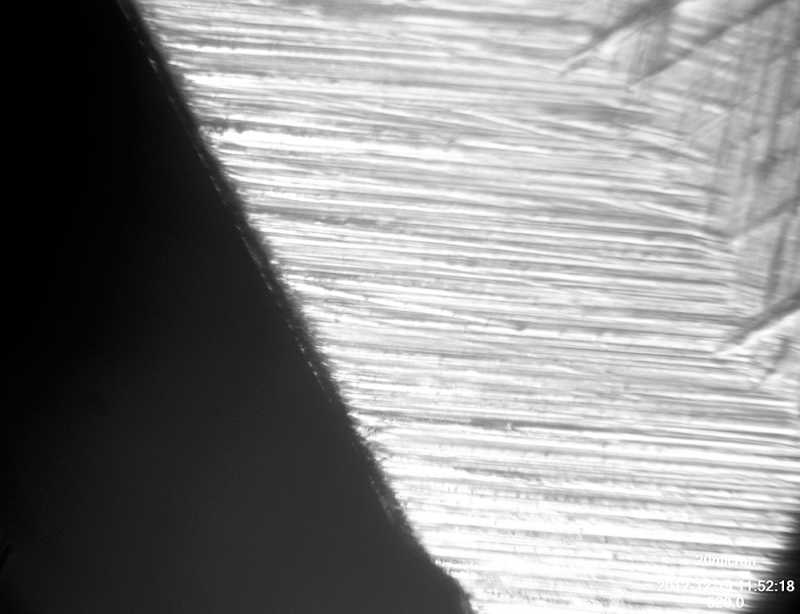
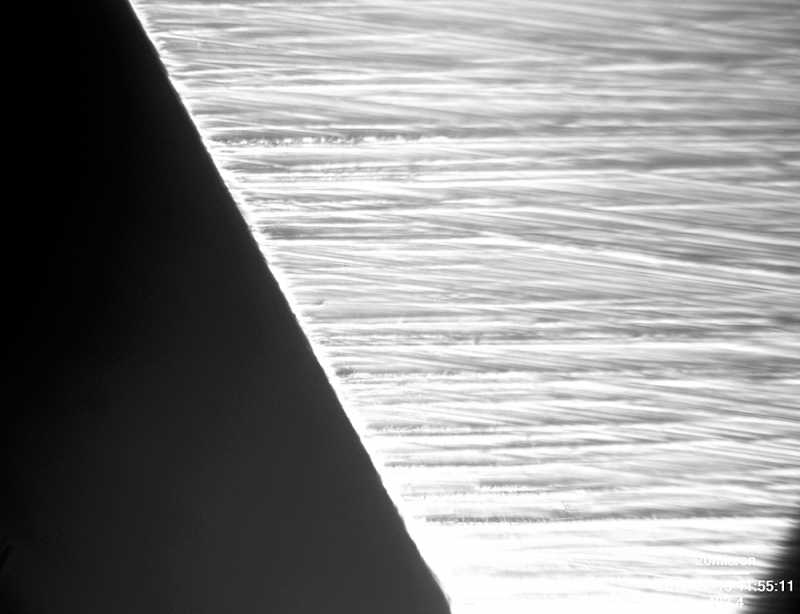
Here is a picture of the edge with edge-leading strokes:
and with edge-trailing strokes:
Both cut phone book paper cross grain fairly well though the cuts from the edge-trailing were noticeably smoother.
So far, I’ve tested the durability of the edge-leading blade by cutting strips of triple-walled cardboard, two layers thick. The edge-leading blade completed 45 24" cuts before failing to cut the phone book paper.
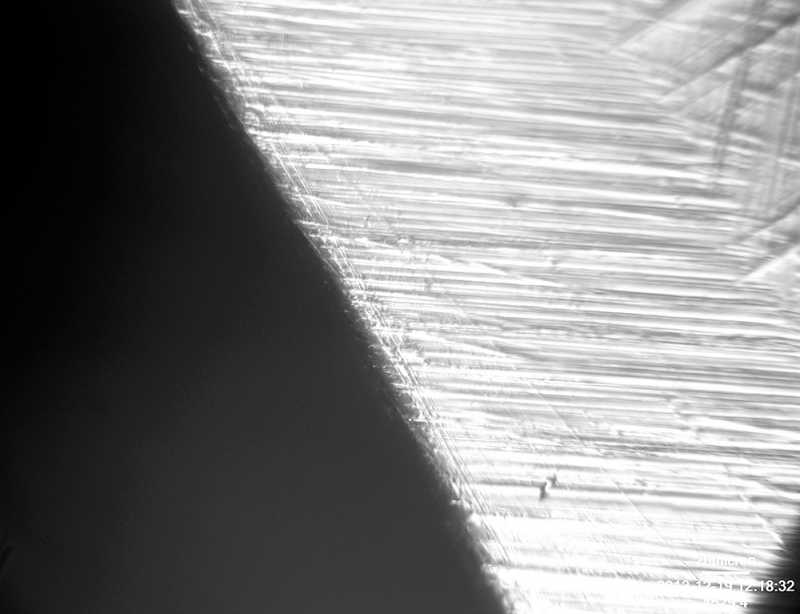
Here is the edge-leading blade after cutting the cardboard:
For both blades, I used very consistent, VERY light strokes once the bevels were set and I started working up the grits. I’ll complete the durability testing of the edge-trailing knife as soon as we get through the rest of the shipping frenzy.
I’m trying to understand it as well, but it looks like there is some folding or blunting of the edge with the edge-leading blade. I was careful to use very light pressure, so I don’t think it’s coming from heavy handedness. I’ll have to redo that blade and triple check my angles etc… to rule out any inconsistency of the sharpening angle. The edge does look fairly well obliterated after the cardboard, but I’ll want to repeat that process to verify.
Another factor you might consider is to have someone else do the sharpening… I’m thinking maybe someone who is familiar with the WE, but doesn’t have a lot of experience on it… might show a different perspective. The sharpener is a factor in the equation after all…
He or she also could not tell you which is which ahead of time… help eliminate a potential bias…