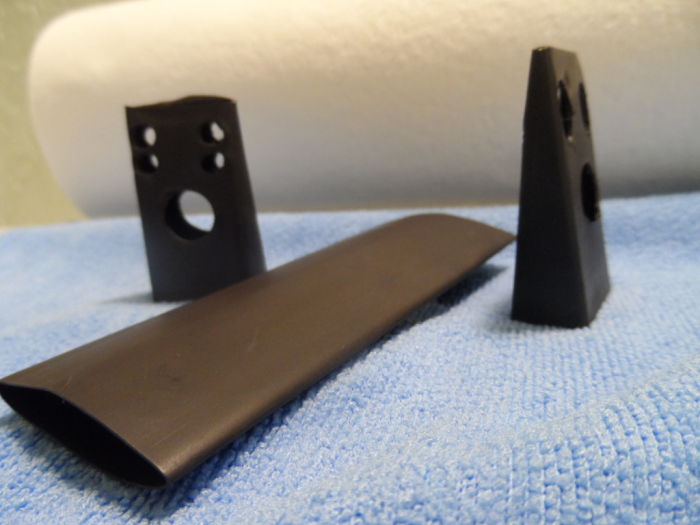
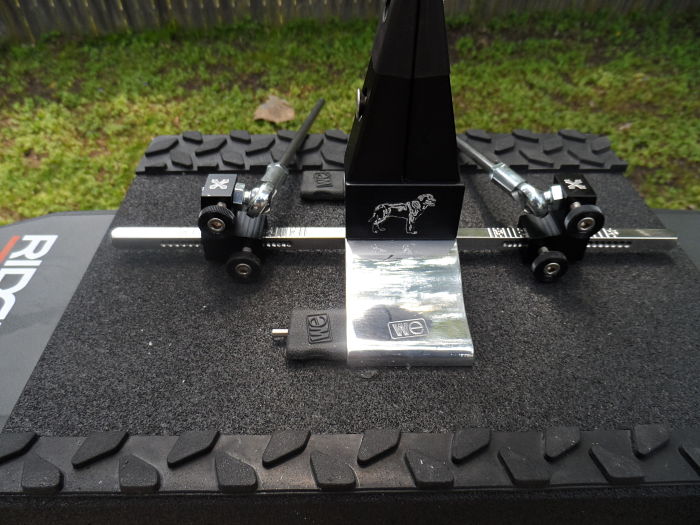
From videos I’ve seen of WEPS users in action, I think that many use the vise improperly, and it can lead to problems like a bent jaw, gouged pockets where the jack screw turns against the lower end of the movable jaw and damaged threads with the upper clamping screw.
When I was on the early slope of my learning curve (yes, I’m still climbing) I was amazed at the clamping power of the vise assembly, so I sat and cogitated on the cleverness of the design, and realized there were reasons for how it was designed. Kudos to the mechanical engineer who designed this doodad. It uses a lot of commonly known principles, but they are very well applied. Clay – was that you?
I soon began to notice that some users were over-tightening the screws unnecessarily. The upper screw thread needn’t (shouldn’t) be turned under a heavy load. It only needs to set the distance between the jaws at the bottom edge of the blade. The lower screw has a tremendous mechanical advantage in producing clamping force and usually needs to be turned only 1/4 to 1/2 turn past contact. If we completely disregard friction, a ten inch-pound twist on the screw would apply 1256 pounds of force to the movable jaw’s lower jack screw contact point. Then there’s the lever principle amplifying the force across the fulcrum of the upper screw to the clamp point above. Producing what? A hypothetical 4,000 lbs? Does somebody have a load cell to measure the actual force?
I lube my screws with a grease which has anti-seize properties. I also took my lower screw out and ground a smooth flat on the end so as to reduce scoring at the contact point. Ideally, you’d have a brass pocket thrust washer between the screw and the jaw face.
Certainly, longer knives need more clamping force than shorter knives, but if you need to apply a lot of force on your vise’s lower (or upper screw) screw to achieve the needed clamp force, ask yourself why. Is the blade very long and easily moved by applying force out at the ends? Is the cross-section of the blade such that the vise is only clamping a very small area? Is it mounted as low in the vise as possible? On another topic in this forum (http://wickededgeusa.com/index.php?option=com_kunena&view=topic&catid=2&id=12761&Itemid=271#15350), I recently demonstrated that you can use shim stock to securely lock a non-flat blade in place. In my test, adding small pieces of shim stock at the upper end of the jaws made a huge difference in how solidly the blade was held. My test case was intended to eliminate vertical rotation of the blade, but the blade was clearly more securely held. In another test I tried, I used a very small strip of 150-grit abrasive fabric from a drum sander to both hold a blade more securely, but also to shim the blade into a more upright position.
If the blade is wide enough, it would be better to lower the blade in the vise - lower than the lower position of the depth key. This would move the point of highest clamping force closer to the fulcrum and farther away from the tip of the jaw, which is the weakest section in terms of bending moment.
Certainly, changing the jaw material to tool-steel or titanium would reduce the chance of bending jaws. That said, the strength of the aluminum alloy jaws is incredible. Should there be an industrial model?
And this is for Clay (or his associates):
Is there a way to “unbend” the jaws? Would you have to over-bend the jaw to achieve full return to form? How about using a hydraulic press to force a bent jaw into a wedge-shaped pocket in a steel fixture? Can it be done without fatiguing the material? Or are the jaws inexpensive enough to make my writing just a bunch of annoying noise.