[quote quote=“mark76” post=2958]
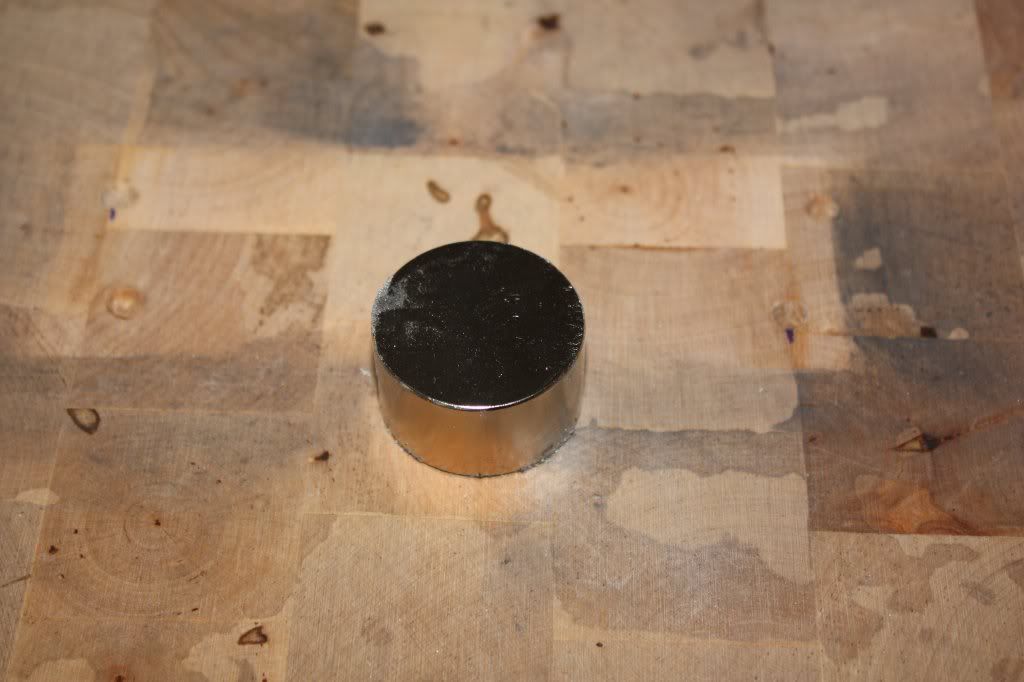
And I now have a new problem: how to remove the steel filings from the magnet? :mrgreen: I think this magnet will have to leave our house…[/quote]
I have three thoughts about this, but don’t know if any of them would work:
(1) Duct tape is the solution to everything?
Tape up your dirty magnet, and then peel it off… Hopefully the filings stick more to the adhesive in duct tape than they are attracted by the magnet. If it works great. But the worst case scenario is that things get worse when the duct tape leaves adhesive residue on the magnet… But presumably you can clean that off with Goo Gone or other solvent.
(2) Hot glue?
Same idea as (1). Put on hot glue, let it cool and solidify. Then hopefully it peels off with the metal shavings.
(3) In the future, maybe keep the magnet in a Zip-Lock bag, or wrapped in aluminum foil? Then to clean, just replace the bag and/or foil.
Oh, if that super-magnet needs to leave your house, maybe it can visit my house? 
Sincerely,
–Lagrangian
“What grit sharpens the mind?”
–Zen Sharpening Koan
P.S. This is both semi-theoretical and semi-practical: many situations involve competing effects of volume to surface area:
(1) The metal particles have an attraction to the magnet which is proportional to their volume.
(Basically true if the particles are close to the magnet, and much smaller than the magnet so that the volume of the particle covers a region of uniform magnetic field.)
(2) The metal particles have an adhesion to the duct-tape/hot-glue which is proportional to their surface area.
(Assuming that if the surface makes good and complete contact with the tape/hot-glue, and assuming that the surface physics of the particles does not change when they very (very, very) tiny, then this is true).)
So the smaller the metal particles, the easier they will be to clean off the magnet surface:
Total Force = c1V - c2A
where V is the volume of the particle, and A is the surface area of the particle. The c1 and c2 are constants involving how strong the magnet is, and how sticky the tape/glue is for the metal. I’m using the convention where a positive force sticks the particle to the magnet, and a negative force pulls the particle away from the magnet.
So if the particles are (more or less) spherical we get:
Total Force = k1*(r^3) - k2*(r^2)
where r is the diameter of the spherical particle. The k1 and k2 are constants, and I had them adsorb the constants c1 and c2, as well as constant factors for a sphere’s volume and area (ie: sphere volume = (4/3)pi(r^3), sphere area = 4pi(r^2)).
Finally we notice this: For a tiny number r, its cube (r^3) is smaller than its square (r^2). As r becomes smaller and smaller, the attractive force to the magnet gets small faster than the adhesion to tape/glue. So we reach our final conclusion (given the simplifying assumptions mentioned above):
For removing metal particles from a magnet by tape/glue:
it is easier to remove small particles than big ones.
In physics, chemistry, and engineering, we very often see effects like this. We call it,“Surface Area to Volume Ratio”, “Scaling Laws” (how do things grow/shrink when you change the size r?), and sometimes “Dimensional Analysis” (similar to unit analysis: area versus volume).
The canonical example of surface-area-to-volume ratio are dust explosions (such as in wheat grain silos): Materials burn on their surface. The more surface area a pound of material has, the faster it can burn. The energy released is proportional to the total amount of material (ie: total volume and/or total weight). Particles of powder have surface area proportional to r^2, and volume proportional to r^3. So if you work it out, the surface-area-to-volume ratio of a powder is insanely huge (surface area per pound of material). So if the powder is mixed in air, it can burn insanely quickly. And that means a low-level explosion (not technically a detonation, but a very fast conflagration). After many grain-silos blew up, they started monitoring silo temperature, humidity, and amount of grain-dust.
Surface-area-to-volume ratio also affects liquid abrasive sprays, such as those used on strops for knife sharpening. In these liquid sprays, you have tiny (sub-micron) particles of abrasive, such as mono-crystaline diamond, poly-crystaline diamond, boron carbide, cubic boron nitride, aluminum oxide, etc. These tiny particles sometimes like to stick together and/or settle out of solution. I won’t go into all the details because I’m not a chemist. But you can see how it could matter: particles stick together with their surfaces (surface area), and part of why they settle out of solution is their weight, which is proportional to their volume. If the particles stick together strongly enough, they can, in effect, form a larger grit particle. This is called “particle aggregation”. So people like Ken Schwartz optimize their abrasive sprays to minimize particle aggregation by changing particle size, as well as concentration of various additives that affect surface-attraction and viscosity. Many of these effects are not important for coarse grits, but as the grit gets finer and finer (sub-micron), they begin to matter more and more.
I don’t know (not a chemist), but believe this is not significant factor in wax-based stropping compounds (because there the particles probably like to stick to wax very much, possibly more than they like to stick to each other, and the particles cannot easily move around in the solid wax). But please don’t shoot me if you talk to a real chemist, and he shows me to be wrong.
The overall point isn’t whether the effects surface-area-to-volume ratio are absolutely correct in complete detail for all the situations described. The point is that surface-to-volume ratio is just another tool for how to understand things. Just like energy and force. Depending on the situation, one tool may be better than another.
I didn’t mean to give a mini-tutorial on surface-area-to-volume ratio; but since I did, I think I’ll just leave it be. I love being a physics major. 

