I think everyone agrees that leather polishes steel. It’s unmistakable. We’ve all experienced it sharpening.
The question is why. Is it because of smearing metal or micro fine abrasions.
I think everyone agrees that leather polishes steel. It’s unmistakable. We’ve all experienced it sharpening.
The question is why. Is it because of smearing metal or micro fine abrasions.
I would suggest that it’s a bit of both, as well as mechanically pushing down some of the weaker peaks.
I am still waiting for some SEM pics from Clay & Sandia to clear up this fuzzy topic. This topic lured me here in the first place - Thanks Anthony Yan 
Mean while, just to refresh where my head was… Took 2 box cutter blades. blade1 - stropped on a NEW bare horsebutt leather for 30 strokes at 10 lbs of pressure. Blade2 - stropped on a 7 months USED bare horsebutt leather for 30 @ 10 lbs. Snapped usb microscope 400x for each result. Doh, I didn’t capture a pic for control/untouched blade.
Oh, I remember now. New bare leather won’t do much because a bunch of tiny silicates too small to cause macro (micron level affect). Used leather where contaminated abrasives (dirty fingers :ohmy:)will abrade, while metal particle (from dirty fingers and came off the blade) will burnish. Other physical interactions are interesting but seem unlikely to have major affect in displacing steel matrix - especially high alloy where complex lattices & bonds will certain resist nano-level of molecular displacement/flow.

Just to be obvious - used bare horsebutt leather strop smoothened the bevel. I simple can’t tell how much it burnished but quite sure it did - probably small part by abrasive and major part by swarf.
We go back to definitions. If you take the specific definition of burnishing, I think it makes sense to say this is not happening with leather on steel. Blunt cut’s statement about the effects of the leather being due to silicates, means that what he saw was abrasive polishing, not burnishing.
We can polish in many ways. One of them is burnishing, then there are abrasive vapor polishing, chemical and electro-chemical polishing and a few others that I can’t think of right off. The idea that anything that ends up being polished gets that way via burnishing is just incorrect. In other words, just because something is polished does not mean it has been burnished.
I think that it is true that burnished is used as a description of many polished surfaces. While this is true, when using the term to describe a precision process such as sharpening, it should be used precisely!
My contention is simply that when we strop we are polishing by using abrasives. I have seen areas in Clays photos that show exceedingly small features that could be interpretted as being caused by burnishing. These are likely caused by dull or rounded abrasive that pushed the metal arounnd (yes this isburnishing). However the percent surface area in the photos that show this effect is well under (guestimating) 10%. This leads me to believe that the vast majority of the results that we get from stropping is due to abrasion and not burnishing. This follows not only from analysis of the 2000X photos, but from what knowledge I have of physical material properties.
There is one thing that Blunt Cut mentions that does need to be addressed, that is contamination. Given enough metal mixed in your abrasive on a strop, there is more chance to seem some burnishing. In general, I believe that, if your strops are kept reasonably claen and charged with sufficient abrasive, this effect will still be small in comparison to the amount of polishing directly by the abrasive. The other thing that we see quite often is that contamination of the strops leads to large visible scratches, not further polishing. Beyond that, I would think that we agree that strops that are loaded with metal particles (Bunt Cut calls it swarf) become less effective rather than more effective. If we accept that contamination by mtal particles causes some burnishing, the fact that we clean and recharge our strops, and they work better, is pretty good evidence that this is not a positve effect.
[quote quote=“JacobWilson” post=10424]I think everyone agrees that leather polishes steel. It’s unmistakable. We’ve all experienced it sharpening.
The question is why. Is it because of smearing metal or micro fine abrasions.[/quote]
Obviously my vote is for microfine abrasion. :ohmy: :woohoo: :evil:
This is supported by the vast majority of the photmicrographs that are available. Down to the point that features are below the resolution threshold of the instrument, all we see are scratches. Abrasive polishing sweet and simple! Even at the highst optical magnification possible, the large preponderance of what we see is scratches!
Here is something to consider. When we use a smooth steel on a blade there is not much if any abrasive involved. The process in theory, straightens the edge by bending week sections. I think that it is possible that there is some burnishing going on here as well. Good steels are fairly hard (Rc 63+), the contact area is small, local pressure per area is high.
When we look at micrographs of a steeled edge, it looks nothing at all like a stropped edge. Wouldn’t we see more similarities if the mechanism of the effect was close?
Anyway,
You folks all have a great day!
Phil
The nanocloth has no silicates like the leather or even paper contains. These silicates are harder than steel on the Mohs hardness scale, hence they are capable of abrasion.
If you strop on nanocloth with no compound, you get no metal swarf unlike leather - even 'roo. Even with a light spray of 0.025 poly applied to nanocloth, you will see metal swarf. On leather you see some metal swarf residue, less so on 'roo but some without the application of any compound. So there is clearly some abrasive component to leather itself. Even fine paper has some level of abrasive, presumably from the wood pulp itself as well as the water particulates involved in paper production. Clairfontaine, a paper mill, owns their own stream and has finer control than most of the abrasive content of their writing paper. Similarly sugar cane based papers seem to have particularly (sorry for the pun) fine surface properties.
At a micro or even nano level, perhaps our definitions fail us and it is best to simply strive to characterize the observations rather than to fit it into preconceived ideas of burnishing or abrasion but rather some hybrid of the two. Clearly the particles are capable of scratching the metal and in so doing both move and push the metal around to some degree. The grooves from the hard particle creating a scratch both remove some metal and push the metal out of the way of the path of the particle. Given the non-spherical shape of silicates - more sheet like, for a given particle size you would expect less depth of cut from a corn flake shape than a bowling ball (sphere) shape. You see this with natural stones too.
So at the lower particle sizes, I think nanocloth ‘rules’ in that it holds more particles more easily and is a bit cheaper than 'roo but far more consistent than bovine or horse. It’s matrix allows for particles to become entangled more easily and hold their position which would favor abrasion. If the particles roll around, this favors (IMO) burnishing a bit more. At the high end, this becomes interesting in that nanocloth is more of a ‘pure’ play, but 'roo brings a draw characteristic to the table. Perhaps this draw causes a smearing effect that the nanocloth doesn’t which MAY be advantageous, combining fine abrasion with dragging the surface around a bit too, which may be counterbalanced by the combined abrasion of the fine CBN / Poly particles against the somewhat coarser silicates. Just some theories on how I see it, but what is actually happening would best support or refute my thoughts with some carefully controlled experiments and detailed inspection under an SEM.
FWIW, you can see this rolling around phenomena more readily if you put some 80 micron CBN on Balsa. Some particles roll around pretty freely, some stick out half way in the balsa and stay in place and some get buried in the balsa producing little effect. Think about this next time you are eating a poppy seed bagel as they are of a similar size  Just don’t get too carried away in a restaurant playing with your bagels
At these really fine grits, the desired result may not be the same for all. For straight razor users, comfort rules even over sharpness and 'roo vs nano might go one way and for knife users, perhaps the other way. Time will tell.
Pardon the rambling post, but perhaps it might provide some fodder for discussion.
Ken
Actually a great post Ken!. Thanks for taking the time to write it!
As I have mentioned many times this will take some objective (SEM) evidence to settle the questions regarding whether what we observe during stropping. Is it abrasion only? Is it actually abrasion and burnishing? What percentage of each type of polishing is in play.
BTW, glad to see you back here.
[quote quote=“PhilipPasteur” post=11338]Actually a great post Ken!. Thanks for taking the time to write it!
As I have mentioned many times this will take some objective (SEM) evidence to settle the questions regarding whether what we observe during stropping. Is it abrasion only? Is it actually abrasion and burnishing? What percentage of each type of polishing is in play.
BTW, glad to see you back here.[/quote]
When I first looked at Clay’s images of scratches, I saw a mention of contacting Sandia Labs. I believe the post was dated about two years ago. Long enough to make me wonder “so what happened at Sandia?” Since all this talk about the SEM remains in future tense, probably a better question is “so what happened with Sandia?”
If there is anyone in this world that comes across as calm, levelheaded and reasonable, it’s Clay. So while I can envision a “get outta here you kook!” if, say I approached them, I just can’t imagine a scenario like that involving Clay. OTOH maybe they didn’t think this was worth giving up precious time on their SEM, or they wanted some math to back it up ahead of time. ??
I’m only asking because there’s always references to a Scanning Electron Microscope in these discussions, but no mention of that actually happening any more.
And now, time for a bagel! B)
-Pie
Why not PIE
:evil:
The folks at Sandia and I keep trying to connect for our project and the slow down has been on my end. They have a very specific, limited window in which they help companies like mine and it has always come a super busy time for me. I’ll have to wait till the next go round in January to try again. In the meantime, I’ll be preparing my samples so they can do their work.
[quote quote=“PhilipPasteur” post=11342]Why not PIE
:evil:[/quote]
The pie I saved for tonight.
Yum!
-Pie
[quote quote=“PhilipPasteur” post=10391]Hello Jacob and Samuel,
I just wanted to point something out. Burnishing is using a tool of a harder material to smooth the surface of a softer material. It is really caused whe the harder material applies enough force to overcome the yeild strenght of the softer material thus enabling a plastic flow of the softer material. This cannot really happen when rubbing hardened steel with leather. Leather would certainly not smear molecules of steel.
Leahther has abrasives in it that do affect steel, but you are abrading at a fine level and polishing…because of those abrasives. You are definitely refining the edge, but certainly not by burnishing.
[/quote]
Straight razor edge, as honed.

after 100 laps of stropping:

after another 100 laps of stropping:

Is this burnishing?
Nice pics! There have been heated discussions here about whether burnishing may occur during stropping or not. I can’t find them right now, but you could try to find them yourself using the search function (on the tab “Search”, not the search box).
I also wrote about this topic on my blog. See for example here and here.
Success! And interested in your further findings!
Nice pics! Where did you get them?
Here is a stropping progression (on clean leather) in side view:


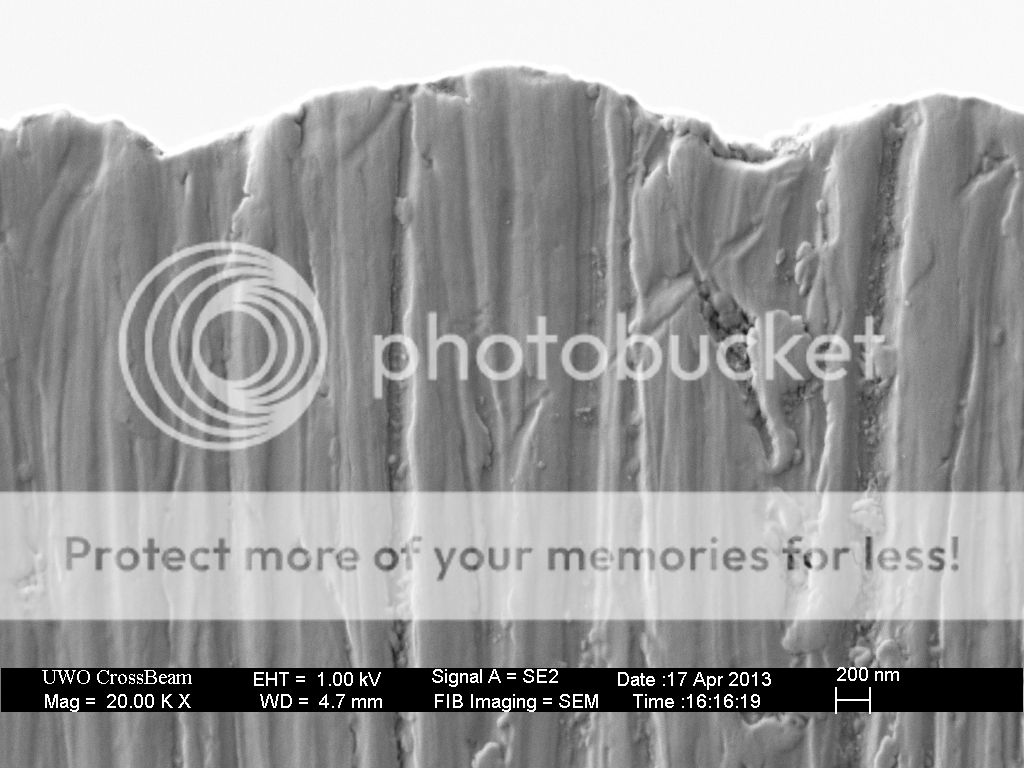

I have imaged the same location at each step.
Great pics! What microscope do you use?
Zeiss SEM
I take it the Zeiss is for your profession it seems that although fantastic for blade edges that level of both magnification & sharpness must be for some shall we say perhaps more serious use.
Zeiss SEM[/quote]
Man… Those are some fantastic pics on the first ones, do you lower the stropping angle a couple of dps? I am curious as clay has shown and had success in showing that lowering the stropping angle increases the refinement of the edge vs keeping it at the same angle (which will round the very edge).
So are you up for some experimentation?
I was part of most of the discussions. I don’t recall any HEAT at all. Maybe it is a matter of perception. I thought is was an academic exchange of thoughts..
[quote quote=“mark76”]I also wrote about this topic on my blog. [/quote]
Not logic, or evidence that was accepted by all was presented there! Simply conjecture based on limited magnification photos showing you something that you had already decided was happening without sufficient data at hand
I too would be interested in controlled research with documentation via the SEM so that we might make some objective conclusions about what is happening to the steel.
Not sure what success in this context means. In looking at the…MOST excellent micrographs, I guess my interpretation differs a bit. At this small a scale, it looks like to me that the results could easily have been caused by polishing by abrasion. I can take sand paper on steel… 1000 grit FEPA.. on a macro level and see features that appear very close to what I am seeing in these SEM captures. Leather, plain leather having very small and very sparse abrasives… generally silicates, the plain leather strop could easily cause the type of wear patterns illustrated into the related micrographs, by polishing the material. This would hardly equate to causing plastic flow of the steel through rubbing it with with enough force as so as to cause plastic deformation of the steel.
Not sure, again, what success in this context means… If the steel is sharper, that is what I would call success. What “I” don’t’ see is evidence of burnishing, in the classical definition of that term!
“Burnishing is the plastic deformation of a surface due to sliding contact with another object. Visually, burnishing smears the texture of a rough surface and makes it shinier. Burnishing may occur on any sliding surface if the contact stress locally exceeds the yield strength of the material.”
Now, maybe someone can point out specifics in the photos that indicate that “plastic deformation” has occurred rather then (sub) microscopic wear patterns (abrasion). Perhaps it is there, but not needing to prove a point to myself that it IS… I just don’t see it. I have looked closely. I worked in a CAL/FAILURE lab for what was Martin Marietta Denver Aerospace, for 5 years, they, taught me to analyze wear patterns and identify the mechanism of wear that was causing different types of patterns in steel. I would have failed my certification class If I told them galling or burnishing was happening to metal as illustrated in the SEM captures . Being able to do this is was critical when performing failure analysis on parts and systems that are MAN rated. If I had deduced That wear was,caused by fine abrasion! That would have passed me… What we had to figure out was the amount and type of wear that occurred in metal parts that rub against east other, and as completely understand the mechanism of the wear, and precisely predict wear over time. There could be no errors or personal bias involved. It was the potential for losing men’s lives in flight that forced us to do it correctly.
Again, I really have no clue what why mark wrote “success” when he did that.
Interesting… after all of these months… and lots more questions than real answers.
We proclaimed success Still unclear about what succeeded and what is the proof of that.
Maybe one day we can discuss biases in observing… it is part of the human psyche. We mostly see what our brains tell us we want to see.. it is inescapable! :evil: 
Merry Christmas ALL and the best of New Years as well!!
Glad to be back for awhile!
Though I am feeling no heat whatsoever…!! Hopefully I am not emitting any either :lol:
If what seems to be called heated here is related or correlated to global warming… the glaciers will be in fine shape for many thousands of years!! :cheer:
But glad to be able to exchange ideas with you folks in any case, at least for the moment!!!
Phil