Just a couple of questions:
(1) Are these images from your new metallographic microscope?
These are from the new scope. The 100x objective still isn’t working, so I’m limited to 800x.
(2) What is the scale of the images (if you know)?
What do you mean by scale? Are you talking about microns/pixel or something else? The camera is 10 MP.
(3) Are these photos taken as black-and-white?
These are taken in color.
So far, it’s a really fun study to do. I’m working on a developing a little jig that will allow me to hold the blade in exactly the same place on the stage so I don’t have to do so much fiddling for every picture.
By “scale” I just mean a length-scale. For example, what is the length across the width of the image? Or something like a little line in the image with a measure of how long it is (something like 0.01mm, or 10 microns, etc.). Maybe you could take an image of your linear stage micrometer at the same magnification?
I’m kind of curious how big the scratches are.
Sincerely,
–Lagrangian
By “scale” I just mean a length-scale. For example, what is the length across the width of the image? Or something like a little line in the image with a measure of how long it is (something like 0.01mm, or 10 microns, etc.). Maybe you could take an image of your linear stage micrometer at the same magnification?
I’m kind of curious how big the scratches are.
Sincerely,
–Lagrangian[/quote]
Clay,
Just curious, what is the problem with the 100X objective? I have no experience with the kind of microscope that you have, but have spent lots of time with various lab microscopes. Usually changing an objective is relatively easy…
I can’t tell what’s wrong with it except that I can’t get it to focus. I’ve sent it back once and the new or repaired one they sent back is the same. Their tech is looking into it now. Hopefully I’ll have an answer today.
[quote quote=“PhilipPasteur” post=4641]Clay,
Just curious, what is the problem with the 100X objective? I have no experience with the kind of microscope that you have, but have spent lots of time with various lab microscopes. Usually changing an objective is relatively easy…
I hope you do get a GOOD answer. It would drive me slightly nuts to have something like that microscope and not be able to use it to the max extent of its capabilities (especially considering the price!!!).
Heck, I am impatient to see what it does… and I didn’t even pay for it
Clay, I hope you can find an ideal number of degrees to back off when moving to stropping with split bovine. I love how fast chromium oxide on split bovine can polish out all scratch marks, but it is so easy to round the edge. Once you work the paste or spray into the split bovine, those little fingers just polish away.
Hi,
What kind of chromium oxide are you using?
I have a bunch of it and they all seem to have considerably different actual grit levels. It seems that some, as in from HA is rated at 0.5 microns nominal. I have some that is no name stuff that I have read is closer to 6 microns and contains more aluminum oxide than CrO… Typically the 0.5 micron CrO wouldn’t be a great scratch remover. Just wondering what you are using that does such a great job for you.
I know that you addressed Clay directly, but let me take a swing at this.
Most people say that 1 to 2 degrees more acute (lower) is a good place to start trying for stropping. I tend to use about a degree less for horse leather…and whisper light strokes. BTW, this is in general, I have never used CrO on WEPS paddles.
If you use more pressure, maybe try 1.5 or 2 degrees lower. I think there is no “ideal”… “it depends” (there is that equivocation again ) on the materials that you use and your technique. Do some experimenting and see what works for you. I don’t think that Clay nor anyone else can determine that for you. The best you will get is some suggestions on where to start trying things.
If you’re talking about losing the “bite” of an edge, one thing you can try, is to add it back in. Clay has posted this somewhere (that I can’t find right now), but basically, after stropping, raise the angle a couple of degrees, and with your finest stone or ceramic, make a couple of passes. This will leave your polished edge, but return the bite.
Thought I’d add this to this thread, since I pulled some pictures from it.
On edges I finish with a leather strop, I’ve been finishing them by stropping 1 deg. higher. For reasons that seem to defy what “should” happen, this leaves me with an edge much sharper, yet without the loss of “bite” that many try to avoid when using leather.
On my last visit to WE, I took a blade that I had stropped after the 1K diamond stone, for Clay to put under the 'scope.. I compared it to a couple of photos in this thread…
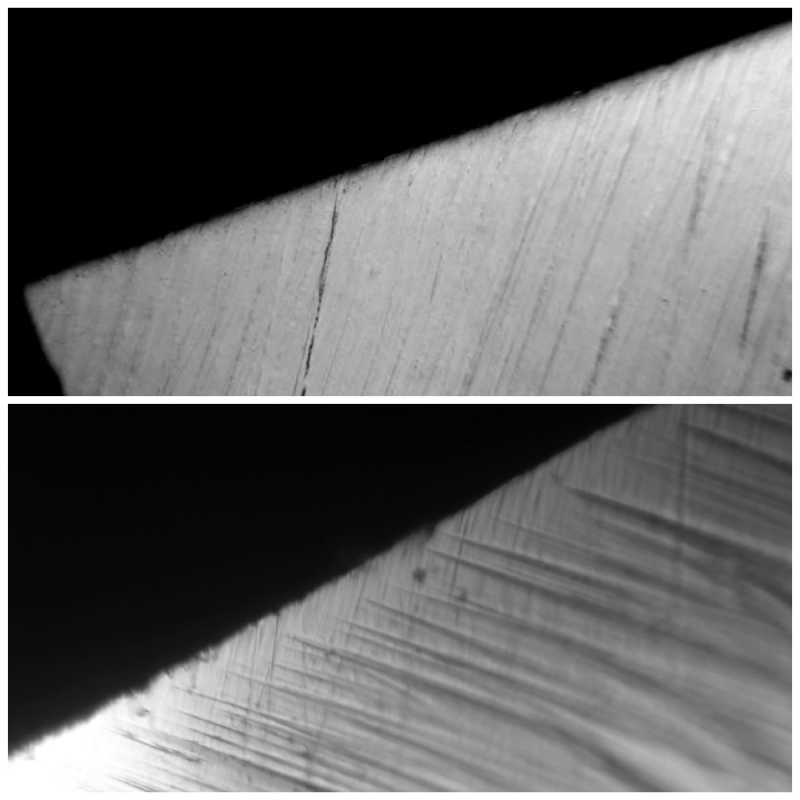
Here 1 deg. higher (bottom) compared to an edge stropped 4 deg. higher (top)
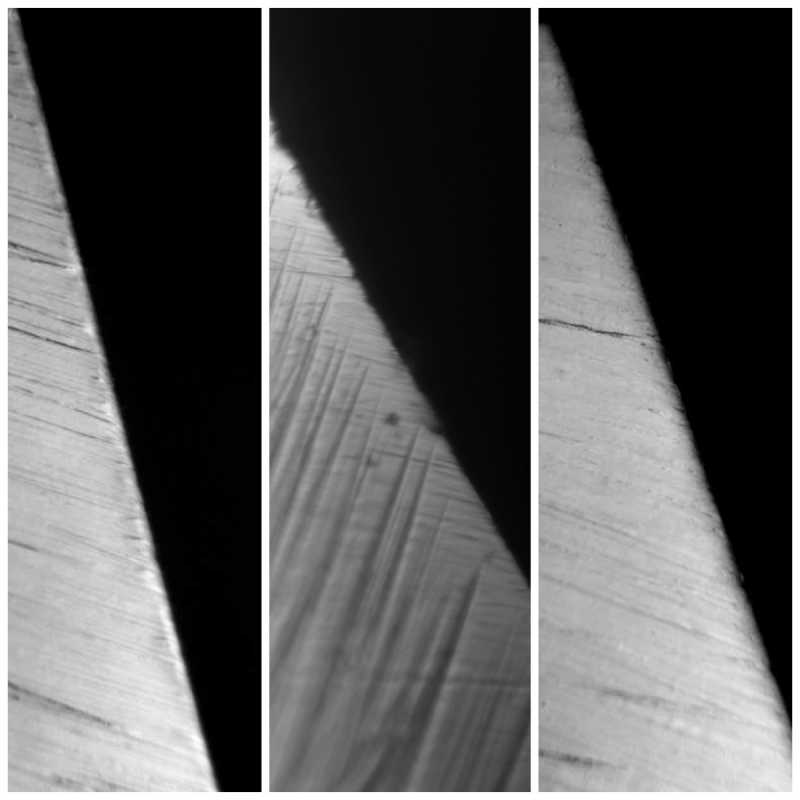
Here 1 deg. higher (middle) between an edge stropped 2 deg. lower (left), and the 4 deg. higher again (right)
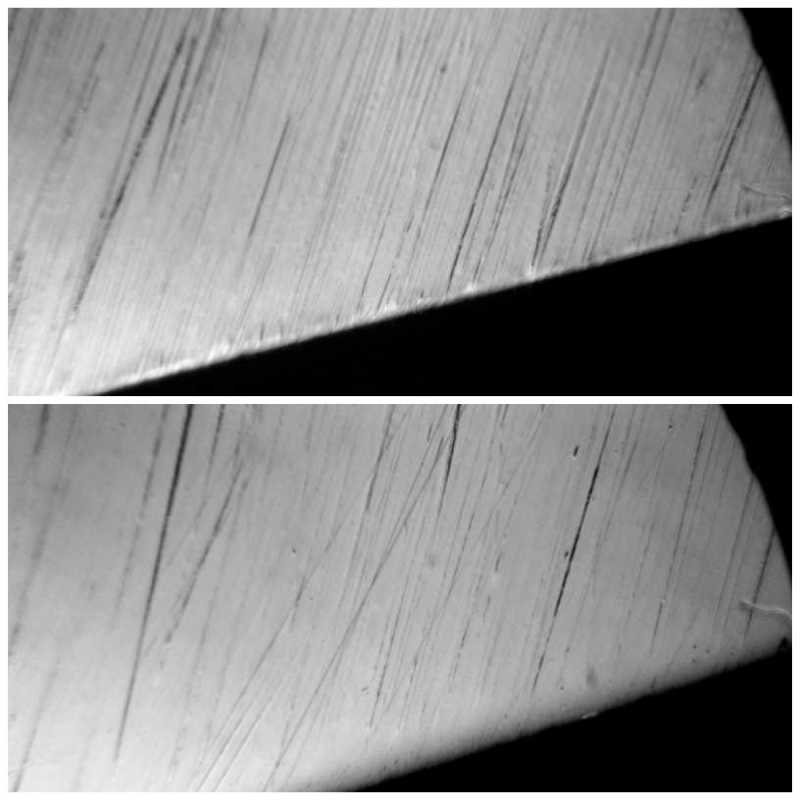
While just one blade, It does seem to show that the edge gets cleaned up without significant rounding. I’m using very light pressure, and the increased angle seems to facilitate this. Pressure probably plays a role, as indicated where Clay was able to take the 2 deg. lower edge (top) and round it by increasing the pressure (bottom) (shown earlier in this thread) …
So, just thought I’d share, since it’s working well for me, this might give at least one clue why, and see if others want to try it and post their results.