Your recap is a bit confusing can you post a picture of the knife
Readheads, if I interpret you correctly, your forumula describe the edge profile of a particular type of knife. That’s fine, but be aware that many knives have quite diferent edge profiles. For example, many of my kitchen gyuoto’s (which I’d regard as pretty standard) first have a long flat spot (and with flat I mean a straight flat spot), followed by some sort of curve. And the curve also differs per knife.
[quote quote=31107]
The main reason I run a double riser block in my setup is to allow for a larger radius and allow it to hit closer to the “primary” circle arc of any given larger knife. If its a small knife I can remove the riser blocks to reduce the radius from ball joint to knife apex to allow for a tighter sweep(narrower cone?).Never really thought about this, but makes sense (which makes my head hurt). :/ Does add another factor to the equation…[/quote]
I think Cliff is right. The picture above by Redheads clearly shows it.
As I noted before, I think this is a very good idea. But there are some major challenges. First of all you need an algorithm that is able to translate a knife profile line drawing into a data structure that is easy to manipulate and that can be used for calculations.
But the main question is what you want to minimize. (1) Do you want the sharpening angle at the tip to be exactly the same as on the flat spot? That would mean there would be angle deviations along the curve at the end of the blade.
Or (2) do you want to minimize the angle change over the curve at the end of the blade? That would usually mean the angle at the tip is not the same as on the flat spot.
In other words: you have to determine what you want. There simply exists no optimal setup that satisfies all constraints (with the exception of a couple of knives with specific profiles).
I think this is a very good idea, ET. Basically it means you have a very easy way to realize option 1.
[quote quote=31107] Curry Custom Cutlery wrote:
The main reason I run a double riser block in my setup is to allow for a larger radius and allow it to hit closer to the “primary” circle arc of any given larger knife. If its a small knife I can remove the riser blocks to reduce the radius from ball joint to knife apex to allow for a tighter sweep(narrower cone?).
Never really thought about this, but makes sense (which makes my head hurt).  Does add another factor to the equation…
[/quote]
A very good idea again! Redheads pictures above show it.
But please keep in mind, again, that the optimal setup does not exist. It’s always a trade-off between angle changes over the curve and the maximum angle at some spot (usually the tip).
Congratz Bill on finding a method that works to your level of satisfaction…the Josh Sweep(can I call it that?) is a great way to visually see where the angle is at on the blade.
I used to put the tape on a paddle with a horizontal line across to observe the sweep but these days I just pinch the rod with my fingers and live dangerous! 
Thanks to Readheads for sharing the clear picture showing what a change in the radius arm length will do for adjusting the sweep to match a given blade size/shape. Well done!
Also greatly appreciate the work of Tom in checking angle variance. Less then half a degree should mean that under average conditions a detectable difference in the bevel width would be hard to notice?
Im still firmly in the camp for the usefulness of the adapter. In the world of a precision system where tolerances are being reduced to thousandths of an inch with custom bearings and rods, precision angle measuring devices and all slop and play is minimized in an attempt to gain micro-repeatability, where we are all on the edge of our seat for the latest SEM images(hint hint) studying the microconvexity of materials and how it effects and edge at sub micron levels it just seems natural to have a tool that could potentially allow us to remount in a repeatable manner beyond the +/- 2mm range.
Aloha, Cliff
So true ET on Homo Erectus, however, they didn’t shave much. It’s more about the quest for excellence. I have more fun on my journeys than when I actually get there (unless that’s another journey too). Electronics is what enables the the Vett to handle optimally. Computer modeling enabled the F117 and B2. Continuous improvement drove changes to the V2 gyros to get the the moon, Hubble, Keystone and the like. I am an ME also, worked at the old Bendix plant in NJ developing gyros. Fascinated by material science but I got too many kids - LOL. My mentors worked with von Braun in their early days. I’d like to see mems accels in the rods then we can think about complex edges and shapes. Great discussions. G’nite from jersey.
Hahah, ET, you’re right. The problem with the WEPS is that it allows you to become so precise that you (well, at least me) also want to be precise. They have a name for this disease… OCD :).
It’s indeed my experience, Cliff, that you won’t notice in practice less than half a degree of variation. That’s also the limit I adhere to when switching whetstones (which have varying thicknesses).
So, if I read your post right, you set the knife at an angle, measured a difference in angle between the heel and a point over the clamp, then returned the knife to horizontal, measured the difference again, and got basically the same result? If so, I’d have to question your test. Back when I basically didn’t believe the angle didn’t change as you moved away from the clamp, I clamped a bar over 2 ½ ft. long, and found to my surprise the angle didn’t change…
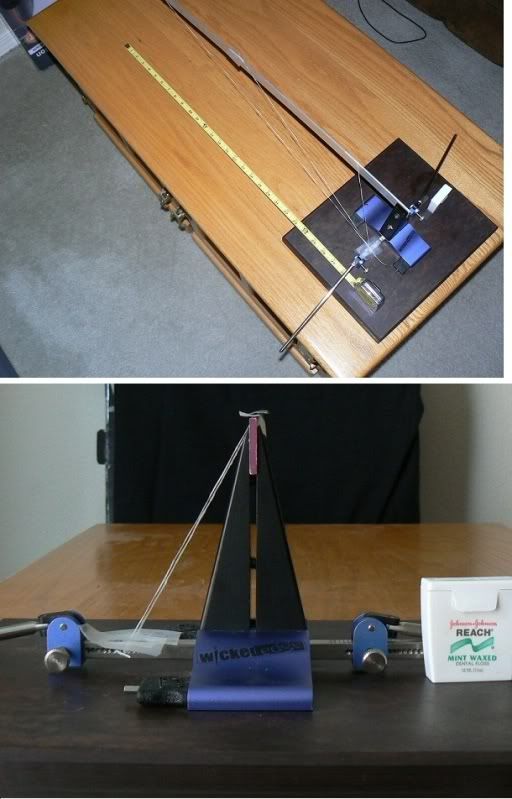
… so if you’re getting a change even with the blade horizontal, I’m not sure why. If I’m misinterpreting. let me know.
Yes, you are misinterpreting my description. I’ll break it down to three simple points:
A. I sharpened the knife while it was clamped at a 20 degree angle.
B: I rotated the knife to a horizontal position, then measured the bevel at that point which had been directly over the vise.
C. I then moved the knife horizontally to place the heel directly over the vise and measured again.
This showed a difference in bevel angle at the heel versus the bevel at a point which had been directly over the clamp.
BTW, I have been trying to explain to others here that the angle doesn’t change along any horizontal line, no matter how far it is away from the clamp. My view of this was that if you consider the WEPS as it would be shown in a side view of an isometric drawing, you would see that the angle is constant, regardless of the rod position. Your bottom photo illustrates this view very well. Thank you for demonstrating this for me.
All are absolutely correct in stating that less than a half-degree of variability is nothing to be concerned about. But this whole discussion is about our basic understanding of the geometry of the WEPS. Clay says his setup resulted in zero difference and we ask why. My test showed 0.4 degrees variation over a span of only 61mm. From Clay’s photo, I’d estimate that his chef’s knife spanned three times as far, both horizontally and vertically. To not show a substantial variation is still a puzzlement.
Ah, that makes more sense. To be honest though, there’s a lot of variables there… I’m not sure you could conclude that there was a .4 deg. variation. Multiple tests would have to be done… and my guess is, it would average out.
Did my earlier posts not help? My view is that the pivot doesn’t “see parallel”… it just sees an angle and sharpens at that angle. To be clear, there may be an angle difference between the two setups… for example if I had a blade horizontal and sharpened at 20 deg. and then pivoted the knife, I might now be sharpening at 18 deg. But, the angle along the blade won’t change… there’s really no height change in relation to the pivot. I think it’s confusing because viewing the knife… it looks like there is a height change in that the heel is higher than the part above the clamp. But tip the whole WE, and it will look just like the blade is “horizontal” again. I don’t think the pivot sees it any different… whether the blade is tipped or not… other than the initial angle. (Again, talking the straight portion here). That’s my theory anyway… if I missing something, let me know.
Redheads,
Are you accounting for the rotation of the stone around the guide rod as the blade curves? People generally describe the motion of the guide rod as conical, which I think is correct, but within the path of the of the rod, the stone also rotates, changing the plane of contact with the blade. I notice this out toward the tip. If we were using square rods with square holes in the stone blocks, there wouldn’t be any rotation and the conical model would work.
Hmm, good point. When the stone traverses a curve, I think only a certain “part” of the stone width would be touching the knife curve. On convex curves (typical on chefs knives) the amount of stone touch would depend on the shape of the arc (or you could use one of the edges). The flatter curves (ie. straighter) would get maximum stone contact. On concave curves (weird knives) you could only touch the curve with the leading, trailing or both stone edges. I think this introduces another dimension which is pretty difficult to control and will introduce a variation in the sharpening angle. This could very well be an error source which overrides everything we are talking about here. Did you ever consider spinning cylindrical stones (LOL) ? It reminds me of Yan’s comments on the Gen 1 with 2 pivots slightly apart. I assume a complete analytical engineering error budget analysis was never done. I am an ME working for the DOD just as a reference.
BTW, in your experience what is your simplest/best test for sharpness (besides arm hair shaving). I use a fast chop into a bent piece of newspaper.
Your design is novel and remarkable. I can feel and hear the knife getting sharper.
ET and all, please chime in.
In studying the stone as it rotates at the tip, I’ve made a couple observations - it’s difficult to get a reading from the cube because, as you say, only part of the stone is touching the blade so it wants to rock. If you push with your thumb so that the trailing edge of the stone is contacting the blade, the cube reads a higher angle and if you press the leading edge of the stone into the blade, the cube reads a lower angle. What you say with concave curves is also true, only the sides of the stone contact the blade.
We do have some curved stones. I’ll play around with measuring the angles using those.
For testing sharpness, I usually start on my thumbnail to ensure the entire edge bites easily at a low angle. From there, I do a three finger test where I hold the knife in my dominant hand and then place the thumb of my non-dominant hand on the spine of the knife and the pads of three fingers lightly on the edge. I then slide them ever so slightly to feel the bite. Your brain will easily prevent you from cutting yourself if it detects the edge biting in.
I’ve spent the morning studying the angle change along the length of the blade. I clearly have a lot more investigation to do… One thing that seems to have made our inquiry more complicated is that variances in user technique could render different results for the same knife setup. As an example, imagine two users taking turns sharpening the same knife, never removing the knife from the clamp or adjusting the angles. User A applies pressure to the stones with their thumbs so that the trailing edge of the stone is in contact with the blade and user B applies pressure with their finger tips so that the leading edge of the stone is in contact with the blade. User A should have more obtuse angles at the tip than use B. You can test this by coloring in the bevel with a marker and then applying pressure in different places while observing how the marker is removed. You can also do it with an angle cube. Getting the cube plumb is tricky, but you can use a square or you can put some strings with weights on your cube:

I’ve got a new loupe that I really like because it has a big objective lens and a very nice graticule. After fiddling a lot with the best positioning of the knife, I did some sharpening to establish a bevel and then took pics of the bevel width through the loupe:


You can see that the bevel width is about .7 mm along the straight section and just about .8 mm at the tip, so just slightly wider. There is marker still covering the earlier, wider bevel at the tip visible in the picture.
Here is the angle measured in three positions on the knife:


You can see that the angle at the tip and heel are very similar and there is an increase of angle in the middle position of the blade. Getting the tip measurement is really tricky because of the way the stone wants to rock on the bevel.
Do you mean 7mm and 8mm ? The 8mm almost looks like 8.5mm
Can you use a caliper to measure the thickness of the blade just above the top of the bevel at each point ?
Here is the positioning I found to be most optimized (for the short amount of time I was tinkering with it):


Using the binder clip in place of an o-ring, I checked to see if it would line up in each position. Unfortunately, it did not. It turns out that the tip of the knife would need to be much further forward for the binder clip to hit the edge in the middle and at the tip. I also found, like Curtis, that the clip could hit the edge at different points of the blade in a variety of knife positions. In each case though, there was a big range in measured angles. I’m not suggesting that my results are definitive, anything but, especially now that I’ve seen just how much the measurement can vary at the tip as different parts of the stone contact the blade. Next up I’ll repeat some of the tests while trying to control for stone rotation…
Here’s another position that seems to also work:


The stones removes the marker appropriately and the cube also shows similar angles to the previous positioning.
As we know, the o-ring (clip) will only will only be perfect along the whole knife if the knife edge is completely part of a circle (this is never the case).
I would tilt the knife until the o-ring (clip) passes as close as possible for as much length as possible. The rest of the knife will vary more (unless the rest of the knife is close to being a tangent from the arc.